Four African Penguins Waddle Into Mobile’s Exploreum for Winter Stay
Four African penguins from a Florida aquarium moved into downtown Mobile's Exploreum this week for a stay through January.
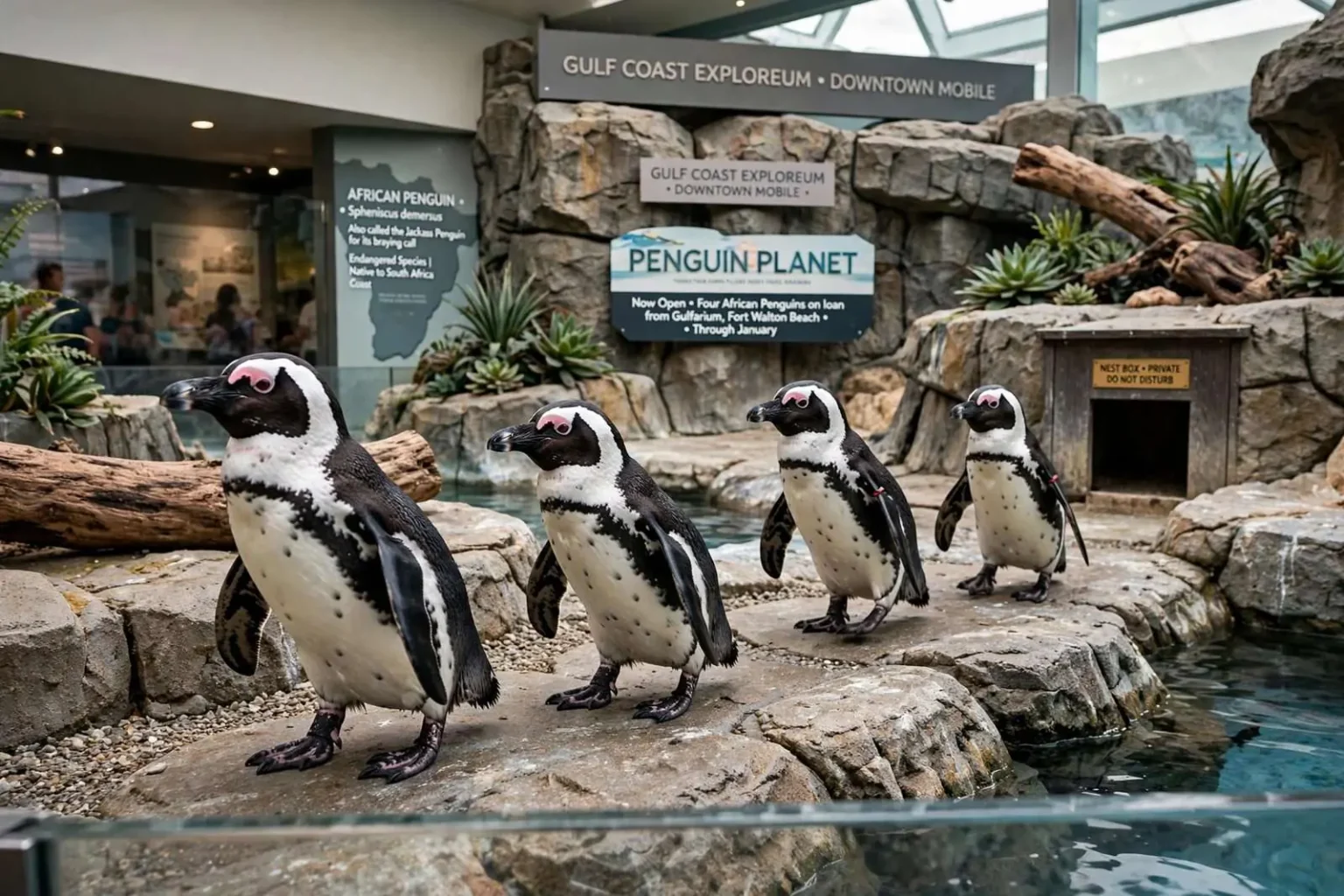
Downtown Mobile’s Gulf Coast Exploreum has four new residents this week, and they are not shy about making an entrance. Mooshu, Cranberry, Ninja and Jelly, a quartet of African penguins on loan from the Gulfarium in Fort Walton Beach, Florida, arrived at the science museum and will call it home through January as part of a new exhibit called Penguin Planet. For a science center better known for its hands-on physics displays and traveling blockbusters, the arrival of four live seabirds marks one of its most ambitious animal exhibits—and its noisiest.
Warm-weather birds with a cool trick
Visitors might assume penguins need icy conditions, but these particular birds are native to the coast of South Africa, one of roughly 17 penguin species worldwide, about half of which live in temperate or even hot climates. The image of penguins on Antarctic ice comes from a handful of cold-adapted species; the rest, like the African penguin—sometimes called the jackass penguin for its braying call—spend their lives on warm beaches and rocky islands where the water off the coast is cooled by currents, not the air by frost.
Rather than relying on cold air, African penguins regulate their body temperature through the bare pink patches of skin around their eyes, which help them shed excess heat. Those patches, along with the birds’ habit of seeking shade and surf during the hottest hours, make the species surprisingly well suited to a Gulf Coast summer—an adaptation exhibit designers took into account when planning the birds’ stay in downtown Mobile, where July heat would defeat a species built for blizzards.
The Exploreum built the birds an indoor habitat complete with artificial rock formations, ramps, a pool for diving and swimming, and a private hut for each penguin. The design mimics the rocky island colonies the species favors in the wild, giving each bird places to climb, swim and retreat from public view—important for animals whose days involve thousands of visitors peering in. The four are paired into two mated couples, Mooshu with Cranberry and Ninja with Jelly, since the species mates for life. Staff say there is already some indication that one of the females may be preparing a nest, a development that would add chicks—and a live lesson in zoology—to the exhibit’s run.
An endangered species far from home
According to Stefanie Link, a caretaker with the Gulfarium who traveled with the birds to Mobile, the penguins range in age from four to nine years old. In professional care, African penguins can live to around 30 years, more than double their typical lifespan in the wild, where many do not survive much past their teens. The care team that accompanied the animals stays connected to their welfare throughout the loan, part of the professional standard that governs how accredited facilities share animals for education.
The species faces serious threats in its native range, largely tied to human activity. Poachers have long harvested guano, the nutrient-rich droppings that once formed thick layers along the coastline and served as prime nesting material, prized commercially as a fertilizer. With natural guano deposits stripped away, wild penguins are increasingly forced to nest in the open, leaving eggs and chicks more exposed to predators and harsh weather.
Exploreum officials said the birds are currently dying off in South Africa at a rate of about 90 per week, a statistic organizers hope the exhibit will help publicize. Conservation groups such as the Dyer Island Trust have been distributing artificial nesting shelters to help offset the loss of natural guano nests—simple engineered boxes that recreate the cool, dark burrows the birds once dug into centuries of accumulated droppings. The population decline has made the African penguin one of the most endangered penguin species on Earth, a collapse measured in decades.
The Penguin Planet exhibit is built around that conservation story. Museum staff want visitors to leave knowing that the comical birds waddling past the glass are not a novelty act but members of a species in genuine trouble—and that the artificial nest boxes, sustainable seafood choices and support for coastal habitat protection that conservation groups promote have measurable effects on the colonies’ chances.
A local experience with rules
Despite the sobering conservation backdrop, museum staff say the penguins have already become a hit with visitors. The birds will remain behind protective viewing areas, and there will be no public petting or holding, both for the animals’ well-being and visitor safety. Those rules follow established zoo and aquarium practice: penguins have sharp beaks, definite opinions about strangers, and health requirements that make direct contact a risk in both directions.
Exploreum staff plan to host a viewing area where caretakers will speak about the penguins’ natural history and current struggles, along with occasional enrichment activities such as bubble-blowing sessions supervised entirely by trained handlers. Enrichment—novel stimuli and play that keep intelligent animals engaged—has become standard practice in modern animal care, and a bird that chases bubbles in front of a crowd of children is doing double duty as both a happy resident and a teaching moment.
Penguin Planet opens to the public on Friday, July 4, and is included with regular museum admission at the Gulf Coast Exploreum in downtown Mobile. The Independence Day opening positions the exhibit to catch the peak summer visitor season, from beach-bound families passing through the city to local members looking for an air-conditioned outing, and it gives the museum a marquee attraction through the holidays and into January.
For the Exploreum, the exhibit also represents a bet on live animals as a draw for a science center’s audience. Traveling exhibits rotate through downtown museums across the country, but a seven-month residency by four married pairs of endangered penguins—with the possibility of a nest—gives Mobile something the usual touring blocks cannot: a reason to come back next month, and the month after that, to see what Mooshu, Cranberry, Ninja and Jelly have been up to behind the glass.
The African penguin’s story explains why its decline has alarmed conservationists well beyond South Africa. The species nests on islands and mainland colonies along the country’s western coast, from Namibia’s border to Algoa Bay, historically in enormous colonies that numbered in the hundreds of thousands of birds. Guano harvesting, which began commercially in the 19th century, removed the nesting substrate generations of penguins depended on; overfishing of the sardines and anchovies the birds feed on squeezed their food supply; and oil spills along the major shipping lanes off Cape Town have repeatedly dealt the colonies devastating one-time blows. The population has since fallen to a small fraction of its historical numbers, and the roughly 90 birds a week that Exploreum officials cited reflects a decline curve that continues.
The Dyer Island Trust’s artificial nest program, which the exhibit highlights, grew out of that crisis. Dyer Island, off the Western Cape coast, was stripped of its guano layer by 19th-century harvesting, leaving penguins to nest in the open among sharp rocks. Volunteers and donors fund the manufacture and placement of ceramic and fiberglass nest boxes designed to match the temperature and darkness of natural burrows, and monitoring has shown improved breeding success in colonies where the boxes are deployed. Supporting that work is one of the concrete actions the Mobile exhibit will encourage visitors to consider.
Facility-to-facility loans like the Gulfarium-to-Exploreum arrangement also serve the species directly. Birds bred and cared for in professional settings act as ambassadors that build public support for conservation funding, while their care institutions share husbandry knowledge that improves survival rates across the population under human care—a genetic and educational reservoir for a species whose wild numbers keep shrinking.
What visitors will find downtown
Practical details shape the visitor experience at Penguin Planet. The indoor habitat sits within the Exploreum’s Government Street facility, so the birds live in climate-controlled comfort regardless of the weather outside, and the viewing areas are arranged at multiple heights so small children get the same close-up view as adults. Caretaker talks are scheduled through the day, giving school groups and drop-in visitors a structured way to learn about the birds beyond reading the display graphics.
The museum’s educators are expected to fold the penguins into the Exploreum’s broader programming—school field trip curricula, summer camps and weekend demonstrations—using the birds to teach lessons in ecology, ocean currents, food chains and conservation biology. Few teaching tools hold a classroom’s attention like a live animal that swims, brays and slides across rocks on cue, and museum staff have the birds for a full academic year to make the most of it.
Through January, downtown Mobile will host one of the few places on the Gulf Coast where the public can stand a few feet from an endangered African penguin. Whether visitors come away with a snapshot, a new fact about guano mining, or a donation to a nest-box program, the exhibit’s organizers count any of the three as the mission working as designed.