Mobile County Bicyclist Killed in Labor Day Weekend Crash
A Mobile County cyclist died in an early-morning crash on Theodore Dawes Road during a Labor Day weekend that saw five fatal wrecks statewide.
Cyclist Struck and Killed Before Dawn
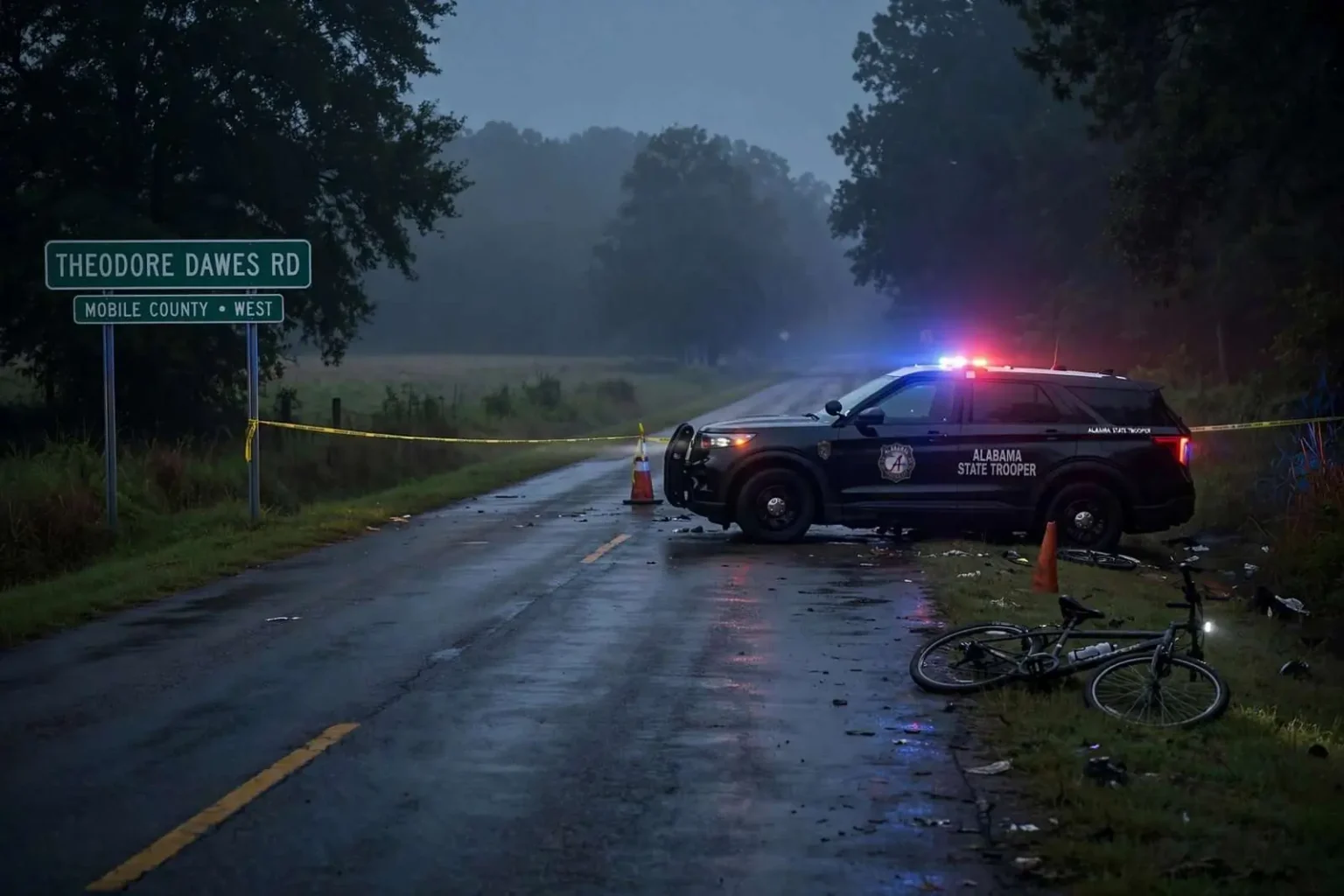
A Mobile man riding his bicycle in the early hours of Labor Day weekend was struck and killed by a car on a rural stretch of road west of the city, according to Alabama State Troopers, part of a holiday period that saw multiple fatal wrecks across the state. Troopers say the crash happened around 1:15 a.m. on a Saturday on Theodore Dawes Road, roughly three miles west of Mobile. Jesse R. Smith, 48, was riding his bicycle when he was struck by a 2004 Pontiac. Smith died at the scene, and troopers said the investigation into the exact circumstances of the wreck was continuing in the days afterward.
The timing and location of the crash fit a pattern that safety officials have documented for years. Rural and semi-rural roads just outside the city limits carry fast traffic at all hours, and cyclists who ride them before dawn face drivers whose headlights may not reveal a bicycle until it is dangerously close. Theodore Dawes Road runs through a corridor of neighborhoods, churches and open land west of Mobile, connecting communities that rely on it as one of the few through routes in the area. At 1:15 in the morning, traffic is thin, sight lines are short and any collision is likely to be severe.
Troopers did not immediately release details about the driver of the Pontiac or whether charges would be filed, saying only that the investigation remained open. Determining fault in a nighttime crash involving a cyclist typically requires reconstructing lighting conditions, visibility, the cyclist’s position on or off the roadway and the vehicle’s speed. Those findings can take weeks, and troopers generally withhold conclusions until the work is done. In the meantime, the crash left a family in mourning and a stretch of road that residents know well marked by another fatality.
Five Deaths Across Alabama Over the Holiday
The crash was one of five traffic fatalities recorded statewide by the Alabama State Troopers during the Labor Day holiday reporting period, which ran from just after midnight on Friday through midnight on Labor Day itself. Two of the five people killed statewide were riding bicycles at the time of their crashes, and Smith was one of them. The figure is a striking one, since bicycles represent only a small fraction of the miles traveled on Alabama roads during any given holiday weekend. For cyclists and the advocacy groups that represent them, the statistic confirmed what they have argued for years: riders are disproportionately exposed on the state’s roads, particularly after dark.
Troopers noted that seat belts were available in three of the five fatal crashes recorded over the holiday weekend, but only one of those drivers or passengers was actually buckled in at the time. That detail is a familiar refrain for Alabama law enforcement agencies, who use every holiday weekend as an opportunity to remind residents that buckling up remains the single easiest way to survive a serious wreck. Alabama’s seat belt law covers front-seat occupants, and troopers step up enforcement during holiday periods under the state’s traffic safety campaigns. Despite decades of public education, unrestrained occupants continue to make up a large share of the state’s traffic deaths, and holiday weekends reliably produce the same grim arithmetic.
The Labor Day reporting period is one of several extended holiday enforcement windows the state runs each year, alongside Memorial Day, Independence Day, Thanksgiving and the Christmas season. During those windows, troopers increase patrols on the corridors that carry holiday traffic, and the fatality counts they publish afterward become the basis for the state’s yearly highway safety accounting. Five deaths over a three-day weekend is consistent with the state’s recent averages, but each one represents a crash that safety officials will examine for patterns they can act on.
Rural Roads and the Cyclists Who Ride Them
For Mobile County residents, the crash on Theodore Dawes Road is also a reminder of the hazards facing pedestrians and cyclists on roads that were not necessarily built with dedicated bike lanes or wide shoulders. Stretches of road just outside the Mobile city limits carry a mix of local traffic and vehicles moving at higher speeds, often in low-light, early-morning conditions like the one in which Smith was killed. The unincorporated corridors west and south of the city developed as rural farm roads and were gradually absorbed by suburban growth, but their design, narrow lanes, minimal lighting and soft shoulders, has lagged behind the traffic they now carry. A cyclist on such a road at night is nearly invisible until a driver is upon them, and the consequences of any error are catastrophic.
Local road-safety advocates have long pushed for improved lighting, reflective signage, and shoulder space in these transitional areas between the city and its rural surroundings, arguing that cyclists and drivers alike benefit when there’s more room for error. Paved shoulders several feet wide, rumble strips at the edge line, and reflectorized signage at intersections are all relatively inexpensive measures compared with rebuilding a corridor. Advocacy groups in the Mobile area have also pressed for designated bike routes that steer riders toward roads with better sight lines, and for education campaigns reminding drivers that bicycles have a legal right to the roadway. Progress has been incremental, and crashes like the one on Theodore Dawes Road renew the calls each time they occur.
The demographic reality of cycling in the county complicates the safety picture. Many riders use bicycles as basic transportation rather than recreation, commuting to work shifts that begin before dawn or end after midnight, often without high-visibility gear or lights. Public health and transportation officials have documented that a large share of serious cyclist crashes in the region happen in exactly those hours, on exactly the kinds of unlit corridors where Theodore Dawes Road sits. Outreach programs that distribute bike lights and reflective vests have made a dent, but the underlying road design issues remain the larger factor.
A Familiar Holiday Toll
By comparison, State Troopers said the previous year’s Labor Day holiday saw five separate crashes result in six deaths statewide, meaning this year’s toll, while still tragic, marked a slight improvement in the raw numbers even as the circumstances remained painfully familiar. The one-death difference is the kind of variation that holiday totals naturally produce, and safety officials caution against reading a trend into a single weekend. What does hold steady from year to year is the composition of the toll: a mix of vehicle occupants and vulnerable road users, a share of victims not wearing restraints, and at least some crashes in which speed or impairment is suspected. The state’s highway safety office compiles these holiday figures to direct its campaigns, and the bicycle deaths on this Labor Day weekend will feed that analysis.
Mobile County officials and state troopers continue to encourage residents to exercise added caution on rural roads during pre-dawn and dusk hours, when visibility is lowest and cyclists can be difficult for drivers to see. For drivers, that means slowing down on unlit corridors, scanning the road edges for pedestrians and riders, and remembering that a headlight beam reaches only so far at highway speeds. For cyclists and pedestrians, troopers recommend lights and reflective clothing. The advice is simple, and it is repeated every holiday period because the crashes keep occurring.
Anyone with information about the Theodore Dawes Road crash was asked to contact Alabama State Troopers. Investigators typically seek witnesses who may have seen either the cyclist or the vehicle in the minutes before a crash, since early-morning collisions often have few observers. The highway patrol post that covers Mobile County handles the follow-up, and even small details from drivers who passed through the area that night can help establish the sequence of events. For now, the case remains under investigation, and a family waits for answers about a holiday weekend that ended in death on a dark road west of the city.
What Comes Next in the Investigation
The investigation into the Theodore Dawes Road crash will follow the standard protocol for a fatality involving a pedestrian or cyclist. Troopers will document the roadway, measure skid marks and final resting positions, examine the 2004 Pontiac for damage and mechanical condition, and, where warranted, seek toxicology testing on the driver. In nighttime crashes, lighting analysis is often the pivotal question: whether the cyclist had a headlamp or reflectors, whether the driver’s headlights were functioning properly, and whether sight distance gave the driver any realistic chance to avoid the collision. The results determine whether the case ends as a tragic accident or moves forward with charges such as negligent or reckless driving, both of which exist under Alabama law.
Crash reports from the holiday period will also feed the broader statistical picture that shapes state policy. Alabama’s transportation and public safety agencies track fatal crashes by time of day, road type, restraint use and mode of travel, and the results drive decisions about where enforcement and engineering money goes. A weekend in which two of five deaths involved bicycles stands out in that data, and it gives county planners another data point in the case for treating rural corridors like Theodore Dawes Road as safety projects rather than simply maintenance items. Funding for such projects typically flows through federal highway safety programs administered at the state level, with local matching efforts.
For the neighbors along Theodore Dawes Road, the practical aftermath is more immediate. Residents who live on corridors like this one describe driving it defensively, knowing where the road narrows and where walkers and riders tend to appear. Some communities have responded to repeated crashes by organizing around specific requests to the county, from speed limit changes to signage, and the outcome of this case may add to that list. In the meantime, troopers repeat the same advice they give at the end of every holiday enforcement period: slow down, buckle up, watch for people outside of cars, and remember that the margin for error on a dark rural road is thin for everyone who uses it.