Hattiesburg Loves the Dead Sea Scrolls, and Carnival Keeps Overbooking
Mobile's tourism chief reported that Mississippi supplied the most out-of-state visitors to the Dead Sea Scrolls exhibit and that the Carnival Holiday was routinely sailing well over capacity.
MOBILE — A speech to a local civic club in April 2005 by Leon Maisel, president and chief executive of the Mobile Bay Area Convention and Visitors Bureau, produced a set of numbers that told a more interesting story about the city’s tourism economy than any brochure could. Taken together, the figures described a city whose visitor base was closer, more loyal and more profitable than the standard assumptions about tourism marketing would suggest.
The Dead Sea Scrolls, by way of Mississippi
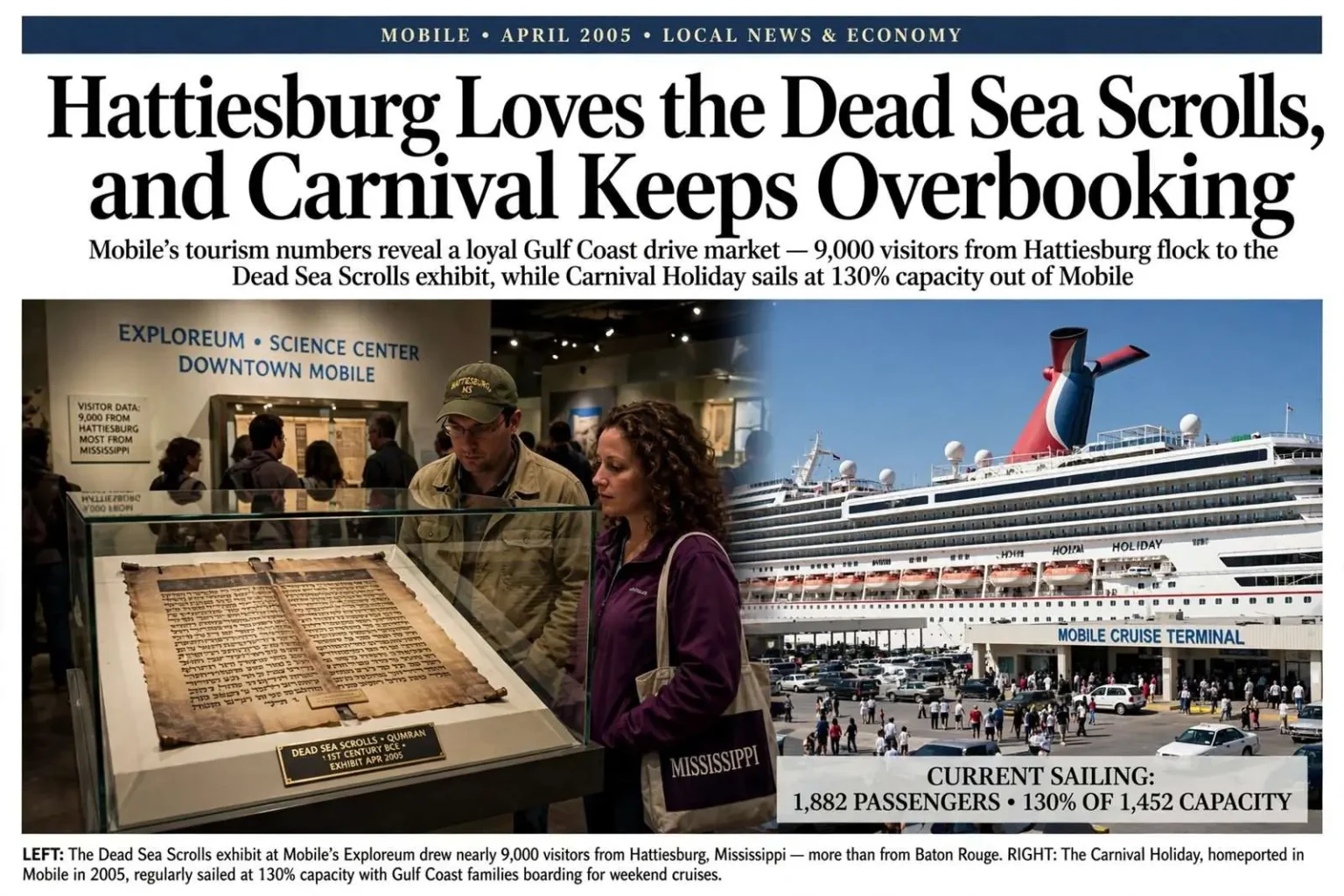
The Exploreum in downtown Mobile was hosting a major exhibition of the Dead Sea Scrolls, and Maisel put a question to his audience: which state was sending the most visitors? The answer was Mississippi. He then narrowed it further. Where in Mississippi? Hattiesburg — a city of modest size that had, by that point, sent roughly 9,000 people to the exhibit.
That was more than had come from Baton Rouge, a considerably larger city and no farther away. The finding is a small lesson in how regional tourism actually works. Marketing dollars tend to chase population centers, because that is where the advertising can reach the most people at once. But the visitors who show up are often those for whom a trip is genuinely convenient — a two-hour drive, an easy day out, a place they already have some reason to know.
Hattiesburg, it turned out, regarded Mobile as its cultural neighbor in a way Baton Rouge did not. The relationship runs on geography and habit more than on ad campaigns: south Mississippians already drive to Mobile for shopping, medical care, the airport and the coast, so an exhibition of international significance downtown was simply one more reason to make the trip. Baton Rouge, by contrast, looks toward New Orleans for the same kind of outing, and Mobile’s marketing budget cannot buy its way past that gravitational pull.
For the Exploreum and the visitors bureau, the lesson was practical. Exhibitions of that caliber should be promoted heavily in the Pine Belt of southeast Mississippi, in the Florida panhandle and along the whole Gulf Coast corridor, because the audiences most likely to come are the ones already halfway here.
Reading the exhibit’s numbers
It is worth pausing on what the Hattiesburg figure actually measured. The Dead Sea Scrolls exhibition was a ticketed, time-limited event, and ticketed museum exhibitions are among the purest instruments for measuring a region’s appetite for cultural tourism: attendance is counted at the door, the buyer’s origin is often known from group sales and memberships, and the run is long enough to reveal patterns rather than one-week spikes. Nine thousand visitors from a single mid-sized Mississippi city, out of one exhibition, is the kind of number that makes a museum’s board pay attention.
It also suggests the depth of the market Mobile was only beginning to serve. Southeast Mississippi’s population centers — Hattiesburg, Laurel, the Pine Belt communities around them — had no institution of the Exploreum’s scale, and Mobile’s was within easy reach. Every additional exhibition of national caliber stood to convert that latent demand again, which is why bureau directors in similar cities spend as much energy on booking attractions as on advertising them.
The cruise ship that could not stop selling tickets
The more consequential numbers concerned Carnival’s Holiday, then homeported in Mobile. Maisel reported that the ship ranked second in customer satisfaction across Carnival’s fleet of more than 20 vessels — a remarkable showing for one of the line’s older and smaller ships, and an unexpected one for a port barely into its first years of cruise service.
Its rated capacity was 1,452 passengers. Its most recent sailing had carried 1,882. That is not an error. The Holiday’s average booking out of Mobile ran 125 to 130 percent of nominal capacity, against an industry average of about 108 percent, because families routinely booked three and sometimes four guests into cabins classified as doubles. Carnival stored 110 roll-away beds at the convention center simply to keep up with demand.
Digging into those numbers explains why cruise lines watch them so closely. A ship’s rated capacity assumes two passengers per cabin; every third and fourth berth sold is essentially found revenue, sold at a discount but still sold on a ship that would otherwise sail with the space empty. A port whose sailings average 125 percent of capacity is not merely popular — it is pulling families from a radius wide enough that four people can share a cabin comfortably, which in practice means drive-market customers who see the cruise as a complete, affordable vacation.
That is precisely what Mobile was. The Holiday’s passengers were overwhelmingly from the Gulf Coast drive market: families from south Alabama, Mississippi, the Florida panhandle and Louisiana who could park at the terminal, board by mid-afternoon and be at sea by dinner. The second-place customer satisfaction ranking fit the same pattern — passengers who expected little from an older, mid-sized ship were delighted, and the ship’s itineraries and crew turned low expectations into loyalty.
Maisel drew the obvious conclusion: the numbers suggested a strong likelihood that Mobile could support a second ship. A port whose only vessel sails 130 percent full, with satisfaction ratings near the top of the fleet, is exactly the case a cruise line’s planners look for when deciding where to add capacity.
What the cruise business meant for downtown
The homeporting of the Holiday had already changed downtown Mobile in ways that were easy to miss from a distance. The cruise terminal brought thousands of passengers through the riverfront on Saturdays, many of them arriving a day early, staying in hotels and eating downtown before embarkation. Parking revenue, taxi traffic and pre-cruise hotel nights became part of the downtown economy almost overnight.
The convention center connection mattered too. Storing 110 roll-away beds at the convention center was a small logistics footnote, but the terminal’s proximity to downtown facilities shaped how the whole riverfront functioned — cruise traffic, convention traffic and downtown nightlife occupying the same few blocks, each feeding the others.
Mobile’s position on the cruise map
Mobile entered the cruise business later than its Gulf Coast neighbors, and its homeport had distinctive advantages worth noting. The city sits within a day’s drive of a large share of the American Southeast, and the terminal’s location on the Mobile River put it minutes from the interstate. For cruise lines, a homeport is a bet on a region’s ability to fill a ship week after week without the expense of flying passengers in — and the Holiday’s load factors were the evidence that the bet was paying.
The dynamics of homeporting also explain why Maisel’s numbers were so valuable to the city. Cruise lines redeploy ships constantly, moving them to ports where demand is strongest, and the statistical case for Mobile — satisfaction, utilization, drive-market booking patterns — was the city’s best argument for keeping and expanding service. Ports that demonstrate overbooked sailings and top-ranked customer reviews tend to keep their ships; ports that do not tend to lose them.
The tourism lesson in both stories
Between the two anecdotes, Maisel’s speech sketched a coherent theory of how Mobile’s visitor economy actually works. The city does not compete with New Orleans for national convention business or with Orlando for destination tourism. Its strengths are regional: it draws visitors from a radius of a few hours’ drive, for cultural attractions of genuine quality, and it converts convenience into attendance better than cities ten times its marketing budget.
That insight carries implications for anyone planning Mobile’s tourism future. The Dead Sea Scrolls result argues for booking exhibitions and events that give the Gulf Coast region — Hattiesburg included — a reason to come. The Holiday’s numbers argue for anything that makes an overnight stay easier: more hotel rooms downtown, more to do on the riverfront, more reasons to arrive the night before. Both are cheaper strategies than trying to out-market larger cities for distant visitors, and both were already producing measurable results.
It is also a reminder that tourism’s effects are cumulative. Nine thousand visitors from Hattiesburg do not transform a downtown, but they buy tickets, park, eat lunch and tell neighbors; a cruise ship that sails overbooked every week does not transform a port, but it supports taxis, hotels and restaurants along the riverfront. The civic club audience that morning heard the local tourism economy described honestly — not as an aspiration, but as a set of numbers that were already better than most people assumed.
What to watch
The questions raised by the speech were straightforward. Would the Exploreum’s success with the Scrolls encourage a schedule of exhibitions heavy enough to keep the regional drive market returning? And would Carnival, looking at a ship it could not overbook fast enough, decide that Mobile had earned a second vessel? Either development would confirm the pattern Maisel described; together, they would mark Mobile’s arrival as a genuine Gulf Coast visitor destination — not by outshouting bigger cities, but by being the closest place with something worth the drive.