Mobile County Schools Expand Student Drug Testing to Eighth-Graders
Mobile County schools are widening a drug testing and education program this fall, inviting eighth-graders to opt in for the first time.
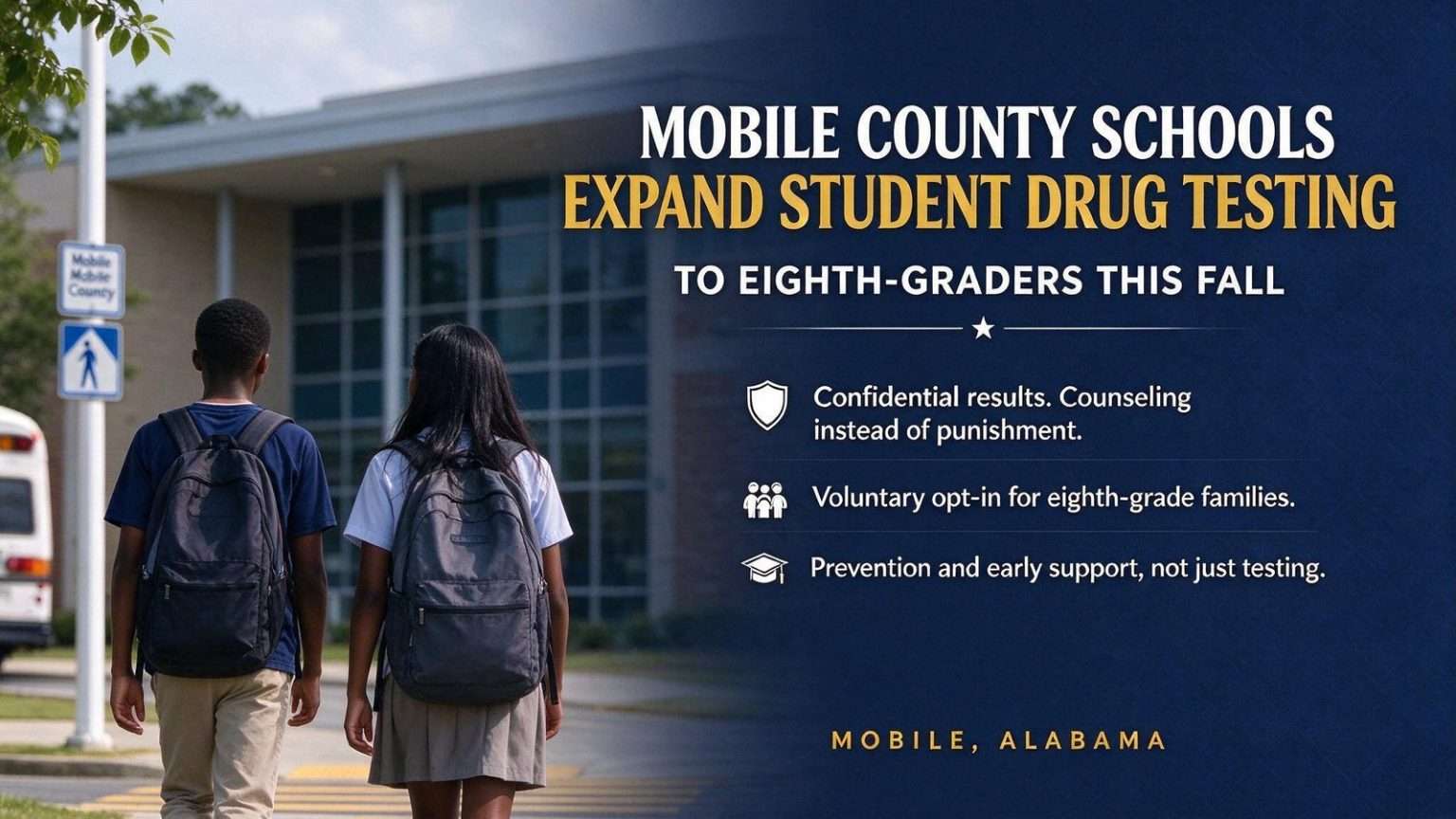
MOBILE, Alabama — Mobile County school officials are pushing to enroll more students in a random drug testing program this fall, expanding the effort down into eighth grade for the first time as the school system works with the Drug Education Council to keep the initiative growing.
The expansion marks a new phase for a program that has quietly become one of the largest of its kind in Alabama. What began as a targeted screening effort for student athletes and drivers has grown into a district-wide apparatus that touches the majority of the county’s high schoolers, backed by a nonprofit with decades of history in Mobile and a coalition of local government and civic funders.
Clean Results So Far
The program’s first round of roughly 120 screenings this year came back completely clear, according to Larry Mouton, executive director of the school system’s career and technical education department. A clean slate, officials are quick to note, is exactly the point: the program is designed less to catch students than to give them a ready-made reason to say no when they are offered drugs.
The Drug Education Council, known locally as the DEC, oversees the testing and now operates with a $120,000 budget and three full-time staff members dedicated to the schools. The organization, a Mobile institution in prevention work for decades, coordinates the logistics — scheduling the random draws, arranging collection sites, contracting with certified laboratories, and managing the confidential chain of custody that follows every sample.
Confidentiality sits at the heart of the design. Results go to the student’s family and the school administrators responsible for the program, not to coaches, teachers or college admissions officers. A positive screen does not become a police matter or a mark on a transcript; it triggers a conversation, counseling and a retest, an approach intended to keep the program trusted enough that families continue to opt in.
Who Gets Tested
The testing pool currently covers any Mobile County high schooler involved in extracurricular activities, students who drive themselves to campus, and anyone who volunteers to be included. Mouton estimated that close to 80 percent of the district’s high schoolers, or about 16,000 students, now fall into that pool.
The breadth of that pool reflects both the law and local choices. Courts have upheld random drug testing for students in extracurricular activities and for those who hold campus driving privileges, categories that in practice sweep in most of a modern high school’s population. Mobile County has layered voluntary participation on top, allowing families with no other connection to the program to sign their students up anyway — an option that prevention workers say plenty of parents take.
Every two weeks, 15 names — 10 primary selections plus five alternates — are drawn at random from each of the county’s 12 high schools, and those students are called in to provide a urine sample screened for 11 different substances, including marijuana, cocaine, opiates, methamphetamine, ecstasy and synthetic marijuana known as spice.
The inclusion of spice and other synthetic cannabinoids tracks the shifting drug landscape among teenagers. Synthetic products, sold for years in gas stations and convenience stores under colorful brand names, were marketed as legal and undetectable, and they landed young users in emergency rooms across the Gulf Coast. Testing for them signaled to students that the laboratory panel was keeping pace with what was actually circulating in their schools.
Middle Schoolers Can Opt In This Fall
Following requests from parents and administrators, the DEC is now extending a voluntary version of the program to eighth-graders, with testing set to begin in middle schools by the end of October. Unlike the high school program, middle school participation requires families to actively sign up rather than being automatically included through extracurricular involvement.
The opt-in design for eighth grade is a deliberate response to the age of the students involved. Fourteen-year-olds are not subject to the same activity and driving hooks that capture high schoolers, and bringing minors into a testing program without a parent’s affirmative consent would raise concerns the district has chosen to avoid. Families will receive information about the program through their schools and can enroll their children before the fall window closes.
DEC Executive Director Virginia Guy said the push for younger students came from a groundswell of requests from families and educators who wanted the option available earlier. Prevention research has long emphasized that the middle school years are when experimental substance use begins for many young people, and educators in Mobile County argued that a program reaching students at that age could intervene before habits form rather than after.
Middle school administrators who backed the expansion pointed to a practical reality: students arriving in ninth grade already know about the high school program, and some families wanted their children covered during the transition year. Starting in eighth grade also lets the district normalize the program early, so participation in high school feels like a continuation rather than a new imposition.
More Than Testing
Guy emphasized that education and counseling are central to the program, not just the screenings themselves. The DEC’s three staff teachers visit schools daily to talk with students about the consequences of drug use and to make sure families know that counseling and free testing support is available through the council, whether or not a student is part of the official testing pool.
That service layer distinguishes Mobile County’s model from purely punitive programs. Students who test positive are connected with counselors rather than expelled or arrested, and the DEC’s classroom presence means the same staff members who administer the program are also the familiar faces teaching prevention lessons. The council treats each screening cycle as a fresh opportunity for outreach — a chance to remind students why the pool exists and what help is available.
The education component also extends to parents. DEC staff walk families through what the tests screen for, how long substances remain detectable, and what warning signs of use look like at home. Officials say informed parents are the program’s most effective recruiters, since a mother or father who understands the process is more likely to enroll a younger sibling.
A Coalition Behind the Program
At its most recent meeting, the Mobile County school board approved a $25,000 contract with the DEC to help fund the expanded effort, joining other longtime supporters that include the Mobile County Sheriff’s Office, the Mobile County District Attorney’s Office, the United Way of Southwest Alabama, the Mobile Area Chamber of Commerce and a number of local businesses.
The funding roster reads like a map of Mobile County’s civic establishment, and that breadth is intentional. Prevention advocates argue that a program touching 16,000 students cannot rest on a single budget line, and the mix of government offices, philanthropy and private business has kept the initiative stable through budget cycles that might otherwise have cut it.
Law enforcement support, in particular, underscores the program’s framing. The sheriff’s office and the district attorney back the testing effort as an alternative to the criminal justice system for young users — a way to identify and treat emerging substance problems in teenagers before they mature into arrests, overdoses or addictions that flow through adult court.
How Baldwin County Differs
Neighboring Baldwin County has taken a different approach and does not run a comparable drug testing program in its schools. High school principals there previously told the Baldwin County school board that such testing does not effectively reach the students most at risk and can disrupt classroom instruction time.
The divide between the two counties illustrates a genuine debate in education policy. Critics of random testing argue that students truly engaged in drug use can simply decline the activities that place them in the pool, leaving the program to screen the compliant while missing those most in trouble. Principals in Baldwin also raised the practical burden: pulling students from class for collection disrupts the school day, and the testing periods multiply across a large district.
Mobile County officials respond with the program’s own arithmetic: thousands of students covered, clean results, and a structure that gives families a tool they would not otherwise have. They note that the voluntary component allows any student, including those outside the activity pool, to be tested, and that the counseling resources the DEC provides are available to every family in the district regardless of participation.
The two counties’ choices are not fixed. Baldwin County’s board has revisited the question as community concerns have shifted, and Mobile County’s program continues to evolve — this year into the eighth grade, and in future years wherever the data and the requests from parents take it. For now, the Gulf Coast’s two largest school systems offer families two different answers to the same question of how best to keep teenagers away from drugs.
What Parents Need to Know
Families in Mobile County with questions about the program can expect information through their schools as the fall rollout approaches. High school students in the testing pool will be selected through the same random biweekly draws, with 15 names called from each of the county’s 12 high schools every two weeks, and middle school families will receive enrollment details for the voluntary eighth-grade option ahead of the October start.
Officials stress that the program’s purpose is prevention, not punishment. A clean first round of screenings this year gave the district’s argument its simplest form: thousands of students stood ready to be tested, and none of the first 120 results came back positive. The district, the DEC and their civic partners intend to spend the school year making that outcome the norm rather than the exception.