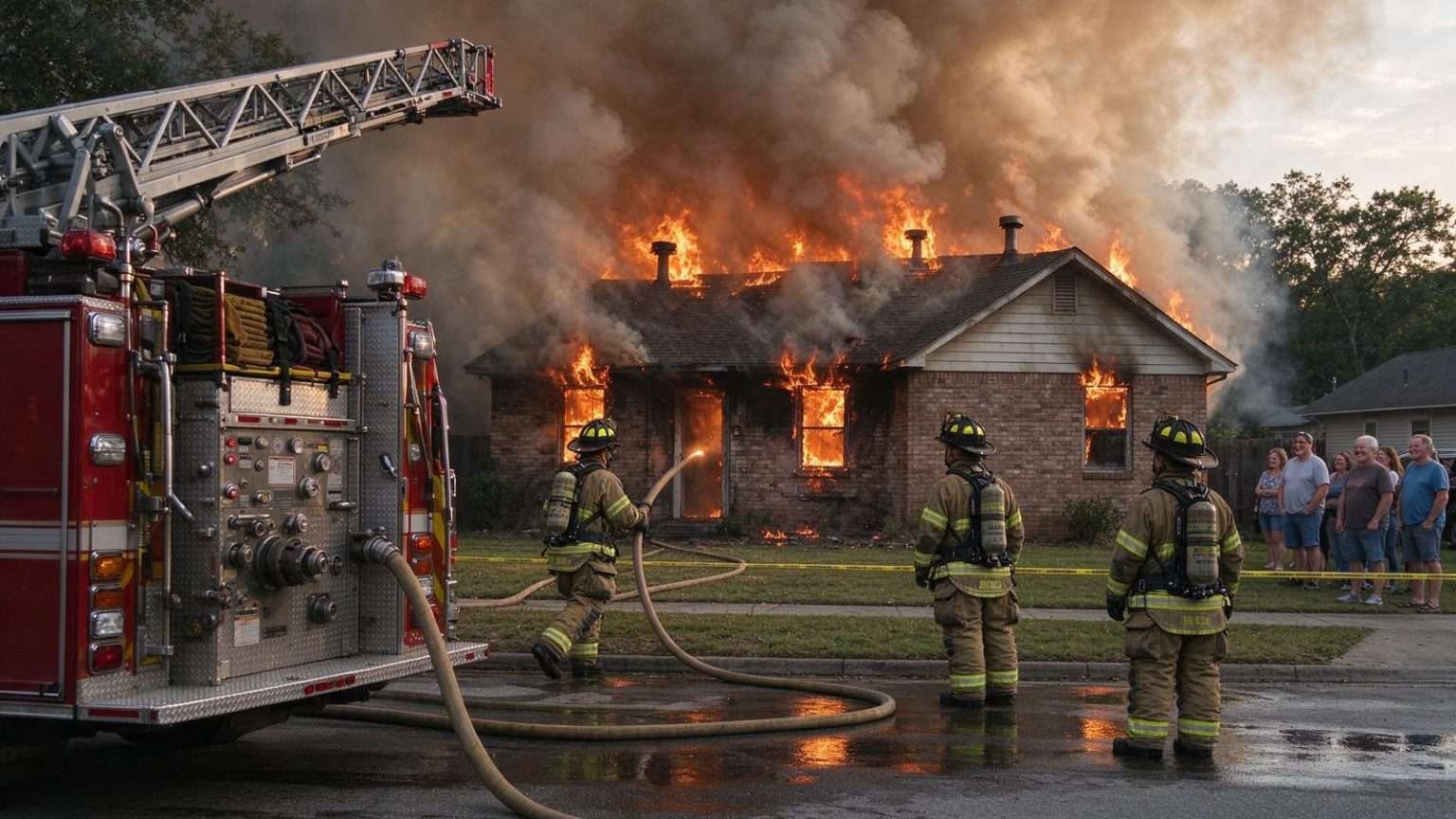
Not every house on fire is an accident. It is not necessarily arson, either, or an act of God. Sometimes the fire was set by firefighters themselves, with the property owner standing across the street, smiling. Those are training burns — the controlled destruction of structures that have outlived their usefulness, converted into classrooms at the last possible moment. For Mobile Fire-Rescue they are a rare chance to practice inside a real structure. For the owner, they are a tax write-off and a cheaper path to a cleared lot. And for the neighbors, they are free street theater — the kind that draws a crowd the way a porch light draws moths.
Not Just Any Old House Will Do
“People sometimes donate a house and they get a tax write-off and we get a training opportunity,” said Steve Huffman, spokesman for Mobile Fire-Rescue. The department cannot simply accept any offer, however. A donated structure has to come with clear title, and it has to be genuinely useful as a classroom. A house entangled in liens or boundary disputes is worse than useless: the fire department cannot legally torch what it does not definitively own, even for an afternoon.
“Not just any ol’ house will do,” Huffman said. “It has to have elements that make it useful for our purposes. It’s got to have a roof, a floor, doors and windows.” The requirements sound obvious until one considers what the department actually needs: an intact envelope through which crews can force entry, advance hose lines, cut ventilation holes and practice searches. A house missing its roof or stripped to studs gives away the conditions that make a burn valuable in the first place.
Location matters as much as construction. The house cannot sit too close to neighboring residences or to power lines, where radiant heat or an ember drift could turn a drill into a second emergency. And there must be an adequate water supply — in practice, two independent sources, usually a fire hydrant plus a tanker truck standing by. Redundancy is not bureaucratic caution; a training burn that outgrows its water supply would be the department’s own version of the disaster it exists to prevent.
Before a single match is struck, the structure is prepared in ways the crowd never sees. Asbestos and other hazards are removed, wells are sealed, windows are replaced with breakaway materials, and fire crews set deliberate ignition points in selected rooms so the burn proceeds on a script. Command officers choreograph the sequence — which room burns, when crews rotate, when the fire is knocked down — with safety officers stationed inside and out. The chaos of the flames is manufactured; everything else about the operation is planned to the minute.
A house that meets those tests gives firefighters something no drill tower can: unpredictable smoke behavior, real heat, real collapse risk, and the disorienting experience of moving through an unfamiliar floor plan in the dark. Crews rehearse search patterns, ventilation and hose advancement in conditions that approximate the emergency they will actually face. The difference between a concrete training tower and a real burning house is the difference between a simulator and weather — the smoke does not read the lesson plan.
The Owner’s Side of the Ledger
For a property owner sitting on a derelict house, the arithmetic is straightforward. Demolition costs money. Hauling the debris costs more. Donating the structure to the fire department can yield a charitable deduction while reducing what is left to haul away. The fire does part of the demolition for free, and what remains afterward is a foundation pad and a fraction of the debris that would otherwise have gone to a landfill at the owner’s expense.
The department benefits from the goodwill as well. Beyond the training itself, each burn lets crews test new equipment, refresh pump operations and exercise mutual-aid coordination with neighboring departments — and the visible display of the department at work in a neighborhood is its own form of public relations. A training burn is one of the few municipal operations that residents will voluntarily gather to watch, and a well-run one leaves them with a better understanding of what the trucks and the ladders actually do.
There is no fixed schedule for these exercises, Huffman said, because there is no fixed supply of houses. The department burns what it is given, when it is given. A slow season of donations means live-fire training has to be improvised around whatever concrete and steel props the department’s own facilities provide; a run of suitable houses allows a burst of realistic drills that can refresh an entire shift’s certifications at once.
Owners interested in donating a structure were told to call the department, which will send someone to inspect the property and judge whether it is suitable. The inspection covers title, structural condition, neighborhood spacing, utilities and water supply — the full checklist — before anyone agrees to put fire in the building. Deals fall through at that stage more often than the public hears about: plenty of offers arrive for houses that are too fragile, too close to other homes, or legally too tangled to use.
Planning for a Neighbor’s Collapse
Huffman also confirmed a more delicate piece of work underway inside the department: contingency planning for Prichard. The neighboring city, buckling under debt and facing questions about its financial survival, has its own fire department. Should Prichard’s finances collapse entirely — through bankruptcy, dissolution, or simple inability to make payroll — the question of who answers a fire call inside its limits becomes urgent, and Mobile is the nearest department with the capacity to absorb it.
“We’ve looked at that possibility,” Huffman said. “We’re already putting in the planning just in case. There’s a very good possibility if that’s what ends up happening.” The planning is not a merger proposal or an annexation scheme; it is a standby file — maps, response zones, staffing math and logistics — that would let Mobile fire stations cover Prichard addresses without a transition period in which calls went unanswered.
He added a note of caution against writing Prichard off: “But they’ve been there before and survived.” The remark carried the memory of earlier rounds — fiscal crises, pension disputes and budget emergency measures that Prichard had weathered before, including the bankruptcy fight that once made the small city a national shorthand for municipal pension trouble.
Prichard’s fiscal troubles have been a recurring feature of Mobile County life for years, and its pension obligations have repeatedly pushed the city toward the edge. Its fire department has continued to answer calls throughout, and residents there have watched the same rumor cycle recycle for years: that the city will dissolve, annex, or be absorbed. Mobile’s quiet scenario planning is the sort of preparation that, if it is ever needed, will look obvious in hindsight — and if it is not, will never be noticed at all.
The two cases — a donated house in flames and a neighboring city’s contingency file — are more alike than they appear. Both are examples of a fire department doing the unglamorous work that happens before an emergency: acquiring the training structure before the drill, mapping the response before the collapse. When the actual emergency arrives, the visible work — the engine, the ladder, the hose line — stands on a foundation the public rarely sees being laid.
Mobile Fire-Rescue’s use of donated structures fits a practice common among fire departments across the country, where live-fire training is both essential and increasingly regulated. National standards require burn buildings to be inspected, crews to be briefed on escape routes, and accountability systems to track every firefighter inside the structure. Departments that train only on acquired structures — rather than permanent burn towers — live on the supply of aging housing stock, which makes Mobile’s arrangement a practical adaptation to a growing city that no longer produces derelict houses in the quantities it once did.
For neighborhoods, a training burn also delivers a small civics lesson. Firefighters typically canvas the immediate area beforehand, explaining the schedule, warning about smoke and inviting questions. Children who watch a crew ventilate a roof or nurse a hose line past a fence learn, concretely, what the department does; older residents who remember an actual house fire in the same blocks sometimes ask the questions that lead to smoke alarms, escape plans and home inspections. The spectacle is memorable precisely because it is real.
Mobile’s readiness planning for Prichard, meanwhile, belongs to a longer history between the two cities. Prichard, once a thriving industrial suburb of shipyard and factory workers, has spent decades navigating population loss and fiscal strain, while Mobile has grown toward and around it. Fire coverage, water service and ambulance response already cross jurisdictional lines in practice, through mutual-aid agreements that are invoked on the worst days — large structure fires, major wrecks, storms. The contingency file Huffman described simply formalizes what cooperation under stress would look like if one side could no longer fund its half.
The economics of such an arrangement are not trivial. Absorbing another jurisdiction’s calls means staffing, apparatus wear, dispatch integration and, eventually, some mechanism of cost recovery — whether through an interlocal agreement, a service fee, or annexation that brings Prichard addresses — and their tax base — into the city proper. Those are decisions for elected officials, not fire chiefs; what the department can do is ensure that if the question lands on the council’s agenda suddenly, the operational answer already exists on paper.
Until then, the routine continues: inspections of offered houses, deliberate ignition points, crews in rotation, neighbors on the curb. The department burns a house a handful of houses at a time and files plans it hopes to never use — two quiet disciplines of a department that understands its job as much about preparation as response. For the property owner, the tax deduction closes the file. For the neighborhood, the smoke clears by evening. For the crews, the lesson stays — carried into the next alarm, where no one set the fire and nobody is standing across the street, smiling.