Poll Found Most Mobile County Voters Thought the Schools Were on the Right Track
A survey of 512 registered voters found 45.6 percent believed Mobile County public schools were on the right track. Among the critics, the school board drew far more blame than teachers, parents or students.
A survey of Mobile County voters delivered a report card on the county’s public schools that was better than many at the time would have guessed, and it identified where the harshest critics placed the blame.
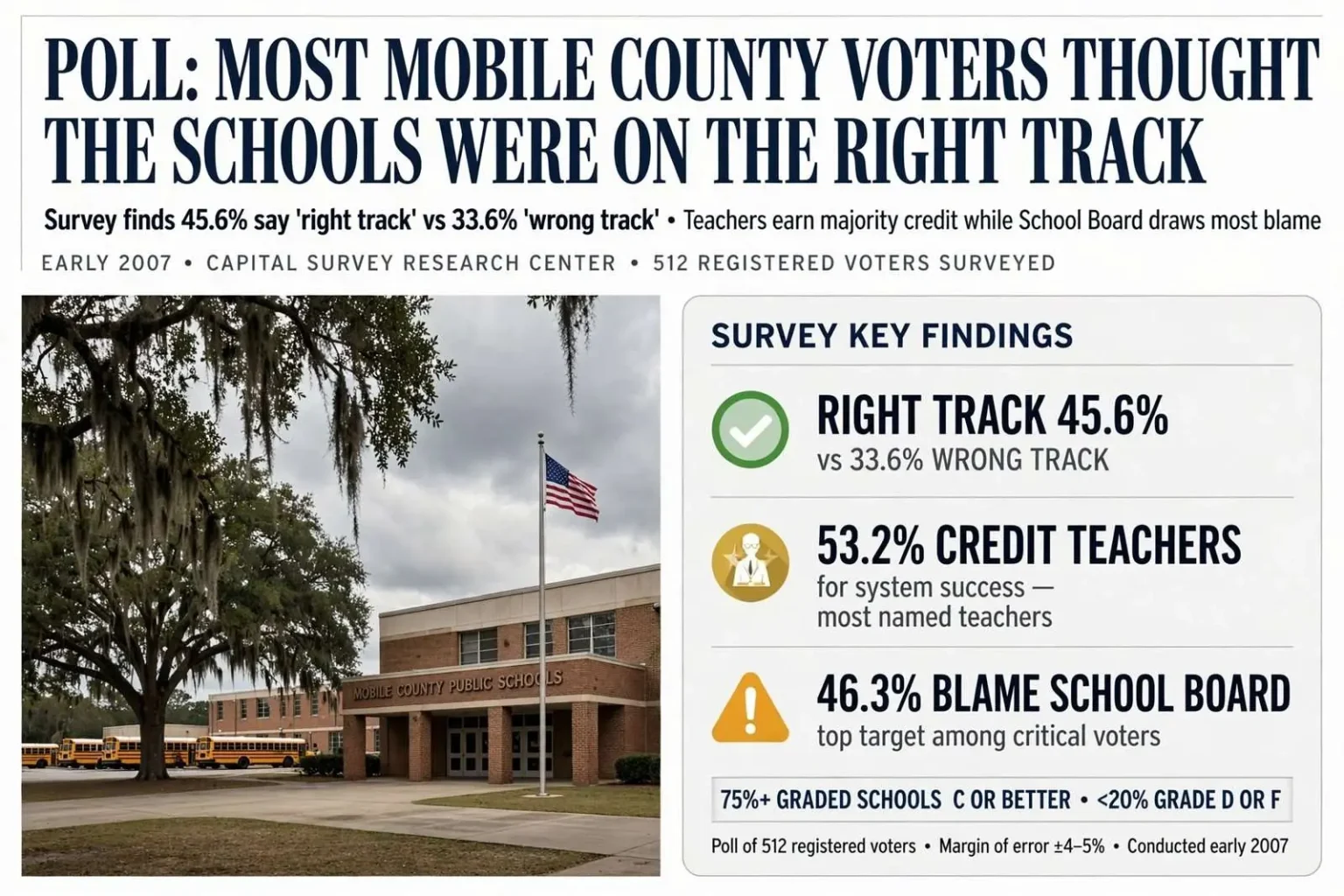
By a margin of 45.6 percent to 33.6 percent, respondents said Mobile County public schools were “on the right track” rather than “on the wrong track.” The Capital Survey Research Center compiled a 34-page survey after questioning 512 registered voters the previous month about public education in the county.
Grading the system
More than 75 percent of those surveyed gave the school system a grade of C or better. Fewer than 20 percent handed out a D or an F.
Asked who deserved most of the credit when the system earned an A or a B, 86 of 162 eligible respondents, or 53.2 percent, saluted the school teachers, a lopsided vote of confidence in the classroom over the administration building.
The blame ran in the opposite direction. Among those with a negative view of the system, the Mobile County School Board was far and away the leading target, drawing 46.3 percent of the criticism. About a third of those who assigned the system a D or an F pointed elsewhere, spreading responsibility among parents, insufficient funding, the superintendent and his staff, the public, or some combination of the four. Notably, the students themselves apparently escaped blame entirely.
The symmetry of the results was striking: when voters thought of success, they thought of teachers; when they thought of failure, they thought of governance. Almost no other institution in the survey drew such a clean division between credit and blame, and the pattern has remained one of the most durable findings in education polling — the public separates the people in the classroom from the people who run the system.
Reading the numbers with care
Any poll of this kind carries qualifications, and this one carried a significant one. Of the 512 registered voters surveyed, the study did not state how many had actually set foot inside a Mobile County public school in the previous 12 months. Opinions about a school system are formed as much by news coverage and neighborhood conversation as by direct experience, and in early 2007 the coverage of public education in Mobile County was rarely gentle.
The sample of 512 registered voters is a standard size for a countywide survey and, in a jurisdiction of Mobile County’s population, typically carries a margin of error of roughly four to five percentage points. That means the gap between “right track” and “wrong track” was real but not overwhelming, and that a third of the county’s voters believed their public schools were headed the wrong way.
For the school system’s leaders, the numbers offered both reassurance and warning. A twelve-point edge on direction is a comfortable margin in ordinary times, but a third of the electorate believing the schools are on the wrong track represents a standing constituency for change — one that any board election, tax referendum or leadership dispute could activate. Systems that ignore that third often find it growing.
The timing of the survey mattered as well. Conducted in early 2007, it captured opinion after years in which Mobile County’s schools had been through desegregation litigation, leadership turnover, charter-style reforms and persistent funding debates, all under the scrutiny of a news market that covered board meetings closely. Voters had plenty of raw material for their judgments, whether or not they had children in the system.
Why the school board took the hit
The concentration of blame on the elected school board rather than on teachers reflected a distinction voters draw instinctively. Teachers are visible, personally known and generally trusted. School boards make decisions about contracts, budgets, personnel and policy in meetings most residents never attend, and they absorb the reputational damage when those decisions go wrong.
The Mobile County Public School System was, and remains, the largest school system in Alabama, responsible for tens of thousands of students spread from the Mississippi line to the Baldwin County line and from the Gulf to the Washington County line. It was governed by an elected board and led by a superintendent, and its politics were rarely quiet.
Scale compounds the problem. A system that large operates dozens of schools across urban, suburban and rural communities with different needs, and every closure, rezoning or construction decision creates a constituency that feels aggrieved. The board sits at the intersection of all of them, which is why single-member districts were designed to guarantee representation — and why the board inherits criticism no matter which way it rules.
Boards also differ from other elected bodies in one respect that surveys regularly expose: most voters cannot name their board member. They can name teachers their children had, principals in their neighborhoods, even superintendents who made headlines, but the elected officials who actually govern the system operate in relative anonymity until a controversy erupts. Anonymous accountability is thin accountability, and it tends to be expressed in bulk — as it was in this survey, with nearly half of critical respondents simply pointing at the board as a whole.
The survey in context
The findings landed at a moment when public education in Mobile County was under sustained scrutiny, and when the conduct of individual board members was itself in the news. In that climate, a result showing three-quarters of voters willing to give the system a C or better amounted to a modest reprieve.
Right track: 45.6 percent. Wrong track: 33.6 percent. Grade of C or better: more than 75 percent. Grade of D or F: fewer than 20 percent. Blame assigned to the school board by critics: 46.3 percent. Credit assigned to teachers by supporters: 53.2 percent.
Set against national polling of the era, the results were unremarkable in one sense — public schools everywhere tend to poll better in the aggregate than in the particulars, and “my schools are bad but mine are fine” is among the oldest patterns in education research. What made the Mobile County numbers notable was the sheer size of the system being graded, and the fact that a majority-vote of confidence in teachers coexisted so easily with near-majority blame directed at the board.
The survey also illustrates the limits of what such snapshots can measure. A “right track/wrong track” question registers mood, not achievement; a letter grade registers impression, not literacy rates or graduation numbers. What the Capital Survey Research Center captured was the political environment in which the school system would operate — the reservoir of goodwill it could draw on, and the size of the constituency waiting to be persuaded otherwise.
The message voters sent was not complicated. They liked their teachers. They were far less sure about the people who governed them. And in a county where the school system touches more families than any other public institution, that distinction — classroom trusted, board doubted — would shape school politics long after the survey’s 34 pages were filed away.
For parents deciding where to enroll their children, for employers weighing the region’s workforce pipeline, and for taxpayers asked to fund the system’s buildings and budgets, the poll offered a plain summary of where public sentiment stood in early 2007: the system was judged to be working, more or less, by a plurality — and watched warily by nearly everyone else.
What the numbers meant for the system
For administrators and board members, a survey like this serves as a benchmark against which later polling can be measured. Direction-of-the-system questions are sensitive to events — a budget crisis, a beloved superintendent’s departure, a string of test-score headlines can move them by double digits — which is why systems track them year over year rather than treating any single result as settled truth.
The results also carried implications for the county’s tax politics. Mobile County’s school system, like most of Alabama’s, depends on a mix of state funding and local property tax support, and Alabama’s constitutionally capped property taxes make local referendums the only realistic route to major new revenue. A public that gives the system a C or better and blames the board for failures is a public that can be persuaded to fund improvements — or to withhold them — depending on which institution it believes is asking.
Teachers’ strong showing in the credit question cut across that calculus. A majority of respondents crediting teachers for the system’s successes suggested that classroom investments — salaries, materials, hiring — were the most politically defensible uses of new money, while administrative spending would face the skepticism the survey registered. Advocacy groups on both sides of school funding debates in the county read the same numbers that way.
And the complete absence of blame directed at students was its own quiet finding. In a period when public debates about education often circled around family responsibility and student effort, Mobile County’s respondents pointed instead at the adults who run the system — the board first, then parents, funding, and the superintendent’s office. Whatever else the survey showed, it described an electorate that located accountability in governance, not in the children sitting in the classrooms.