Mobile Council Approves 2015 Budget With Major Changes to Stimpson Plan
Mobile's City Council passed a 2015 budget 6-1 while Mayor Sandy Stimpson was away, reshaping his plan with new retiree and soccer complex funding.
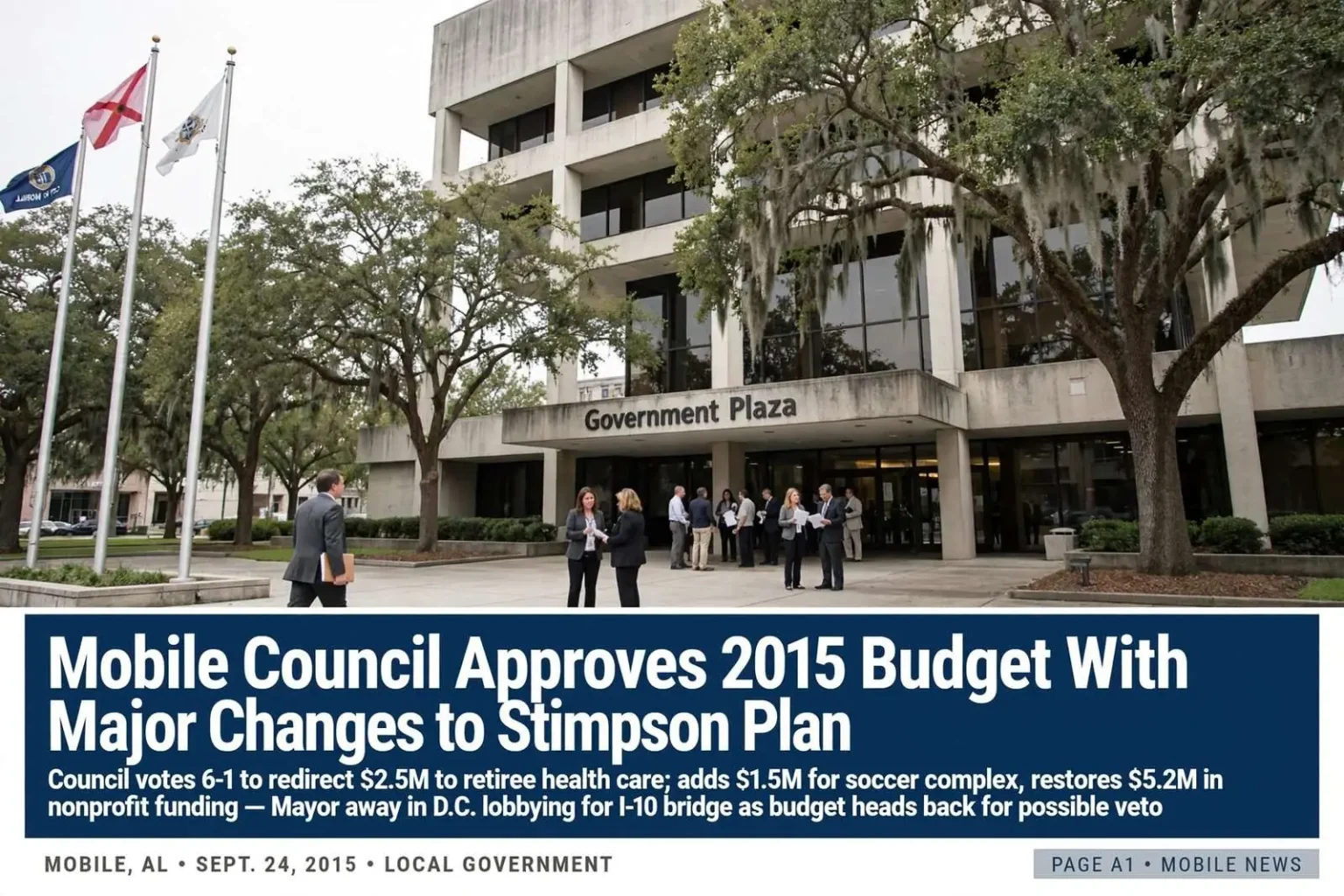
Mobile’s City Council pushed through significant changes to Mayor Sandy Stimpson’s proposed 2015 budget this week, voting 6-1 to approve a spending plan while the mayor was out of town in Washington, D.C. lobbying for the proposed Interstate 10 bridge project. The approved budget, which takes effect Oct. 1, now heads back to Stimpson’s desk for possible reconsideration.
Under the city’s charter, the mayor has 10 days to propose vetoes on any part of the council’s action, and it would take five council votes to override any veto he issues. Stimpson’s chief of staff, Colby Cooper, said the administration was still reviewing the amendments. “We are pleased that it passed,” Cooper said, adding that executive staff planned to meet to discuss the changes in detail.
The mayor’s absence during the final vote — hundreds of miles away pressing the case for a new I-10 crossing — underscored the awkward geometry of the moment: the city’s chief executive was pitching the region’s biggest infrastructure request to federal officials while his first budget was being rewritten at home. Administration officials had spent weeks making their case to the council, only to watch the body redirect key pieces of the plan in a single session.
The council’s amendments included three major shifts from Stimpson’s original proposal. First, members approved shifting $2.5 million from the city’s Capital Fund into the General Fund specifically to help cover retiree health care costs, passing that piece 5-1 with Councilman Joel Daves opposed and Councilwoman Bess Rich abstaining. The move came after weeks of criticism from city retirees over planned changes to their health coverage, though the council did not alter increases planned for active employees, whose cost-sharing arrangement is set to shift from an 84/16 split to 80/20 starting in January.
The Capital Fund redirect was the amendment with the most immediate human impact. Health care changes proposed for retirees had dominated public comment periods for weeks, drawing standing-room crowds of former police officers, firefighters and clerical workers to Government Plaza. Shifting $2.5 million in capital money — funds earmarked for construction and equipment rather than daily operations — preserved retiree benefits without cutting services, but it also traded long-term project money for short-term relief, a trade-off some council members were unwilling to make.
Second, the council dedicated $1.5 million within the Parks and Recreation budget toward a proposed soccer complex near Interstates 10 and 65, an idea pushed by County Commissioner Connie Hudson in the weeks leading up to the vote. That funding would likely draw from the extra $3 million Stimpson had proposed for general park improvements. Councilmen Daves and John Williams both voted against that allocation.
The soccer complex debate pitted a specific regional amenity against a broad network of neighborhood parks. Hudson, who had championed the idea from her seat on the County Commission, argued that a tournament-quality complex would draw travel teams and their spending from across the Gulf Coast. Council skeptics countered that steering half of the city’s new park money toward a single site shortchanged mowing, lighting and playground maintenance in districts whose residents pay the same taxes.
Third, the council approved $5.2 million in performance contract funding for a range of local nonprofit organizations that had faced steep cuts under Stimpson’s original budget. To offset that, the council eliminated another $400,000 tied to a fee-waiver approval process the mayor’s office had proposed for rental and overtime waivers. That amendment passed 5-2, with Williams and Rich voting no.
The nonprofit restoration was the amendment’s costliest piece. Organizations ranging from youth programs to cultural institutions had faced funding reductions that, in some cases, threatened their operations, and council members argued that $5.2 million in city support leveraged far more in matching grants and private giving. The offset — scrapping a new fee-waiver review process before it launched — reflected the council’s judgment that the city could not afford a new administrative layer while cutting outside partners.
Retired Mobile firefighter Michael Farver praised the retiree health care shift, calling it a “great” move by the council. “When they hired us to work for the city, you worked for your pension and insurance,” Farver said. “Now they are trying to back up and change their minds.”
What retirees were facing
The stakes for retirees were concrete. Under Stimpson’s original proposal, roughly 775 Medicare-eligible retirees would have received a $175 monthly subsidy toward supplemental coverage that phases out after four years, while about 381 non-Medicare retirees faced monthly premium increases from $54 to $103 for single coverage and from $140 to $210 for family coverage.
For a retiree living on a fixed pension, those numbers represented a real reduction in household income — in some cases several hundred dollars a year for single coverage and far more for families. The four-year phase-out of the Medicare subsidy added a second layer of anxiety, since beneficiaries could see the benefit shrinking on a schedule regardless of future medical costs. That arithmetic, repeated in meeting after meeting, is what turned a budget line item into a sustained political fight.
The council’s $2.5 million redirect did not repeal the active-employee changes, which shift more health care cost onto the city’s current workforce through the move from an 84/16 to an 80/20 cost-sharing split beginning in January. That distinction — protecting the already-retired while increasing costs for those still working — drew less public opposition, in part because active employees’ premium increases were smaller in dollar terms and phased in alongside the city’s broader benefits overhaul.
The episode reflected a tension playing out in municipal budgets across Alabama and the country. Decades of accumulated retiree health promises, made when coverage was cheap and workforces were younger, collide with present-day budgets that must also pay for police, paving and parks. Every option — cutting benefits, raising premiums, diverting capital money — carries a cost that someone, somewhere in the city’s population, feels directly.
For the council members who voted to shift the capital money, the calculus was straightforward: retiree promises were made at hiring and should be honored before new projects are funded. For the dissenters, the same $2.5 million represented drainage, resurfacing and equipment needs that the Capital Fund exists to meet — and borrowing from it this year only pushes those costs into the next budget cycle.
Veto math and what comes next
With the budget now formally passed, attention turns to whether Stimpson will use his veto authority on any of the council’s amendments once his administration completes its review, or whether the negotiated changes will stand as the final word on the city’s spending plan for the year ahead.
The charter’s numbers frame the decision. A mayoral veto of any amendment would need five of the council’s seven members to override — the same threshold, notably, that the Capital Fund redirect barely cleared with its 5-1 vote. Any veto strategy therefore begins with vote-counting: which amendments passed narrowly enough that the administration might realistically sustain its objections, and which carried votes that a veto would only embarrass the mayor.
The 6-1 final passage complicates any confrontational approach. A budget adopted with near-unanimous council support represents a genuine legislative consensus, however much it departs from the mayor’s draft, and a veto aimed at rewriting that consensus would test the administration’s standing with a council it must work with on every future item — from zoning changes to the very bridge project the mayor was lobbying for in Washington.
Cooper’s measured response — pleased that it passed, still reviewing — signaled exactly that calculation. The administration’s review would determine whether any of the amendments contained drafting problems or unintended consequences worth a formal objection, and whether accepting the changes served the mayor’s larger agenda better than a fight over line items in his first budget’s opening act.
Whenever the veto window closes, the fiscal year begins on Oct. 1 with the council’s version in force: retiree health costs covered by capital money, a soccer complex funded, nonprofits restored, and a fee-waiver process shelved. The mayor’s first budget fight ended, unusually, with a legislative body that had bent his proposal in three places at once — and with every indication that the relationship between the mayor’s office and the council would define the city’s politics in the year ahead.
The soccer complex fight also previewed the politics of the coming year. Hudson’s role — a county commissioner successfully pressing city hall to fund a regional amenity — illustrated how Mobile and Baldwin County interests increasingly intertwine on both sides of Government Plaza, and how park money has become a proxy for every larger argument about growth: where the city wants it, how to pay for it, and who decides.
Whatever the administration decides, the council’s amendments have already reset expectations for future budgets. A council willing to redirect capital funds, restore nonprofit cuts and earmark park money in the mayor’s first spending plan has established that its role is legislative, not ceremonial — and that future budget drafts will arrive at Government Plaza under the assumption that line items can and will be moved. For a city accustomed to smoother budget passages, that may prove the most consequential amendment of all.