Foley Forum Debates Common Core Before Packed Republican Women’s Luncheon
A South Baldwin Republican Women luncheon in Foley drew about 100 people to a heated panel debate over Common Core education standards.
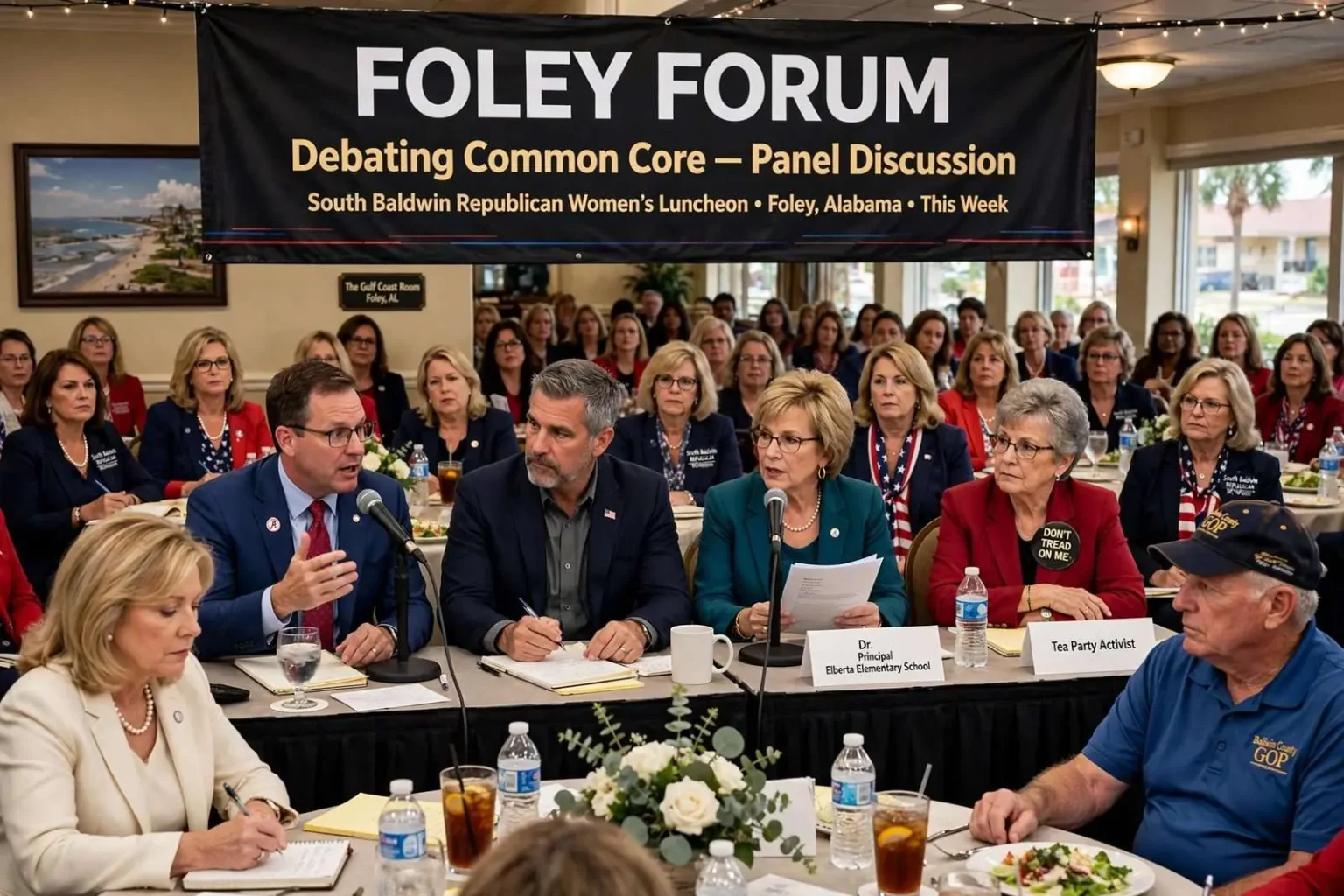
FOLEY, Alabama — About 100 people packed a luncheon at a Foley restaurant this week to hear a pointed but civil debate over Common Core, the education standards that have split Alabama Republicans for years. The crowded room in one of Baldwin County’s fastest-growing cities reflected how much staying power the standards fight has had in Alabama politics, where the issue has divided state boards, legislative sessions and county party organizations since the standards were adopted more than a decade into the modern accountability era.
A panel divided
The South Baldwin Republican Women’s club, which has not taken an official position on Common Core, organized the panel and stacked it with voices on both sides of the issue. The club’s neutrality was deliberate: rather than staging a rally, organizers wanted a forum where the arguments could be heard back to back, and the standing-room crowd suggested the appetite for that kind of debate in south Baldwin County remains strong.
A state Board of Education member who represents part of the state defended Alabama’s version of the standards, known officially as the College and Career Ready Standards, arguing they better prepare students to compete nationally and internationally. The defender’s case rested on the substance of the standards themselves — higher expectations in mathematics and English language arts, structured to build skills coherently from grade to grade — and on the argument that Alabama’s students compete not just with each other but with peers across the country and the world.
A conservative commentator on the panel countered that the standards amount to confusing, federally driven mandates that strip away local control of classrooms. That critique has animated the anti-Common Core movement since its beginning: whatever the standards’ academic merits, opponents argue, the process that produced them and the federal incentives tied to their adoption made them a Washington-driven project rather than a state-led reform. The result, in this view, is a one-size-fits-all framework that overrides the judgment of local school boards and the teachers who know their students.
Also on the panel were a longtime tea party activist who has traveled the state campaigning against Common Core, and the principal of Elberta Elementary School, who defended the standards by comparing trust in classroom teachers to trust in doctors: residents would not turn to a chef for a medical diagnosis, she said, and educators deserve similar deference on how children are taught. The analogy landed as one of the afternoon’s most quotable exchanges, framing the debate as a question of professional expertise versus lay skepticism — and putting the perspective of a working school administrator, rather than a politician or pundit, at the center of the discussion.
Local schools, an undecided board member and a packed room
Among those in the audience was the newly appointed state school board member for southwest Alabama, who told the crowd he remains undecided on Common Core even as he settles into representing the region on education policy. His attendance underscored how directly the debate touches Baldwin County classrooms, even though the standards themselves originated with a national governors’ group years earlier. The board member’s presence mattered for practical reasons as well: the state board holds the authority to revisit, revise or replace Alabama’s standards, and a member still weighing the question represents exactly the audience both sides were courting at the luncheon.
The Common Core standards trace their origins to the National Governors Association and state education leaders who sought common academic expectations across state lines, on the theory that a student moving from one state to another — or entering college or the workforce — should not find the bar dramatically different depending on geography. Alabama adopted its version as the College and Career Ready Standards, aligning state assessments and classroom instruction with the new benchmarks. That national origin is precisely what opponents point to when they argue the standards were never a homegrown Alabama reform, and the tension between the two framings ran through the entire afternoon.
For Baldwin County specifically, the stakes are concrete. The county school system is one of Alabama’s largest by enrollment and geography, stretching from Gulf Shores and Orange Beach to Bay Minette, with campuses in Foley, Elberta, Robertsdale, Summerdale, Silverhill, Loxley, Daphne, Spanish Fort and Fairhope. Whatever the state board decides about the standards determines what teachers across those communities are trained on, what textbooks align with, and what the state’s standardized tests measure — decisions that shape classrooms from the Gulf to the causeway.
Audience questions probe the classroom details
Audience questions ranged from whether required reading lists under Common Core included books with mature content, to whether the standards emphasize group-based learning methods over getting to correct answers quickly. Panelists disagreed on both points, with the standards’ defenders noting that curriculum decisions — which books appear in which classrooms — remain in the hands of local districts and teachers rather than the standards document itself, which specifies skills and expectations rather than reading titles.
On the mathematics criticism, the debate mirrored the argument playing out in family kitchens across Alabama: parents puzzled by homework that asks students to explain multiple solution strategies, and educators who argue the approach builds deeper number sense even when it slows down the pursuit of a right answer. The standards’ defenders say the methods prepare students for higher-level mathematics by teaching why procedures work; critics say they confuse parents, frustrate students who already know the answer, and substitute process for mastery.
A civil argument that keeps going
What the Foley forum demonstrated — and what organizers said they intended — was that the two sides can share a stage without the discussion collapsing into shouting. The South Baldwin Republican Women’s club’s decision to host a genuinely two-sided panel on an issue that has fractured Republican politics in Alabama set the luncheon apart from the usual advocacy event, and the packed room suggested that Baldwin County residents wanted to hear the full argument rather than a sermon for one side.
The divisions on display in Foley reflect a broader pattern. State legislatures across the country have debated repeal bills; several states have withdrawn or rebranded the standards; and in Alabama the fight has surfaced in state board elections, legislative sessions and party platforms, with Republican voters themselves split between the standards’ conservative defenders — who argue that high, comparable expectations are pro-family and pro-market — and its conservative critics, who see federal overreach in anything with Washington’s fingerprints. The debate has rarely turned on a single fact; it turns on how much faith a community places in professional educators, in state control, and in the value of common national benchmarks.
Both sides at the luncheon agreed on at least one thing: the person closest to the child matters most. The Elberta Elementary principal’s doctor-versus-chef analogy was offered in defense of professional judgment, but even the panel’s skeptics framed their objection as a defense of teachers freed from mandates imposed from above. The room left with no consensus — that was never the goal — but with a clearer picture of what each side actually believes, and with the southwest Alabama’s newest state board member still carrying his undecided vote into the policy fight that will settle it.
The tea party activist’s statewide campaigning gives a sense of how the anti-Common Core movement has operated in Alabama. Rather than a single organization, the opposition has functioned as a loose network of parent groups, activists and sympathetic legislators, with speakers traveling from county to county carrying the same core arguments — federal overreach, local control, and classroom confusion — to civic clubs, church fellowship halls and party luncheons much like the one in Foley. The luncheon circuit matters in Alabama politics: the state’s Republican supermajority was built from the ground up in exactly these rooms, and activists on both sides of the standards fight treat them as the entry point for persuasion.
Foley itself is an apt host for the debate. The city sits at the heart of south Baldwin County’s growth corridor along Alabama Highway 59, where years of rapid residential development have filled classrooms as fast as the county can build them, and where new arrivals from other states often carry their own expectations — and their own home states’ policies — into local school discussions. A growing system with rising enrollments makes every state-level academic decision land harder locally, because the county is actively hiring teachers, adopting curricula and opening campuses while the debate continues.
Organizers said they hope the forum models how the community can continue discussing the issue: directly, with both sides represented, and with the people who actually run classrooms — principals and teachers — given a voice equal to the politicians and commentators. Whether the state board ultimately revises the standards or keeps them in place, the decisions will be made in Montgomery by members like the newly appointed southwest Alabama board member who watched the debate unfold from the audience, still undecided, as his region’s neighbors made their cases.