Investigator: Suspect in Fatal Foley Crash Tested Positive for Alcohol, Marijuana
A Summerdale man accused of leading deputies on a chase before a fatal Foley crash tested positive for alcohol and marijuana, an investigator testified.
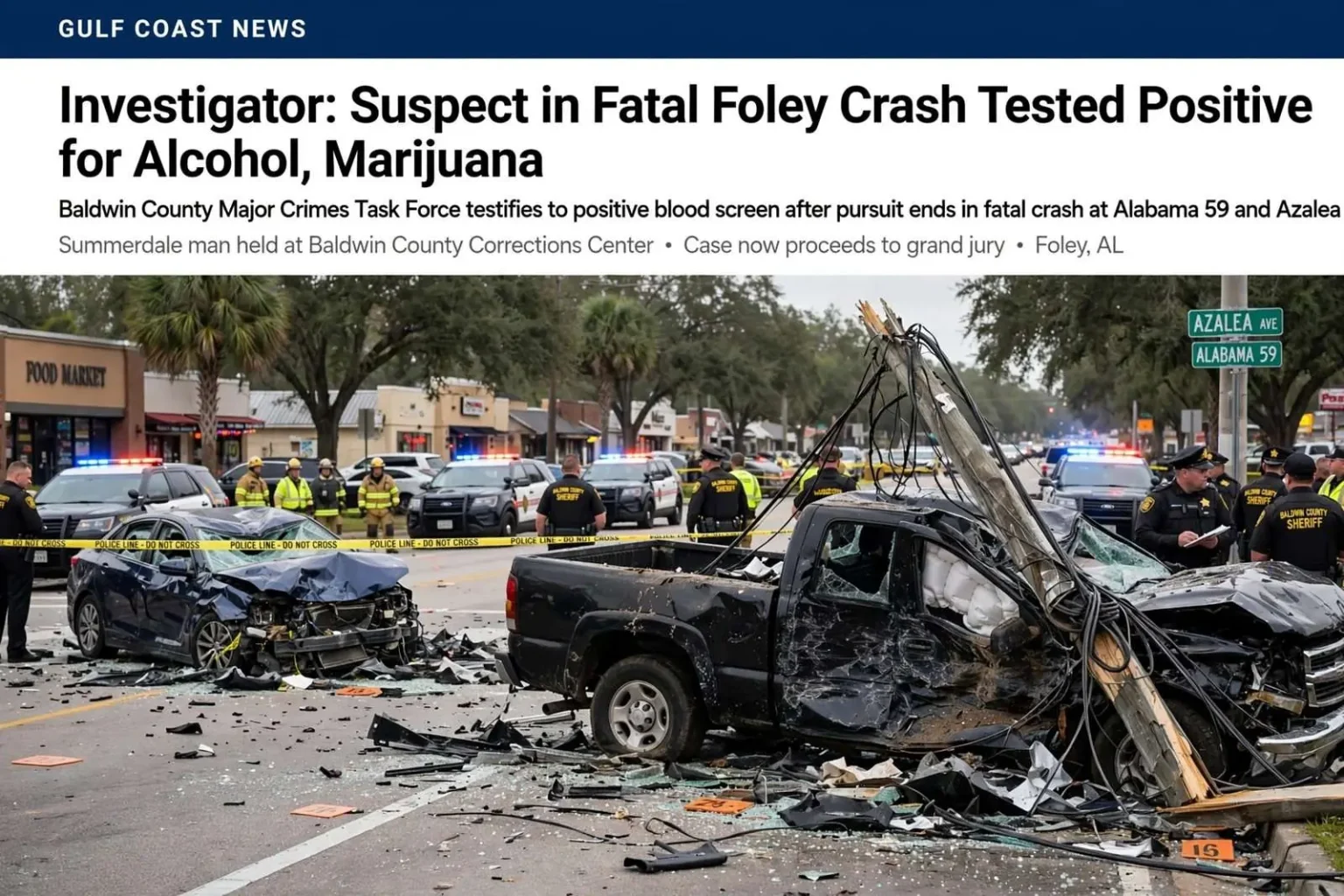
A Summerdale man accused of leading Baldwin County deputies on a chase that ended in a fatal crash in Foley tested positive for both alcohol and marijuana, an investigator testified at a preliminary hearing. The 30-year-old defendant is accused of running a red light at Alabama 59 and Azalea Avenue and slamming a pickup truck into a car driven by a 42-year-old Foley man, who died in the crash.
The testimony added a chemical foundation to what had already been a detailed account of the pursuit, and it came at the first major procedural checkpoint in the case. Preliminary hearings in Alabama district court exist to answer one question — whether probable cause exists to hold the defendant for the grand jury — but they also produce the first public, sworn account of what happened, which is how the details of this chase entered the record.
What the Blood Tests Showed
A Daphne Police Department detective, assigned to the Baldwin County Major Crimes Task Force, testified that hospital blood tests taken after the wreck came back positive for alcohol and marijuana, with additional samples still pending further analysis from the Alabama Department of Forensic Sciences. The distinction matters in DUI-related prosecutions: hospital screenings can establish the presence of substances quickly, but the forensic sciences laboratory runs the confirmatory testing that courts rely on for precise measurements, and those results remain part of the case as it moves forward.
The detective’s assignment to the task force reflected how the county investigates its most serious cases. The Baldwin County Major Crimes Task Force draws investigators from multiple municipal departments and the sheriff’s office, pooling resources for homicides, fatal crashes and other major felonies that exceed any single agency’s capacity. A Daphne detective handling a Foley crash is the task force model at work — the investigator’s own city has no stake in the prosecution, which helps insulate the case from jurisdictional appearances.
How the Chase Began
According to testimony, the chain of events began when a Baldwin County Sheriff’s lieutenant, driving an unmarked vehicle, noticed the pickup speeding south in a turning lane on Alabama 59 and passing other vehicles. The lieutenant activated his siren and lights and pulled alongside the truck, identifying himself and telling the driver he was being stopped for reckless driving.
Instead of stopping, the driver said he intended to continue on to a nearby restaurant and could be stopped there, according to testimony. When the driver failed to pull over, additional marked patrol units joined the pursuit.
That exchange — a warning shot across the bow of a driver who kept going — became central to the prosecution’s account. Alabama law treats fleeing or attempting to elude a law enforcement officer as its own offense, and the testimony laid out a driver who not only failed to stop but stated a position: that he would decide where the stop happened. From the state’s perspective, everything that followed traces back to that decision.
The detective testified that the driver briefly stopped at a red light, then sped off again when a deputy approached on foot, cutting through an apartment complex parking lot at roughly 50 mph and a grocery store parking lot at about 40 mph before returning to Alabama 59. The details carried weight beyond their drama: speeds like those through parking lots, where pedestrians and parked cars are constants, formed the basis of the reckless endangerment charge alongside the fleeing counts, and the route showed a driver maneuvering specifically to avoid capture rather than merely outrunning a traffic stop.
The Crash and the Capture
The truck ultimately collided with the victim’s car at the Azalea Avenue intersection, then struck a light pole and overturned. The driver ran from the wreck but was quickly captured by deputies, who testified they could smell alcohol on his breath at the scene.
The intersection where the collision occurred sits along the commercial spine of Foley, where Alabama 59 carries local traffic, beach-bound summer travelers and freight through the heart of the city. A crash of that force — impact, then a light pole, then an overturned truck — in such a corridor left the victim’s car destroyed and closed the intersection for the investigation that followed. The 42-year-old driver of the car, a Foley man, was killed in the collision.
The attempted flight ended quickly, and the deputies’ observations at the scene — the smell of alcohol, the driver’s condition — joined the hospital blood results and the forensic laboratory’s pending analysis as the evidentiary spine of the state’s case. In prosecutions built on chases, the first minutes after capture are often where the strongest testimony originates, and the hearing’s account suggested investigators moved to preserve all of it.
Probable Cause, and What Comes Next
Following the hearing, a district judge ruled there was sufficient probable cause for the case to proceed to a Baldwin County grand jury. The defendant faces charges including manslaughter, attempting to elude police, reckless endangerment and driving with a suspended license. He remains held at the Baldwin County Corrections Center.
Manslaughter is among the most serious charges available in a vehicle death that does not involve intent to kill. Under Alabama law, the offense covers causing a death recklessly, and prosecutors use it when a defendant’s conduct — here, a high-speed flight through commercial corridors while under the influence — shows a conscious disregard for a known risk. The charge carries a potential prison sentence measured in years, and it dwarfs the traffic-related counts filed alongside it, though prosecutors point out that the eluding and endangerment charges tell the same story from different angles.
The grand jury stage shifts the case from a hearing to a closed proceeding. A Baldwin County grand jury will hear the state’s evidence — the chase testimony, the blood results, the forensic findings — and decide whether to return an indictment. If it does, the case moves to circuit court, where felony prosecutions are tried. If it does not, the case ends there. The hearing’s probable-cause ruling is not a verdict, but it is the system’s judgment that the evidence, taken as true, supports the charges.
A Baldwin County assistant district attorney said prosecutors intend to pursue the case aggressively, emphasizing the fatal consequences of the pursuit regardless of intent. The crash and the criminal case remain under review as it heads toward grand jury consideration.
The message to the court was consistent with how DUI-death cases are handled across Alabama: the state does not have to prove the defendant meant to hurt anyone, only that his choices — drinking, then driving, then fleeing — made the death foreseeable. The victim’s family, meanwhile, will watch the case advance through a process that begins, formally, with the grand jury’s review of an account already laid out in sworn testimony: a chase that started with a turning lane on Alabama 59 and ended at a red light at Azalea Avenue, where a Foley man was simply driving home through his own city.
The Forensic Work Behind the Charges
The pending analysis from the Alabama Department of Forensic Sciences will occupy a central place in the case as it advances. Confirmatory blood testing at the state laboratory can quantify both the alcohol concentration and the presence of marijuana metabolites, converting the hospital’s positive screens into measurements that toxicologists can interpret. In prosecutions involving both substances, defense counsel frequently examine the timeline of ingestion, the reliability of the draw and the chain of custody, and the laboratory’s reports — once completed — become exhibits the grand jury and any trial jury will weigh.
Toxicology in combined alcohol-and-marijuana cases is famously complex, because the two substances affect driving differently and their combined effects are harder to characterize than either alone. Prosecutors do not need to prove a specific number for the marijuana component; the charge rests on the driver’s overall condition behind the wheel and the reckless conduct the chase documented. The alcohol readings, however, will matter to the manslaughter count, where the defendant’s impairment helps establish the conscious disregard the statute requires.
The pursuing deputies’ observations fill the gap between the crash and the lab. Alabama law permits officers to testify to the signs of impairment they observed — the smell of alcohol, driving behavior, the driver’s appearance and statements — and those lay-witness accounts, combined with the chase itself, can sustain a DUI-related prosecution even before blood numbers arrive. The hearing testimony made clear that deputies documented those observations immediately at the scene, the sequence investigators prefer because it precedes any opportunity for explanation or recovery.
The Corridor Where It Happened
Anyone who drives Alabama 59 through Foley knows the setting the testimony described. The highway is the region’s main north-south artery, funneling beach traffic through a corridor of restaurants, shops and grocery stores, with cross streets — Azalea Avenue among them — feeding local residents into and out of the flow. On summer days the traffic thickens with visitors; in the off-season it carries the school runs and commutes of the people who live and work in south Baldwin County. A pursuit through that corridor, at the speeds testified to, put exactly those drivers at risk before it ended.
Foley police and fire units responded to the crash alongside the sheriff’s deputies who had been in the chase, and the intersection investigation that followed — measuring skid marks, documenting the vehicles’ final positions, canvassing for witnesses — is standard procedure for a fatal collision. Those physical findings matter in the prosecution, because they corroborate or challenge the speeds and movements the officers described. A light pole struck and a truck overturned tell their own story about the forces involved.
The case now sits where every felony in Alabama begins its serious phase: awaiting the grand jury. For the Foley man’s family, the proceeding is the first formal step toward whatever accountability the system provides, and prosecutors’ stated intention to pursue the case aggressively sets the tone for what will follow. For the defendant, the grand jury’s decision will determine whether the manslaughter charge and its companions move to circuit court, where the trial record — already built in outline through the preliminary hearing — will be filled in witness by witness, test by test.