Real Estate Roundup: Spanish Fort Apartments Fetch $15 Million as Foley’s Burger Wars Heat Up
A 216-unit Spanish Fort apartment community changed hands for more than $15 million, while Foley prepared for a burger showdown and Gulf Shores saw a former Resort Quest building sell.
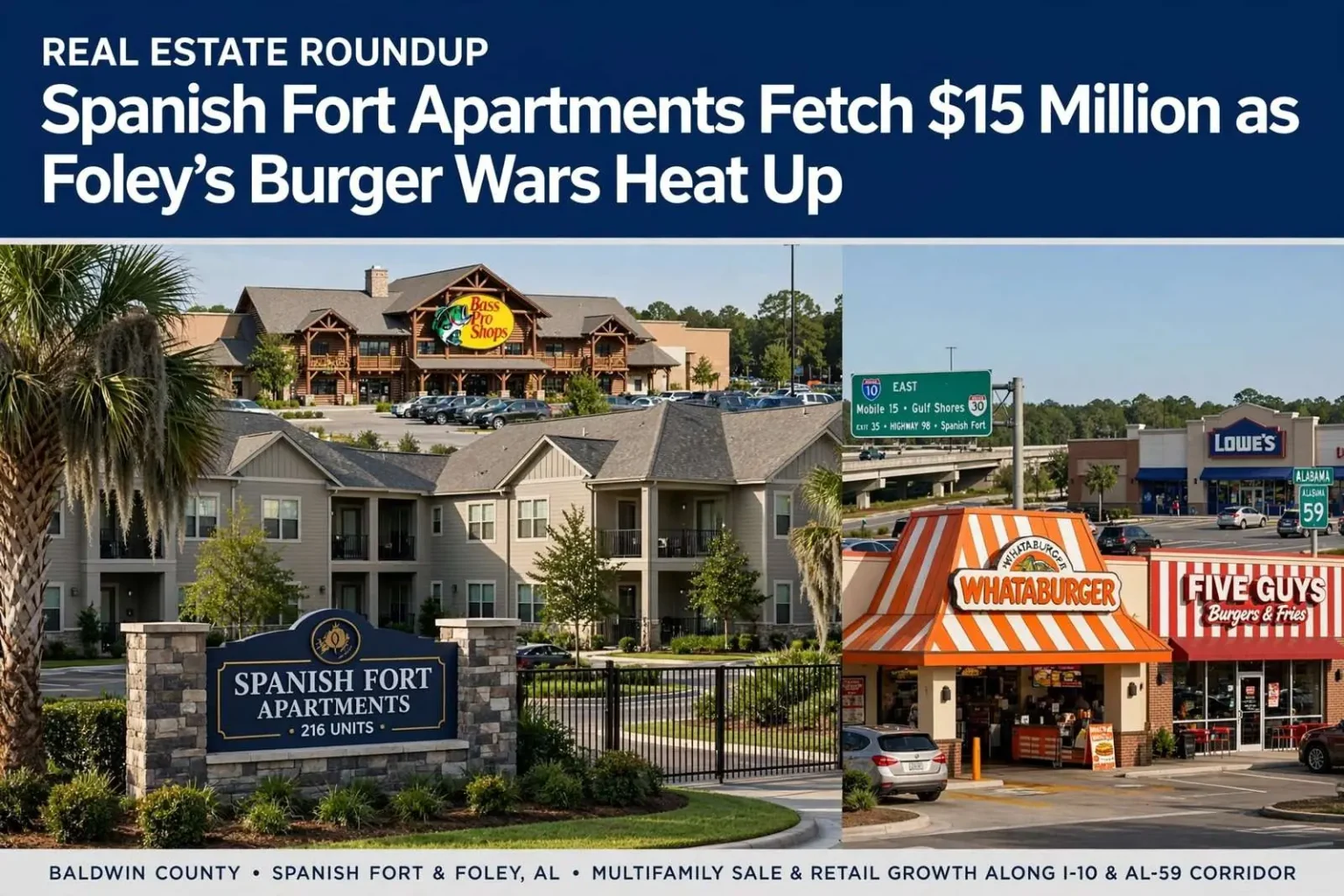
Investors paid more than $15 million for Spanish Fort Apartments, a 216-unit community located behind the Bass Pro Shops off Interstate 10 in Spanish Fort, records showed. The gated complex had been controlled by Bank of America and the Baldwin County Circuit Court, a disposition that traced back through foreclosure proceedings before the property found new institutional ownership. Cushman & Wakefield handled the sale, and Surety Land Title in Mobile managed the closing. The transaction was one of the largest multifamily deals recorded on the Eastern Shore in that period, and it underscored how quickly the strip of Baldwin County along Interstate 10 had grown into a genuine investment market rather than a suburb defined only by its proximity to Mobile.
The complex’s location explains the price. Spanish Fort sits at the junction of Interstate 10 and Highway 98, directly across Mobile Bay from the city, and the Bass Pro Shops megastore anchored a retail cluster that draws shoppers from both sides of the bay. A 216-unit community behind that anchor sits within an easy commute of Mobile’s employment centers while offering the lower taxes, newer schools and perceived value of Baldwin County — a combination that has kept Eastern Shore apartments occupied through nearly every phase of the regional economy.
West Mobile Deals
Navigator Credit Union paid $535,000 for a 1,600-square-foot office building on 1.27 acres at 5229 Cottage Hill Road, next to the Walmart Neighborhood Market in west Mobile. David Monroe and David Milstead of Bellator Real Estate & Development represented the buyer, while Jay Roberds of NAI Mobile worked for the seller. The purchase put the credit union’s footprint on one of west Mobile’s busiest retail corridors — Cottage Hill Road functions as a commercial spine for the neighborhoods south of Airport Boulevard, and the stretch near the Walmart market generates the daily traffic that branch locations compete for.
Navigating the deal required coordinating a small building and a large tract, since the acreage — 1.27 acres for a 1,600-square-foot structure — left substantial room for parking, expansion or redevelopment, which is typically the point of buying a corner parcel on an established corridor rather than leasing space in a multi-tenant center.
Elsewhere in west Mobile, MedPoint Medical Services leased 6,200 square feet at 1000 Hillcrest Road. Angela McArthur of the Prudential Cooper & Co. commercial division represented the tenant, and Jill Meeks of John Toomey & Co. worked for the landlord. Medical users have long been a stabilizing force in Mobile’s office market: physicians and healthcare service companies sign longer leases than most office tenants, invest in build-outs, and draw patient traffic that benefits neighboring businesses. The Hillcrest Road location places the practice among the medical offices and clinics clustered in the west Mobile area, where the concentration of providers makes referrals and shared patients a practical daily reality.
Together, the two west Mobile transactions showed a market functioning at the smaller scale that defines most commercial activity in any city — a credit union buying a branch site, a medical services company securing space — even as the larger multifamily deal across the bay drew the headlines. Local brokerages on both sides of these deals, including Bellator, NAI Mobile, Prudential Cooper & Co. and John Toomey & Co., handled the kind of repeat, relationship-driven business that makes up the base of the Mobile area’s commercial real estate economy.
A Foley Burger Showdown
Foley was shaping up as a battleground for fast-casual burgers, a competition that said as much about the city’s growth trajectory as about anyone’s hamburger. Construction was under way on a Whataburger on Alabama 59, in front of the Lowe’s Home Improvement Warehouse and adjacent to a Five Guys Burgers location. The Texas-based Whataburger chain has a devoted following across the Gulf South, and its arrival on a corridor already occupied by Five Guys — a fast-casual chain that had been expanding aggressively — created an unusually direct head-to-head matchup for the dining dollars of shoppers headed to and from the big-box stores.
Restaurant chains do not site restaurants by accident, and the logic of the cluster was transparent. Alabama 59 is Foley’s main commercial artery, running south toward Gulf Shores, and the Lowe’s parcel sits amid the retail concentration that serves both local residents and the heavy beach-bound traffic that passes through the city on summer weekends. A burger customer counts as a stop on the way home from the home-improvement store; a family driving to the coast plans its meals around exactly this kind of interchange of fast-casual options. Whataburger’s bet was that brand loyalty could pull drivers out of a crowded field; Five Guys’ presence suggested its operators believed the traffic could support everyone.
Observers also expected Big Lots to build a store in front of the same Lowe’s later in the year, adding a discount retailer to the mix. The pattern — anchor big-box, surrounded by quick-service restaurants and value retail — is the standard template of commercial development in growing Southern cities, and Foley was executing it along a corridor with room to expand in both directions.
Foley Plaza Adds Tenants
Two more tenants had signed on at Foley Plaza on Alabama 59, according to Steve Ladas of Ladas Development: Little Caesars Pizza, which planned to open in 2,000 square feet, and Outlaw MMA, a mixed martial arts training facility that had opened in 3,500 square feet. The pairing illustrated the range of uses a well-positioned strip center can attract in a growing market — a national pizza brand filling a compact footprint with takeout volume, alongside a locally operated fitness business that needed open floor space, matting and the kind of high ceilings that second-generation retail space can sometimes provide affordably.
Ladas Development’s activity at Foley Plaza reflected the broader leasing environment in Baldwin County at the time. The county had been among the fastest-growing in Alabama for years, driven by the Eastern Shore’s residential boom and the permanent population that the beach tourism economy supports, and national tenants followed the rooftops. Every new subdivision south of the interstate represents customers for the pizza chain, the gym, and the burger restaurants competing down the highway — which is why retail leasing in Foley tracked the county’s housing data so closely.
Gulf Shores Sale
Local investors paid $615,000 for the former Resort Quest building on Alabama 59 in Gulf Shores, according to David Milstead of Bellator, who represented the buyers. Melissa White of REMAX Paradise represented the seller. The building was to be updated and offered for lease, possibly as second-floor executive suites — a telling reuse for a beach town whose commercial strip was maturing beyond its tourism-only roots. Gulf Shores by then supported a year-round business community of property managers, contractors, insurance agencies and real estate brokerages, and office space for professional tenants had become a viable product in a market once dominated entirely by condominiums, gift shops and restaurants.
The buyers’ plan — acquire, renovate, and lease — is the classic value-add formula of small commercial investment, and its presence in Gulf Shores showed how far that investment logic had spread down the Alabama 59 corridor from Spanish Fort to the coast.
Reading the Baldwin County Numbers
The Spanish Fort Apartments sale rewards a closer look at the arithmetic. A $15 million-plus price for 216 units works out to roughly $70,000 per unit — a level that only penciled for buyers who believed Baldwin County rents would keep climbing alongside the county’s population growth. Institutional buyers of that kind of property underwrite occupancy, rent growth and deferred maintenance with the same discipline whether the complex is in Atlanta or Spanish Fort, and the fact that a disposition controlled by a national bank and settled through Baldwin County Circuit Court attracted that level of bid said something about how far the county’s reputation as an investment market had traveled.
The bank-and-courthouse control of the property was itself a artifact of the era. Foreclosed or distressed assets flowed through lenders and courts in the years after the downturn, and sales like this one — brokered by a national firm such as Cushman & Wakefield, closed by a Mobile title company such as Surety Land Title — represented the point at which distressed property returned to productive institutional ownership. For renters, the change of hands at the top rarely alters the daily experience of the complex, but it typically brings capital budgets for roofs, parking and unit upgrades that distressed ownership defers.
Why the Interstate 10 Corridor Works
Spanish Fort’s rise is inseparable from its geography. The city occupies the high ground on the east side of Mobile Bay where Interstate 10 crosses the BLT — the Blakeley, D’Olive and U.S. 98 interchange area that developers prize because it captures traffic in every direction. Commuters reach downtown Mobile in minutes via the Bankhead and Cochrane-Africatown bridges; shoppers reach the Eastern Shore Centre and the big-box cluster around Bass Pro without fighting Mobile’s surface streets; and beach traffic headed down Highway 98 to Fairhope, Point Clear and the passes rolls past the community’s front door. An apartment community behind the Bass Pro sits inside all of those catchments at once, which is precisely what a multifamily buyer is paying for.
Across the bay, the west Mobile deals told the complementary story. Cottage Hill Road and Hillcrest Road anchor the residential southwest quadrant of the city, and the transactions there — a credit union buying its own building, a medical services firm taking 6,200 square feet — reflect the day-to-day commercial activity that follows rooftops. Navigator Credit Union, a longstanding Mobile-area institution serving the Gulf Coast, buying rather than leasing on Cottage Hill Road signals the same confidence in the corridor that the multifamily buyers signaled across the bay.
The Corridor From Bay to Beach
What linked the week’s transactions was geography as much as economics: every property involved sat along the U.S. 59, Highway 98 and Interstate 10 spines that tie Mobile Bay’s economies together. The Spanish Fort complex serves commuters and Eastern Shore renters. The Foley parcels serve the permanent population that has grown up around the beach resort economy — the teachers, contractors, restaurant workers and retirees who need burgers, pizza, hardware and groceries year-round. The Gulf Shores office building serves the professional services layer that mature resort towns develop once the tourism base is established.
Taken together, the transactions pointed to steady commercial momentum across the Mobile Bay area, from multifamily investment in Baldwin County to the retail and restaurant expansion reshaping the Alabama 59 corridor in Foley. None of the deals involved the showy office towers or industrial mega-sites that make regional headlines, and that is exactly what made them representative: the Mobile Bay economy in this period was being built transaction by transaction — apartment communities changing hands, credit unions buying branch sites, pizza chains and gyms signing leases in strip centers — at a scale visible mostly in land records, court filings and the storefronts multiplying along the highways between the bay and the beach.