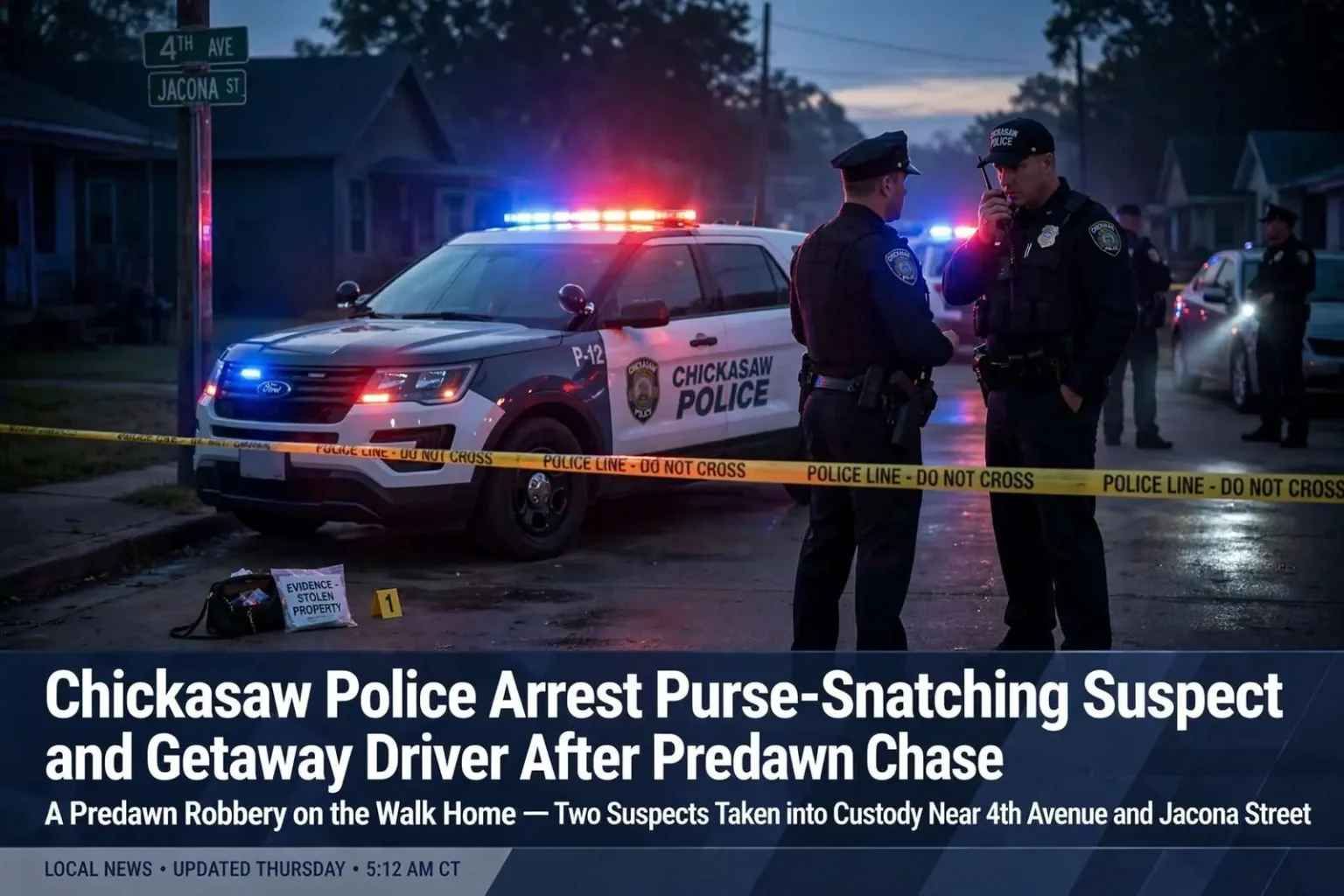
Chickasaw Police Arrest Purse-Snatching Suspect and Getaway Driver After Predawn Chase
Chickasaw police arrested a juvenile and a 20-year-old man after a woman's purse was snatched near 4th Avenue and Jacona Street.
A Predawn Robbery on the Walk Home
Chickasaw police arrested two suspects early one Thursday morning after a woman reported that her purse had been torn from her hands while she was walking home before dawn. Officers took a 20-year-old Mobile resident, identified as Joshua Lendarius Epps Jr., and an unnamed juvenile into custody around 5 a.m., both facing charges of second-degree robbery. The juvenile also faced an additional charge of third-degree receiving stolen property.
Epps was later booked into the Mobile County Metro Jail, while the juvenile suspect was taken to the Strickland Youth Center, the facility that handles juvenile detentions for Mobile County. The split shows how the justice system sorts such cases: the adult answering charges in the county jail system, the juvenile processed through the youth court track with its own rules on detention and confidentiality. Because the juvenile was not named, police released no further identifying details about the younger suspect.
According to Chickasaw police, the incident began about an hour before the arrests when the victim was knocked to the ground near the intersection of 4th Avenue and Jacona Street. One of the suspects snatched her purse and fled on foot. Rather than losing sight of him, the woman followed closely enough to watch him jump into a waiting vehicle, which then sped away. She was able to write down the car’s license plate number and provide a description to responding officers.
The Victim Who Followed
Using that information, police located the vehicle nearby on the 60 block of 10th Avenue and found both suspects in the area. The recovery came together quickly because the victim had given investigators exactly what a fast-moving street robbery usually denies them: a plate number, a direction and a description — all gathered in the minutes after she had been knocked to the ground.
During a post-arrest interview, investigators determined that Epps had served as the getaway driver while the juvenile carried out the actual purse snatching. The victim later identified the juvenile as her attacker in a police lineup. The division of roles is a pattern police see repeatedly in street robberies — one suspect commits the snatch while another waits behind the wheel — and establishing it matters for charging, since the driver’s role supports the same robbery count as the hands-on offense.
The Purse, the Rifle and the Second Investigation
Investigators recovered the stolen purse inside a trash bin in front of the business where Epps worked. But while searching that business, officers also found a .223-caliber rifle that had been reported stolen from the Mobile County Sheriff’s Office months earlier, adding a separate line of investigation to the case. The discovery transformed a street robbery arrest into a multi-agency matter involving stolen county property.
A stolen rifle turning up in a trash-bin search is the kind of development that rippled well beyond the original case. The .223-caliber weapon, reported stolen months earlier from the sheriff’s office, raised immediate questions about where it had been since the theft, how it came to be at the business, and whether additional charges would follow for anyone connected to its possession. Police did not say whether the rifle’s discovery would produce new counts against Epps, the juvenile, or anyone else.
The recovery also illustrates why officers search thoroughly at the scene of an arrest rather than stopping at the item first reported stolen. A purse in a trash bin is evidence of a robbery; a stolen rifle behind it is evidence of something larger, and locating it before it moved again kept a dangerous weapon off the street and returned it to the agency that lost it.
Charges and What Comes Next
Both suspects were charged with second-degree robbery, the count that applies when force is used during a theft — here, knocking the victim to the ground as the purse was torn from her hands. The juvenile’s additional third-degree receiving stolen property charge suggests property beyond the purse itself was connected to the younger suspect, though police did not detail what it covered.
Epps was released on bond following his arrest, with a court date set for later in the month. From there, the case moves through the standard path: arraignment, discovery, and either a plea or trial in Mobile County’s courts. The juvenile’s case proceeds separately in the youth court system, where proceedings are closed and outcomes are handled under juvenile law rather than adult sentencing.
Why the Plate Number Mattered
Chickasaw police credited the victim’s quick thinking in tracking the getaway vehicle’s license plate as a key factor in identifying and arresting the suspects so quickly. In most street robberies, the suspect is a stranger, the encounter lasts seconds, and the only description officers receive is fragments recalled after the fact. Here, the victim turned those odds around: she followed the fleeing suspect on foot, watched him enter a waiting car, and wrote down the plate before the vehicle disappeared.
That single act compressed an investigation that often takes days into about an hour. A plate number converts an anonymous crime into a searchable record; a vehicle located on the 60 block of 10th Avenue put officers within feet of both suspects within the hour. Police noted the arrests came around 5 a.m., roughly an hour after the robbery near 4th Avenue and Jacona Street — a timeline made possible almost entirely by the information the victim provided.
Safety experts generally caution robbery victims against pursuing suspects, and the outcome here was fortunate rather than a recommendation. But the principle that made the difference — noticing and recording details instead of discarding them — costs nothing and carries no risk. Writing down a plate number from a distance gave investigators everything they needed without the victim placing herself in further danger.
Robbery Response in a Small City
The case is also a snapshot of how police work proceeds in Chickasaw, the small city north of Prichard whose department handles the full range of municipal calls with a compact roster of officers. A predawn street robbery tests that capacity: patrol officers secured the scene, took the victim’s detailed statement, ran the plate, located the vehicle, and coordinated the arrests of both an adult and a juvenile within roughly sixty minutes.
The interagency elements show how a small department’s cases extend outward. The adult suspect was booked into the Mobile County Metro Jail, which serves the county’s municipalities; the juvenile went to the Strickland Youth Center; and the stolen rifle recovered at the scene brought the Mobile County Sheriff’s Office’s own theft case back into play. What began as one woman’s walk home ended with two robbery charges, a recovered purse, a recovered county rifle and a second investigation opened in a single morning.
Inside the Charges: Second-Degree Robbery
Second-degree robbery under Alabama law covers thefts accomplished by force or the threat of force, and the facts police described fit the statute precisely: the victim was knocked to the ground so her purse could be torn from her hands. The felony classification matters for what follows — a robbery conviction carries prison exposure far beyond a theft charge, and the force element is what separates the two.
For the adult defendant, the charge follows him from the county jail booking through the district court process. Bond was set and met, with a court date scheduled later in the month, and prosecutors will now evaluate the full file: the victim’s statement, the lineup identification of the juvenile, the interview in which investigators say Epps acknowledged driving the getaway car, and the physical evidence from the scene and the search of his workplace.
The juvenile’s path runs differently. Cases in the youth court system are built around rehabilitation as much as accountability, and detention at the Strickland Youth Center is a holding measure pending proceedings rather than a sentence. The additional receiving-stolen-property count will be resolved in that same closed process, which does not produce a public record the way adult court does.
The Rifle Investigation That Remains Open
The .223-caliber rifle’s recovery left a thread the robbery arrests did not tie off. The weapon had been reported stolen from the Mobile County Sheriff’s Office months earlier, and its appearance at the business where Epps worked raises questions police have not publicly answered: who took it from the agency, how it traveled to Blackburn-area Chickasaw, and whether anyone will face charges for its possession during those months.
Stolen firearms cases are treated seriously in Alabama, where illegal gun possession carries its own felony exposure, and a weapon with a documented theft from a law enforcement agency draws particular scrutiny. Investigators have the advantage of a documented chain: the theft report from months earlier, the discovery during a lawful search, and two suspects already in custody. Whether that thread produces new charges — against Epps, the juvenile or others — remains the open question in a case that otherwise moved from report to arrests in about an hour.
For the victim, the outcome delivered what the criminal justice system promises most unevenly: her property recovered, two suspects charged and a court date on the calendar. For Chickasaw police, it was a predawn case that confirmed the department’s working rule — that the difference between a cold street robbery and a solved one is often a single license plate number written down in the dark.