Mount Vernon Shooting Investigated as Possible Self-Defense Case, Sheriff’s Office Says
Mobile County Sheriff's deputies are investigating a Sunday morning shooting near Mount Vernon after a man admitted to firing in what he called self-defense.
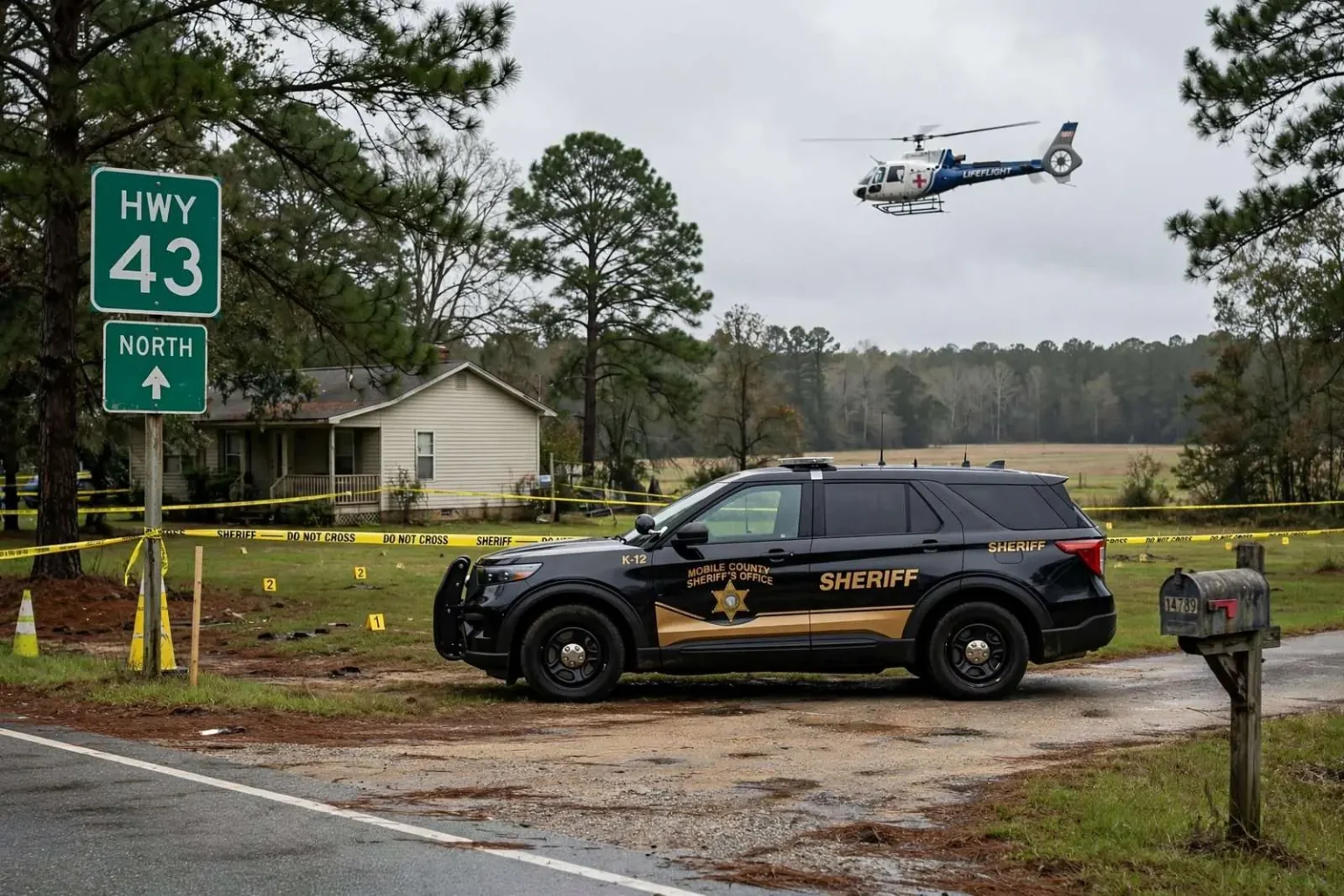
Mobile County Sheriff’s deputies are investigating a Sunday morning shooting near Mount Vernon after a local man came forward and admitted to firing the shots, telling investigators he acted in self-defense. The case, which unfolded along a stretch of Highway 43 in the northeastern corner of the county, left a 25-year-old man hospitalized and raised immediate questions about how Alabama’s self-defense laws will apply to the circumstances detectives documented at the scene.
Deputies responded to a report of a man shot along Highway 43 and found the 25-year-old victim suffering from two gunshot wounds inside a vehicle. He was flown by helicopter to a hospital with injuries described by the sheriff’s office as not life-threatening. The decision to airlift rather than transport by ground reflected the seriousness of the initial report, though authorities later confirmed the victim was expected to survive.
The medical response drew on resources common to rural Mobile County, where serious trauma cases are often flown to hospitals in Mobile or across state lines because of the distance involved. Helicopter transport can cut a trip that might take an hour by ground down to a matter of minutes, a difference that frequently determines outcomes in rural shootings and crashes. Residents along Highway 43 are accustomed to seeing medical helicopters overhead, but Sunday’s flight marked the first time in recent memory that one had been summoned to the area for a shooting.
An Uncooperative Victim, a Voluntary Confession
According to a sheriff’s office spokeswoman, detectives initially had difficulty piecing together what happened because the victim was uncooperative at the scene. Investigators who are unable to interview a wounded party typically turn to physical evidence, witness canvassing and area cameras, and that is the route deputies took as they returned to the neighborhood to retrace the moments before the shooting.
When investigators returned to the area, they were met by a 25-year-old man who acknowledged shooting the victim and said he had done so to defend himself. The admission is a notable detail in a case of this kind, since investigators say people involved in shootings frequently flee the scene or decline to speak with deputies at all. By coming forward, the man placed his own account on the record from the earliest stage of the investigation.
Deputies secured both the residence and the vehicle as part of the initial response, treating the front yard and the roadway as one continuous scene until detectives could document every piece of evidence in place. Shell casings, weapons and vehicle positions are photographed and measured before anything is moved, because the geography of a shooting scene often tells investigators as much as witness statements do. In rural areas like northeastern Mobile County, where doorbell cameras and security systems are less common than in the city, physical evidence carries even more weight in reconstructing events.
Mount Vernon is a small town of roughly 1,500 residents tucked into the rural northeastern edge of Mobile County, an area where Highway 43 serves as the main north-south corridor linking the communities around Mount Vernon and Citronelle to the rest of the county. Incidents involving gunfire are rare in the town, and Sunday’s shooting drew immediate attention from residents in a community where many people know their neighbors by name.
The Sheriff’s Office covers one of the largest geographic territories of any law enforcement agency in Alabama, patrolling unincorporated communities spread across more than 1,200 square miles from the Mississippi state line to Mobile Bay. Deputies from the precincts that serve the county’s northern communities handled the initial response on Sunday, with detectives from the major crimes section taking over the investigation once the scope of the shooting became clear. The agency has stressed that cooperation from residents in rural areas often makes the difference in cases like this one, where camera coverage is sparse and witnesses are few.
What Deputies Found at the Scene
Detectives recovered spent shell casings in the shooter’s front yard along with a loaded ammunition magazine. Inside the victim’s vehicle, deputies found a handgun and a short-barreled shotgun, items that became central to the account both parties ultimately provided. The presence of multiple weapons on both sides of the encounter gave investigators a more complex picture than a one-sided ambush would have produced.
Investigators said evidence at the scene supported the account that the man who fired the shots was on his own property at the time and that gunfire was exchanged between both parties. That combination — a shooter located at his residence and an exchange of fire rather than a single direction of attack — is precisely the sort of scenario Alabama’s self-defense statutes were written to address, and it will now fall to prosecutors and a grand jury to weigh whether the legal standard was met.
The sheriff’s office said the case would be presented to a Mobile County grand jury for review, a standard step in cases involving self-defense claims. Grand juries in Mobile County hear evidence presented by the District Attorney’s Office and decide whether probable cause exists to return an indictment. The process allows prosecutors to evaluate self-defense assertions against physical evidence before any charges are filed, and it can end with no charges at all if the panel finds the use of force was justified.
The grand jury route also gives the sheriff’s office breathing room in high-profile or legally sensitive cases. Rather than making an arrest decision within hours of a shooting, investigators can complete forensic work, ballistics testing and follow-up interviews before the case reaches the panel. Prosecutors in Mobile County have used the process in previous self-defense cases to lay out the full evidentiary picture, including scenes reconstructed from shell casing placement and witness accounts, before any determination is made about criminal responsibility.
Alabama’s Self-Defense Framework
Alabama’s self-defense laws generally allow the use of deadly force when a person reasonably believes it is necessary to prevent death or serious injury on their own property. The state is among those with strong protections for people who use force to defend their homes, and courts have repeatedly upheld the principle that individuals do not have a duty to retreat when attacked in a place they have a right to be. Still, the law does not offer blanket immunity: prosecutors and a grand jury ultimately determine whether a shooting meets that legal standard, and investigators must establish who initiated the confrontation and whether the force used was proportional.
The distinction matters in practice. A person who is attacked inside their home or yard generally enjoys the strongest protections the law provides, but investigators must still establish the sequence of events: who arrived first, who displayed a weapon first, and whether the person claiming self-defense could have avoided the confrontation. Short-barreled firearms such as the one found in the victim’s vehicle are also regulated under federal law, an added layer that prosecutors may examine as the case moves forward.
Legal observers note that cases involving wounded but uncooperative victims present particular challenges for prosecutors. Without a full account from the injured party, the state must rely on shell casing locations, ballistics, the positions of vehicles and weapons, and any civilian or camera evidence from the rural corridor. The findings that deputies described — casings in the front yard, weapons inside the victim’s vehicle and signs of a mutual exchange of gunfire — will all factor into how the grand jury evaluates the claim that the shooting was an act of defense rather than an act of aggression.
The Victim’s Record
Jail records show the shooting victim had been booked into the Mobile County Metro Jail in the weeks prior on drug-related charges, including possession of a controlled substance. An earlier arrest involved marijuana possession and an attempt to distribute a controlled substance. Authorities did not say whether the prior arrests had any connection to the events of Sunday morning, but the record became part of the public account of the case as details of the investigation emerged.
The Mobile County Sheriff’s Office, which patrols unincorporated parts of the county and provides coverage to communities like Mount Vernon that do not maintain their own large police forces, said the investigation remained active. Detectives continued to canvass for witnesses and review any available recordings from the Highway 43 corridor in the days after the shooting. No charges had been announced against either party at the time of the report, and the office said updates would come through the District Attorney’s Office as the grand jury process moves forward.
For residents along the rural stretch of Highway 43 where the shooting occurred, the case has renewed attention to the realities of self-defense law in Alabama — a set of statutes that give broad protection to homeowners acting in genuine fear for their lives, while requiring the state’s full legal machinery to sort out the facts whenever gunfire crosses property lines. Until the grand jury weighs the evidence, the shooting near Mount Vernon remains exactly what the sheriff’s office has called it: an open, active investigation with no final answers.