Mobile Police Bust Meth Lab on Reynolds Drive, Arrest Three
Mobile police arrested three women after discovering an active methamphetamine lab operating inside a residential home on Reynolds Drive late one night.
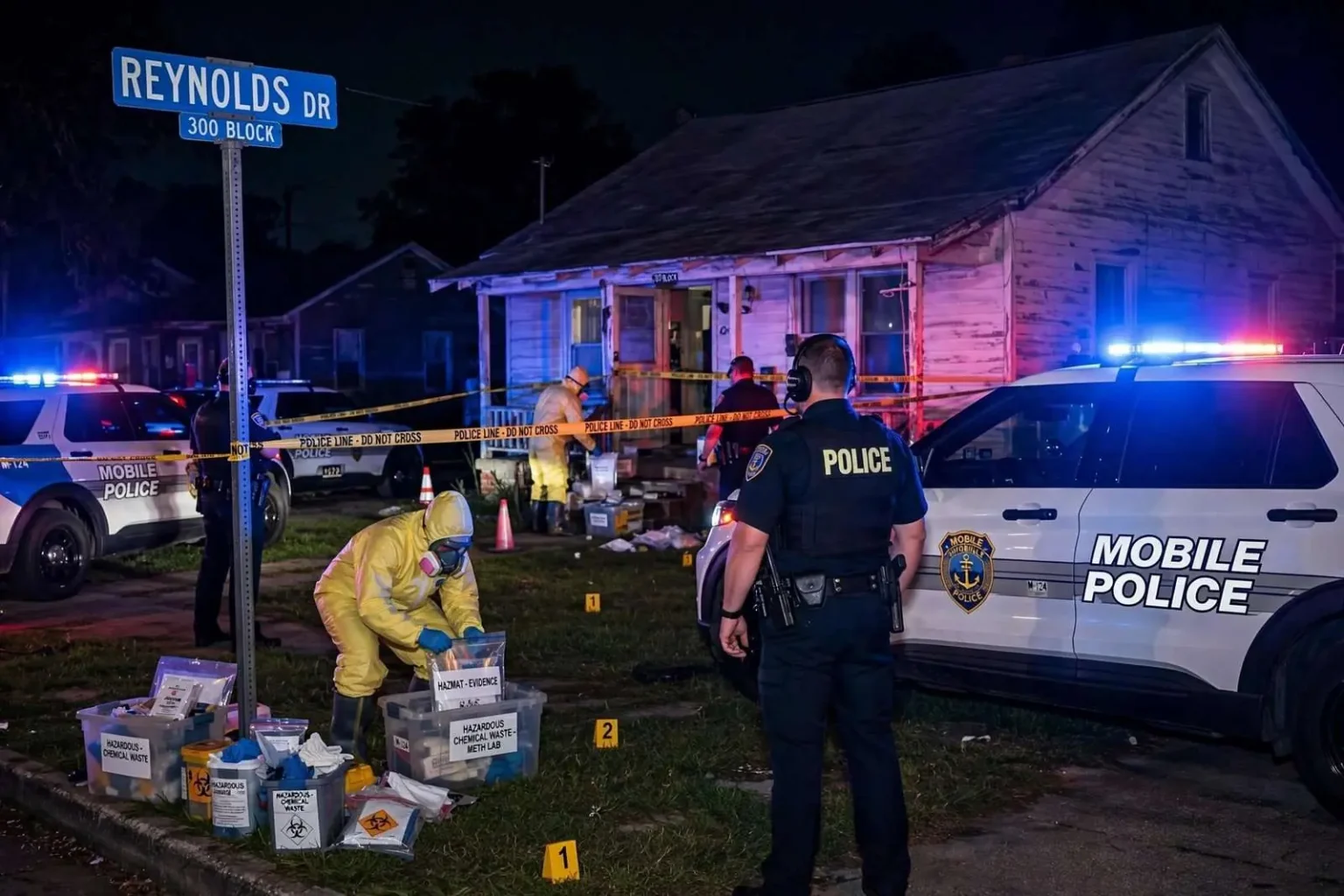
MOBILE, Alabama — A late-night call about a suspected drug operation led Mobile police to a home on Reynolds Drive where officers say they found an active methamphetamine lab, resulting in three arrests. The discovery added another entry to the region’s long ledger of clandestine labs found in residential neighborhoods, and it set in motion the specialized cleanup and investigation work that every meth lab seizure requires before a home can be considered safe again.
Officers respond to a tip
Police were dispatched to the residence around 11:30 p.m. after receiving a report of a possible meth lab at the address. Late-night calls of that kind are a common entry point into meth cases, since production generates distinctive odors, unusual traffic patterns and discarded chemical containers that neighbors frequently notice before police do. The department has long encouraged residents to report such signs rather than investigate them personally.
According to a Mobile Police Department spokeswoman, officers who arrived found methamphetamine, marijuana and multiple ingredients commonly used to manufacture the drug, along with other evidence indicating the substance had recently been produced on site. The combination — finished product, raw materials and signs of active production — distinguishes a working lab from simple possession, and it triggers additional protocols for evidence handling, scene processing and disposal that ordinary drug seizures do not require.
Once officers confirmed the presence of a lab rather than merely drugs, the scene changed character entirely. Meth production relies on volatile solvents and reactive chemicals, and the mixing of those substances in a residential structure creates fire and explosion risks that persist long after the last batch is cooked. Patrol officers secured the address and investigators began the careful work of documenting and dismantling the operation without setting any of its hazards loose.
Three women taken into custody
Investigators arrested three women at the scene. Jennifer O’Neal was booked on charges of possession of a controlled substance and tampering with physical evidence. The tampering charge, a standard companion to meth lab arrests, reflects allegations that suspects attempted to conceal or destroy evidence — flushing chemicals, discarding components or otherwise interfering with the materials officers found.
Lesa Sessions faced the same two charges in addition to second-degree unlawful possession of marijuana. The marijuana count arose from the smaller quantity of that drug recovered alongside the meth production materials, and its second-degree designation reflects the possession threshold charged when the amount recovered exceeds the threshold for simple possession but falls short of quantities associated with distribution.
Tabatha Eady was also charged with possession of a controlled substance and tampering with physical evidence. All three were taken into custody at the residence without further incident, according to police. Charges at the time of arrest are formal accusations, and prosecutors determine the final counts after reviewing the evidence gathered at the scene; the investigation that follows an arrest like this one typically takes weeks before the case file reaches a grand jury.
Part of a broader pattern in Mobile County
Small-scale meth production operating out of residential homes has remained a persistent challenge for law enforcement across Mobile County, with officers periodically uncovering labs tucked inside otherwise unremarkable houses in established neighborhoods. Unlike the large clandestine operations of past decades, the labs that dominate the current era are compact — portable enough to fit in a kitchen, a garage or a car trunk — which makes them harder to spot and more likely to surface in ordinary neighborhoods rather than remote locations.
Because meth production involves volatile chemicals, discoveries like the one on Reynolds Drive often require specially trained hazardous materials personnel to safely process the scene and dispose of the chemical waste left behind. A single cook leaves behind corrosive liquids, solvent-soaked materials and contaminated glassware, none of which can simply be bagged as ordinary evidence. The cleanup teams that handle that work follow federal and state protocols designed to keep officers, residents and the environment clear of the toxic residue.
The hazards extend past the lab itself. Homes used for meth production frequently require professional remediation before they are habitable again, since chemical residue permeates walls, carpeting and ventilation systems. Neighbors of a lab site often learn only after an arrest that the house next door has been processing toxic chemicals, sometimes for months — one reason police emphasize early reporting over after-the-fact discovery.
Mobile police said the investigation into the Reynolds Drive lab remains ongoing as officers work to determine how long the operation had been running and whether additional people were involved in supplying materials or distributing the finished product. Meth cases rarely end with the people found at the scene; investigators typically trace the supply chain of precursor chemicals and the distribution network for the finished drug, work that can expand an initial arrest into a broader case.
What residents can do
The department reiterated that any information the public can offer about drug manufacturing or trafficking in the area is valuable to investigators working to shut down similar operations before they expand. Tips about chemical odors, frequent short-term visitors, windows blackened or covered, and discarded packaging from common household products all feed the intelligence that drives lab investigations, and police can act on an anonymous report without disclosing who made it.
Residents who suspect drug activity in their neighborhood are encouraged to contact the police department’s intelligence unit rather than confront the situation directly, since clandestine drug labs can pose safety risks to anyone nearby, including neighbors unaware of the chemical hazards involved. A lab active in a house puts everyone on the block at risk — from the fire and explosion dangers of the cooking process to the toxic fumes and contaminated waste that don’t respect property lines.
The Reynolds Drive case, for all its late-night drama, follows the pattern that Mobile County has seen repeatedly: a tip, a rapid response, a careful hazardous cleanup and an investigation that stretches well beyond the front door. The three arrests resolve the question of who was in the house that night; the larger work of identifying how the operation was supplied, how long it ran and who else it touched is what detectives will continue in the days ahead.
For the neighborhood, the episode ends with a house sealed for remediation and a reminder of how close to home meth production now happens across the Gulf Coast. For police, it is another iteration of a playbook they have run many times — and another argument, repeated in every case like it, that the first and most important warning usually comes from the people who live next door.
The tampering charges attached to two of the three arrests reflect how evidence in meth cases differs from other drug seizures. Because the materials used in production are common — lithium batteries, cold medicines, solvents, drain cleaner, tubing — nothing found at a lab scene carries the straightforward chain of a bagged narcotic. Investigators must reconstruct what was used, what was in use and what may have been destroyed in the minutes before officers arrived, which is precisely the interference the tampering statute is written to punish.
Police spokespeople in cases like this one typically release little beyond the charges and the circumstances of discovery, and the Reynolds Drive briefing followed that pattern. Names, charges and the neighborhood identify the case; quantities, street value and the lab’s estimated output are left to the investigation. The restraint is deliberate — details released too early can complicate prosecution — but it also means the public record on any single lab captures only a sliver of what investigators document.
The meth problem Mobile County faces today bears little resemblance to the superlabs of the early 2000s, when large-scale Mexican-produced meth dominated the supply and domestic operations were bigger and more organized. State laws restricting the sale of pseudoephedrine and similar precursors shrank what a domestic cook could produce, pushing production into a scattered network of small, mobile operations — each modest on its own, but collectively persistent enough to keep local drug units busy year after year.
Those constraints shaped how police fight it. Precursor purchase logs give investigators a paper trail that can flag suspicious buying patterns, and inter-agency task forces pool the hazmat training and cleanup resources that individual departments cannot each maintain. A lab found by Mobile police may be processed by a regional team, its evidence examined at a state lab, and its prosecution carried forward by prosecutors working under the same precursor laws that reshaped the market in the first place.
The warning police attach to every such announcement — call, don’t investigate — carries real weight for the people most likely to notice a lab: the neighbors. The chemical smells that mark meth production are distinctive, and the traffic and behavior around an active cook site are often visible from the street. Residents who pass those observations to the department’s intelligence unit give investigators what they most need — a location and a pattern — without ever placing themselves near the hazards that make these scenes dangerous for the officers who enter them.