Mobile Police Seek Two Men Caught Using Card Stolen From Vulnerable Woman
Mobile police released surveillance images of two men accused of using a stolen debit card belonging to a woman who lives with mental illness.
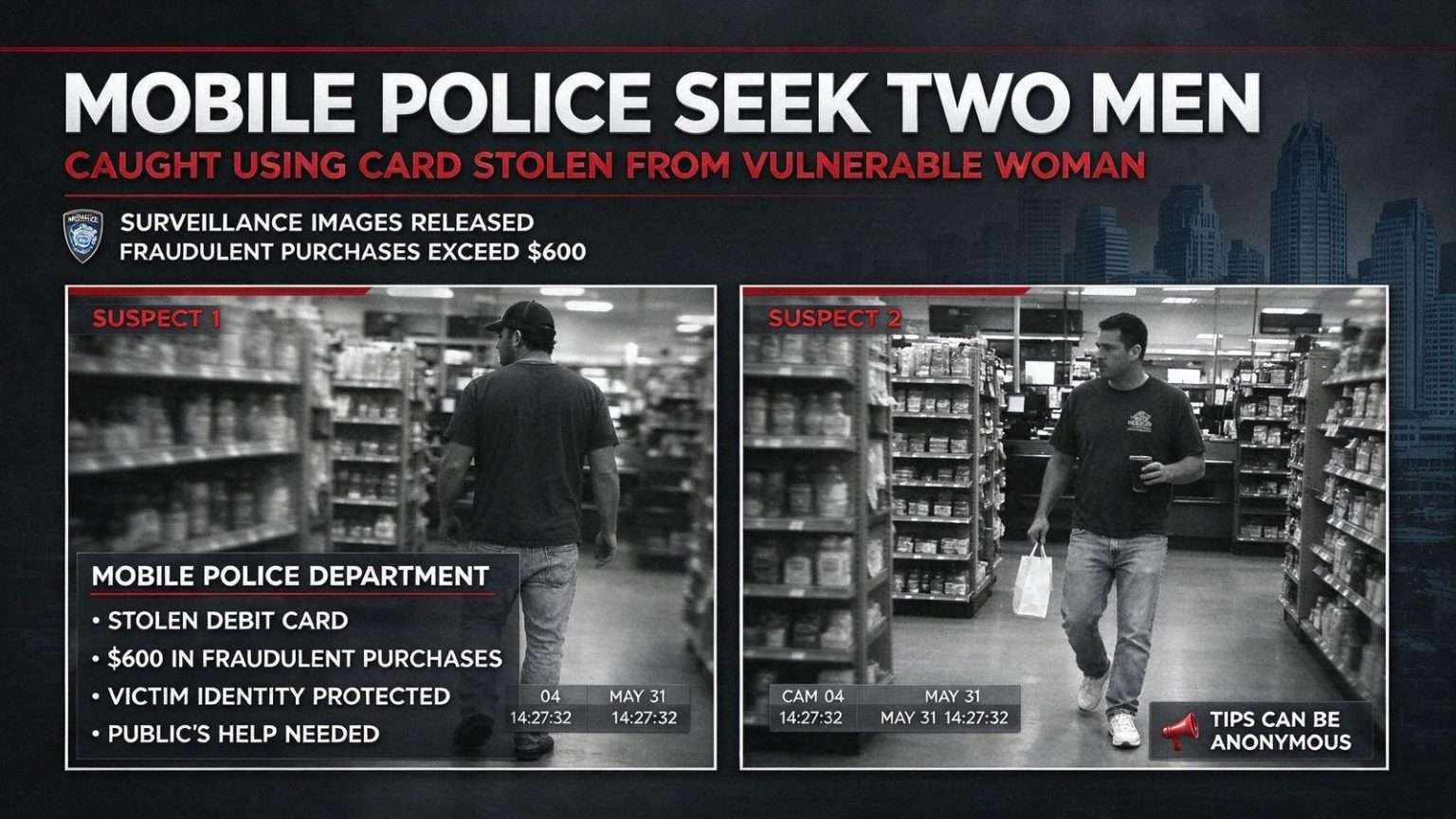
MOBILE, Alabama — Mobile police are asking the public to help identify two men caught on surveillance video using a debit card that was stolen from a local woman who lives with a mental illness.
The case is the kind that plays out in cities across the country every week — a stolen card, a string of quick purchases, a victim left to sort out the damage — but investigators here say the circumstances are what make it worth public attention. The woman at the center of the case is vulnerable in ways that made the theft easier to commit and slower to discover, and detectives hope someone in the community will recognize the faces in the photographs and come forward.
Surveillance Images Released
A Mobile Police Department spokeswoman said investigators released still images showing the pair leaving a retail location after using the stolen card. The photos, pulled from store surveillance footage, carry a timestamp from early summer, giving detectives a rough window for when the transactions took place.
According to police, the men obtained the woman’s debit card in late May or early June and used it to make more than $600 in fraudulent purchases before the theft was discovered. Investigators have not said how the card was originally taken from the victim, whose identity has not been released out of consideration for her privacy and vulnerability.
The roughly $600 in spending represents more than an inconvenience for a victim on a fixed or limited income. Unauthorized debit transactions can freeze an account while the bank investigates, leaving the account holder without access to her own money in the meantime, and recovery of funds from a debit card — as opposed to a credit card — can take longer because the money is drawn directly from the victim’s account rather than from a line of credit.
Surveillance stills like the ones police released are a standard investigative tool in retail fraud cases. Stores retain footage for a limited window, so investigators move quickly to pull and circulate images before they are overwritten, and department spokeswomen distribute them through media outlets and the department’s social channels in hopes that the footage reaches someone who knows the men by sight.
The sequence of the alleged spending — a card obtained at the end of May or beginning of June, then run up over the following weeks at retail locations — is a familiar pattern in these cases. Thieves who take a card rather than a wallet full of cash typically use it in small and moderate increments at stores where card transactions draw little attention, stretching the value of the card until the theft is discovered and the account is frozen. By the time most victims notice, dozens of transactions may have accumulated across multiple locations.
Detectives in such cases piece the pattern together from store records: timestamps, transaction amounts, register footage and the surrounding parking-lot cameras that may capture a vehicle and its plate. Every transaction location the men visited is another source of images, and another chance that a clerk or customer remembers them — which is why the department is treating public identification of the pair as the critical next step rather than a long shot.
Targeting a Vulnerable Victim
Cases involving victims who live with mental illness or other vulnerabilities often draw additional scrutiny from investigators, since such victims can be less likely to immediately notice unauthorized charges or report them quickly. Advocates for people with disabilities have long pushed for stronger consumer protections and quicker bank fraud alerts specifically to help limit financial exploitation in these situations.
Financial exploitation of vulnerable adults is a recognized and persistent problem, and it takes many forms — a stolen card used by strangers, as here, or the quieter predation of relatives, caregivers and acquaintances who gain access to accounts over time. Studies of elder and disability fraud consistently find that the majority of such exploitation goes unreported, often because the victim does not realize it is happening, feels ashamed, or fears that reporting will result in a loss of independence.
In Mobile, advocates and social service agencies work with law enforcement to connect vulnerable adults with protective services, and cases like this one tend to renew those conversations. Banks and credit unions have gradually added features aimed at catching fraud sooner — instant transaction alerts, faster provisional credits during disputes — but those protections only help when the victim or someone watching over her notices the alerts and acts on them.
Mobile police did not release a description of the suspects beyond the images themselves, but the surveillance photos give the public a direct look at the pair believed responsible for the spending spree. Investigators say identifying the men is a key step toward building a case that could lead to theft and fraud charges.
The charges such a case can carry are substantial. Theft of a payment card and fraudulent use of it can be prosecuted under Alabama’s theft and financial identity fraud statutes, with penalties that escalate based on the amount taken and the number of transactions. A pattern of repeated uses of a stolen card, spread across multiple visits, typically strengthens the prosecution’s case because each transaction is a separate documented act.
Mobile’s Crime Stoppers program has been a fixture of the department’s casework for decades, feeding anonymous leads into investigations ranging from homicides to property crimes. For a case like this one — where the suspects’ faces are clear but their names are unknown — the program is often the difference between an unsolved string of purchases and an arrest. Detectives note that surveillance images circulate widely online, and that a single share by someone who recognizes a former coworker, neighbor or acquaintance can close a case within days.
How the Community Can Help
Tip line open for the public: anyone who recognizes the two men pictured in the surveillance images is asked to contact Mobile’s Crime Stoppers tip line or reach the police department’s intelligence unit directly. Tips can be submitted anonymously, and police noted that even small details, such as a name or a workplace, can help investigators identify a suspect.
Crime Stoppers programs operate on a simple premise: many people know something but hesitate to get involved. Anonymity lowers that barrier, and reward offers give an additional incentive for those on the fence. Tips that produce an arrest can qualify for cash rewards, and tipsters never have to appear in court or give their names to detectives.
Police departments across the Gulf Coast rely on the same model, and Mobile’s experience has shown that identity-focused cases — where investigators need only a name to move forward — are among the most responsive to public appeals.
Investigators stressed that partial information is still valuable. A caller who cannot name either man but recognizes where the footage was taken, the clothing in the images, or a vehicle seen in the surrounding footage can still give detectives a thread to pull. In fraud cases built on surveillance footage, identification almost always begins with a member of the public who saw something familiar.
Protecting Yourself After a Stolen Card
The case also serves as a practical reminder for cardholders everywhere. Consumer protection experts advise monitoring bank accounts daily through a mobile app rather than waiting for monthly statements, setting up transaction alerts for every purchase, and reporting a lost or stolen card immediately — federal rules limit a debit card holder’s losses to $50 if the theft is reported within two business days, but that window matters, and losses can rise sharply the longer unauthorized use goes unreported.
For families with a vulnerable member — an adult child with a mental illness, an aging parent, a relative with a disability — experts recommend a trusted person be added as a joint account holder or granted view-only access to statements, so that a second set of eyes is watching for irregular activity. That simple step, advocates say, is one of the most effective protections against exactly the kind of exploitation described in this case.
The Investigation Continues
Mobile police continue to investigate the fraudulent purchases, and detectives are working to identify the two men shown in the surveillance images. Anyone with information is encouraged to come forward through Crime Stoppers or the department’s intelligence unit, whether or not they believe what they know is significant.
For the woman whose card was taken, the resolution of the case carries real weight — recovery of the funds, accountability for the men who used her card, and the reassurance that the city took her loss seriously. Investigators say the fastest route to that outcome runs through the community’s eyes and memory, and they are counting on someone who has seen these photographs to pick up the phone.