Soil Trouble Pushes the New Citronelle High School to a 2016 Finish
Unstable soil forced a new site for the $25 million Citronelle High School, and the Mobile County school board learned the project now trends past its contract completion date, into the summer of 2016.
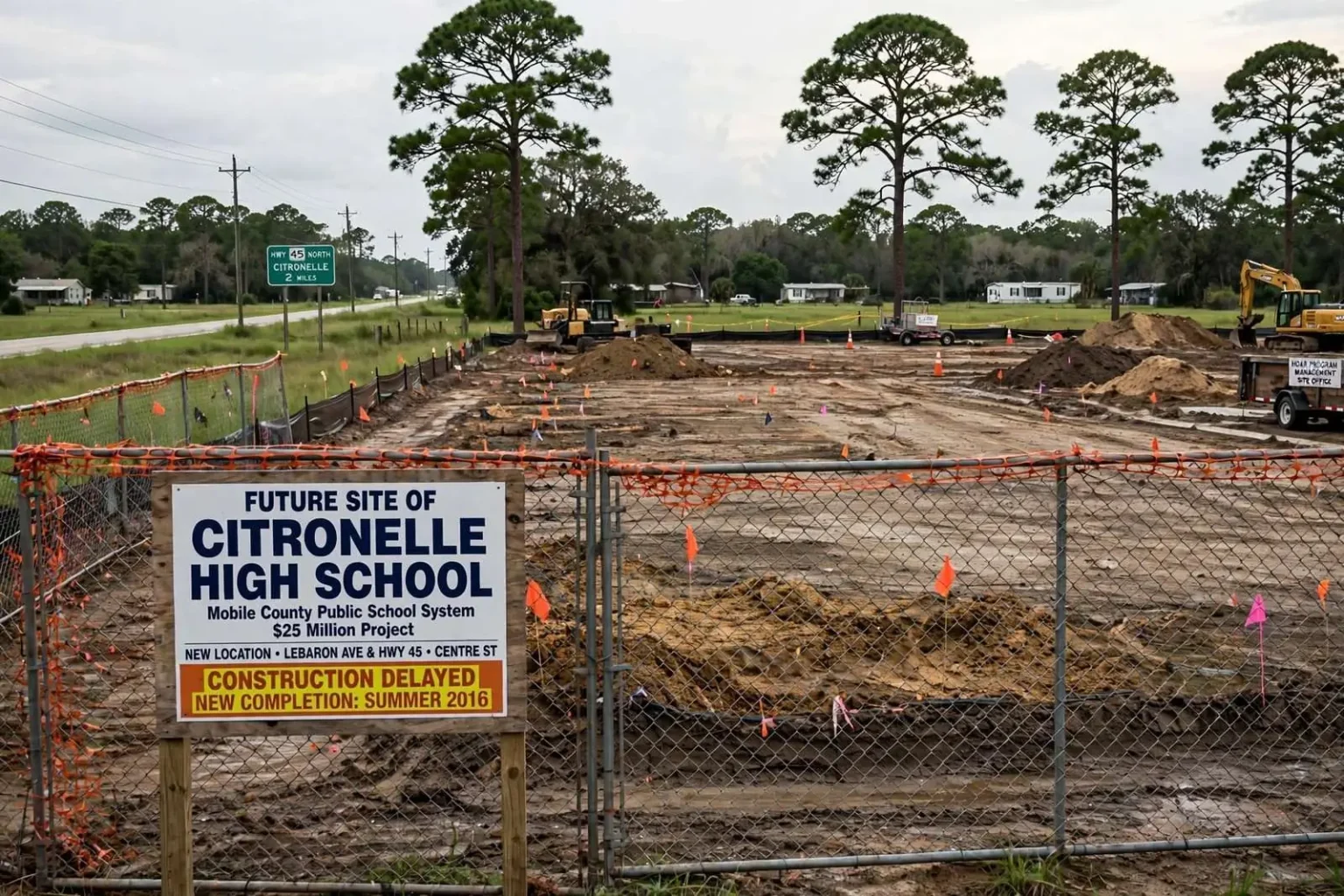
The most expensive single project in the Mobile County school system’s building program had run into a problem beneath the ground, and school board members learned that the new Citronelle High School would not be finished until the summer of 2016. The update, delivered by Hoar Program Management during the board’s annual two-day retreat at the Grand Hotel in Point Clear, carried with it the specter of a possible schedule overrun.
The board’s summer retreat is where the district takes stock of its building program away from the press of regular business, and the Citronelle update landed as the unwelcome centerpiece. Citronelle sits in the far northern reaches of Mobile County, a rural community whose schools serve students spread across some of the county’s most distant territory, and the promise of a new high school had been the anchor commitment of the bond program to that part of the county. A delayed completion date, then, was not just a construction story — it was a story about how long north Mobile County families would wait for the building they had been promised.
An unstable foundation forces a new site
The $25 million Citronelle High School had become the problem project in a much larger program. Testing showed that the soil at the site of the original high school was not stable enough to support a two-story building. Following that finding in mid-May, school officials and Hoar representatives recommended moving the new school to a different parcel across the street, bordered by Lebaron Avenue, Highway 45 and Centre Street.
Soil problems of this kind are not exotic in south Alabama. The Gulf Coast’s geology runs to loose sandy clays and compressible soils that behave badly under the weight of a multi-story building, and the standard remedies — deep pilings driven to stable strata, extensive soil replacement or re-engineering of the foundation — carry costs that can upend a project budget. Choosing a new parcel instead is often the cheaper option, but it forfeits time: site acquisition, redesign, re-permitting and utility work all start over, and no amount of scheduling pressure creates ground that will bear a two-story building.
The site change came with consequences for the calendar. James Adams, a representative from Hoar Program Management, told the board the delay could push the firm beyond the 33 months stipulated in the original $100 million bond contract, a window set to conclude in March 2016.
The 33-month commitment was the backbone of the entire program. When the district embraced the bond plan, it promised voters and taxpayers that the work would be finished within a fixed window, and the program management contract made Hoar accountable to that promise. A single project threatening the window therefore mattered to every other project in the queue — and to the district’s credibility with the taxpayers funding it.
Board members press for answers
Not everyone on the board was satisfied with the explanation. Members Doug Harwell and Bill Foster questioned the reasons for the delay, with Foster voicing concern that Hoar officials were implying the construction might not be finished within the contract’s time frame. Harwell pointed to the time it had taken to complete the soil tests and deliver the resulting report. “As a board, we should look at the length of time it took to get the results,” Harwell said.
The exchange reflected a broader tension in big public construction programs: the division between problems the contractor controls and problems nobody controls. Soil conditions are a fact of the ground, but the sequence of testing, reporting and decision-making is management, and a board member’s insistence on examining the timeline — how long the tests took, when the results were delivered, when the recommendation to move came — was an argument about accountability rather than about geology.
Board President Reginald Crenshaw struck a more confident note, saying he believed Hoar would “move forward to get this done” before the 33 months elapsed. After the meeting, Adams acknowledged that the soil problem and the subsequent selection of a new site had produced an unavoidable delay. The project was “trending beyond our contract completion date, and we’ve made the board aware of that fact,” he said.
Adams’ phrasing was a project manager’s careful honesty. “Trending beyond” stops short of declaring failure against the contract while conceding the direction of the trend, and the candor — telling the board before the deadline passed rather than after — was itself part of managing the relationship. Boards forgive delays far more readily than they forgive surprises, and the retreat briefing was designed to make sure the Citronelle schedule came as an announcement, not a revelation.
A two-phase path forward
The Citronelle work was reorganized into two phases: demolition and preparation of the new site, followed by construction of the school itself. The demolition phase was expected to be completed in early December. Construction was set to go out for bid on Nov. 20 and to begin in late December, with completion planned for the end of July 2016.
Splitting the project let the district move the pieces that could move. Demolition and site preparation do not require the finished construction drawings that the building itself does, so clearing the new parcel early preserved every week that could be preserved while the design work caught up. A late-December construction start and an end-of-July 2016 completion targeted the district’s favorite window — the summer break, when builders can pour concrete and tie into utilities without working around classrooms in session.
Part of a countywide building push
The Citronelle school was one piece of a sweeping construction effort. After selecting Hoar Program Management as its project management firm, the district had set a schedule to complete work on 17 schools within 33 months. Among the larger commitments were $10 million in major renovations at Lott Middle School, $10 million for Phillips Preparatory School, and $14 million to build a new K-8 school in Mobile’s Trinity Gardens, replacing Brazier Elementary and Chastang Middle.
The program’s scale put it among the largest building efforts in the district’s history. Seventeen projects running simultaneously across a county the size of Belgium — from the rural north to the city’s oldest neighborhoods — requires the kind of professional program management the district had hired Hoar to provide: sequencing bids so contractors are not competing for the same crews, standardizing designs where possible, and keeping the money moving in time to finish within the bond window.
The project mix reflected distinct needs in distinct neighborhoods. Lott Middle School and Phillips Preparatory represented renovation of existing campuses — aging buildings brought up to current standards rather than replaced. The Trinity Gardens K-8 consolidation took two smaller aging schools and replaced them with a single new building, part of a national trend toward combining elementary and middle grades under one roof to share staff, technology and facilities.
Hoar was also overseeing renovation of the exterior of the historic Barton Academy and Yerby School in downtown Mobile. On Aug. 19, the board awarded that contract to Ben Radcliff Construction for $2.8 million. At that point, the Barton project and the Citronelle site demolition were the only jobs for which a contractor had been chosen.
Barton Academy carries historic weight beyond its function. The Greek Revival landmark on Government Street served as Alabama’s first public school building and remains one of Mobile’s most recognizable downtown structures, and its exterior renovation was the first visible step in a longer rehabilitation story that civic leaders hoped would return the building to active educational use. Historic renovation work moves differently from new construction — materials must match, facades must be preserved and the review requirements are stricter — which is one reason the board awarded that contract early and let it proceed on its own track.
The next project set to go out for bid was a new multipurpose building at George Hall Elementary, a $2 million job with a bid date of Sept. 16. Other elementary schools slated to receive multipurpose buildings, all expected to be completed by the summer of 2015, were Burroughs, Ella Grant, Indian Springs, Orchard, Robbins and St. Elmo.
The multipurpose buildings were the program’s workhorse projects. A gym-cafeteria-auditorium combination relieves a crowded elementary campus of its three biggest scheduling problems at once — lunch periods that stretch into class time, physical education without a gym and assemblies without a stage — and because the designs repeat across schools, each successive build costs less and moves faster than the last. Spreading them across eight campuses in a single year meant every one of those communities would see its share of the bond money within the program’s first wave.
For Citronelle, the retreat’s news was the program’s one genuine setback: a new school delayed not by money or politics but by the ground itself. The board’s path forward — new site, two phases, bids in November, construction by the new year — committed the district to a summer 2016 finish, giving north Mobile County a date it could hold onto and the building program a visible answer to the question every taxpayer asks a delayed project: what happens next.