Saraland School Board Names Stan Stokley to Lead Its Elementary School
The Saraland City Schools board hired Stan Stokley as its new elementary principal in July 2014 and approved a $1.6 million classroom wing set to open before the new school year.
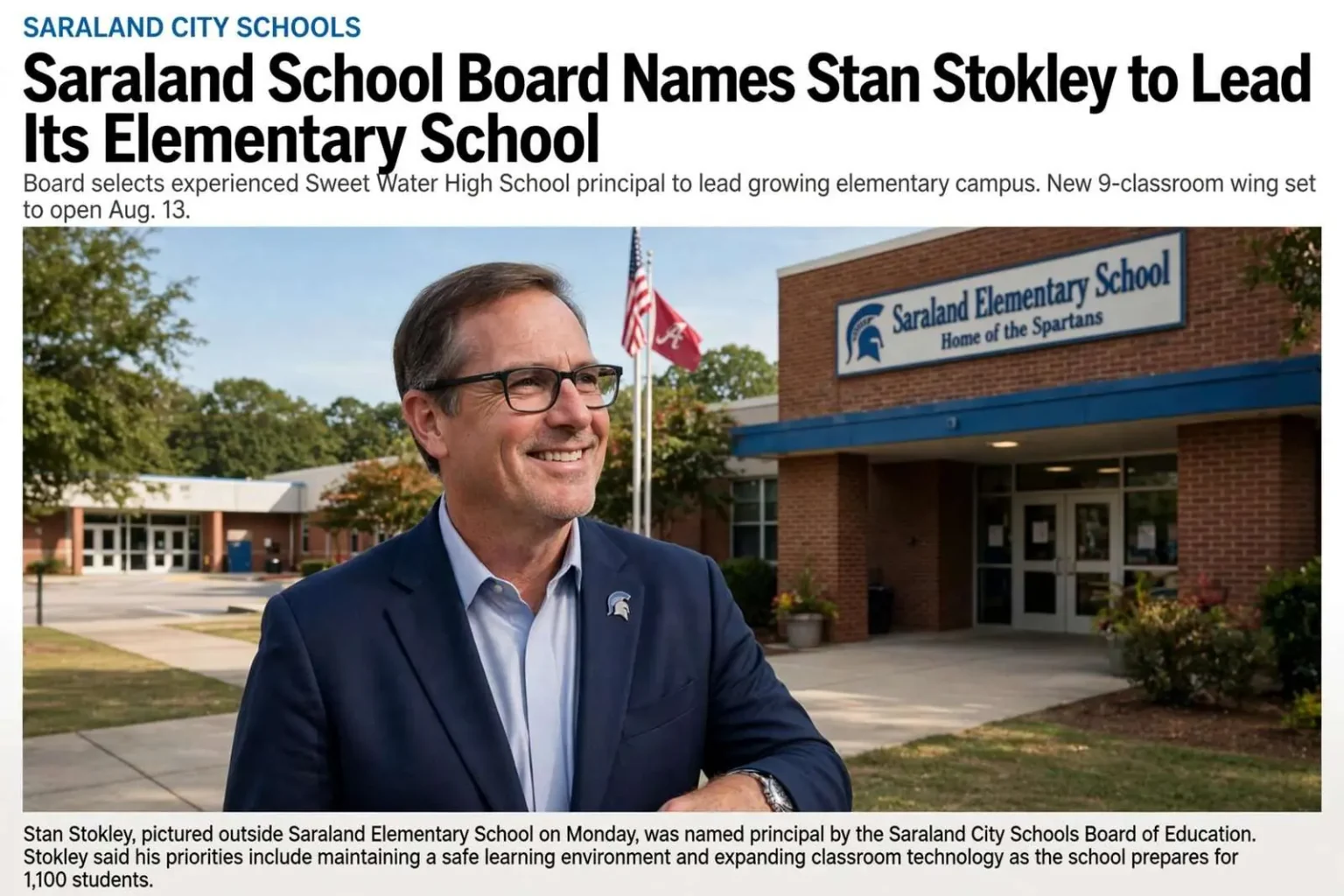
The Saraland City Schools Board of Education approved the hiring of Stan Stokley as its new elementary school principal at a meeting on Monday, choosing an experienced administrator to replace Chris Tangle at Saraland Elementary School. The hire filled one of the most visible leadership posts in a district that has made a habit of drawing attention across Alabama for its rapid rise, and the board paired it with another key staffing move the same night.
Saraland’s city school system is one of the youngest in Alabama, created after the city broke away from the Mobile County Public School System to form its own district — a split driven by residents who wanted local control over schools and were willing to tax themselves to fund them. In the years since, the system’s test scores and athletic programs have turned it into a magnet for families moving to the north Mobile County suburb, and every leadership decision at the elementary level carries weight in a community that measures itself by its schools.
An experienced hire
Replacing Tangle at the elementary school was the kind of transition a growing system cannot afford to fumble. The elementary school is where a district makes its first impression on new families, and where a decade of enrollment growth has put the most pressure on classrooms, parking and staff. Board members weighing the appointment had to balance respect for what the school had already become with the practical demands of running a campus of more than a thousand students.
Stokley came to Saraland after serving 12 years as principal at Sweet Water High School, Superintendent Aaron Milner told the board. He had spent 17 years with the Marengo County School District before making the move to the young Saraland system.
Sweet Water, in rural Marengo County, gave Stokley a decade-plus of experience running a school through every cycle a principal faces — staffing, budgets, testing seasons and the daily discipline of keeping a campus running — and nearly two decades in public education in total. The move also represented a leap in scale and pace: from a small rural county district to one of the fastest-growing suburban systems on the Gulf Coast, where a principal can watch his school’s enrollment climb year over year and where the pressure to keep standards high is constant.
At the same meeting, the board hired Amy Pippins as a new special education coordinator. Pippins joined Saraland from Enterprise City Schools, a Coffee County district in the state’s southeastern corner with its own substantial special education program. Special education coordination is one of the most compliance-intensive jobs in any district, covering individualized education plans, federal reporting and services that must be delivered to students with a wide range of needs, and growing districts typically move quickly when they can attract experienced hands for the role.
Stokley used his introduction to reassure families and staff that he did not intend to overhaul the elementary school. He said his primary goals were to maintain a safe, orderly environment, to teach students good citizenship and respect for adults, and to expand the use of technology as a learning tool. The message was deliberately unglamorous: no new initiatives announced, no programs retired, just a promise of steady management from someone who had run schools long enough to know what stability is worth to parents.
“We want to use technology to enhance instruction, and we want to teach our kids to use it responsibly,” Stokley said. The framing reflected an era in which classrooms were acquiring interactive boards, computer labs and early one-to-one device programs, and in which educators were learning that digital tools could just as easily distract as instruct. Stokley positioned technology as an instructional aid to be woven into lessons — with an explicit citizenship component — rather than an end in itself.
He thanked Milner for bringing him aboard and said the superintendent had “really sold me on the mission of what you’re trying to do here.” Milner, who had led the young district through its early growth years, built that pitch around what Saraland was becoming: a small city system with big-system ambitions, where the elementary school served as the front door for a stream of new families arriving every year.
A growing campus
The board also took up construction business, approving payments on a building project that had been under way for about four months. The work added a new wing with nine classrooms and a connecting corridor linking the elementary school to the middle school.
Approving progress payments is routine board business, but each one marked off another stage of a project that directly answered the district’s most basic problem: too many students for the space it had. Class size is the arithmetic that no growing district can escape — every new subdivision adds students who must be seated somewhere, and the choice is between adding classrooms, adding teachers faster, or letting both class sizes and school culture stretch to the breaking point.
The project carried a cost of about $1.6 million and, according to Milner, was on schedule and on budget. For a district funding its own construction with local tax dollars, staying on both targets mattered doubly — every overrun would come straight out of the same revenues that pay teachers and run classrooms. When completed before the start of school on Aug. 13, the new wing was expected to give the elementary school a capacity of 1,100 students.
The connecting corridor between the elementary and middle schools was more than a convenience. Physically linking campuses allows staff and services to move between buildings, gives the district flexibility in how it assigns classrooms as enrollment shifts, and signals a campus that is being designed as a unified K-12 complex rather than a collection of separate schools. Districts that plan that way can absorb growth without buying land or building new campuses every few years.
The expansion reflected the pressures of a district that had grown quickly since Saraland broke away to form its own city school system. Adding classrooms and tying the elementary and middle schools together physically pointed to a system planning for continued enrollment growth rather than simply keeping pace with the current year. Mobile’s northern suburbs were adding rooftops steadily, and each new subdivision fed more students into Saraland’s classrooms.
Leadership for a young district
Every hire a young district makes carries a double weight, because it sets the school it serves today and the reputation it will recruit with tomorrow. Saraland’s breakaway from Mobile County was approved by voters who bet their property taxes on better schools, and the system’s early returns — steady enrollment growth, competitive test scores and a widening reputation in the region — have made school leadership appointments a matter of broad civic interest rather than a routine personnel vote.
Bringing in a principal with more than a decade of experience leading a school, and pairing that hire with a new special education coordinator, gave the elementary school steady leadership heading into the new year. Districts in growth mode walk a fine line with leadership changes: they need experienced people to manage expansion, but too much turnover can unsettle the school culture that made the system attractive in the first place. Stokley’s hiring was pitched as the former, not the latter.
Stokley’s message of continuity — a safe environment, an emphasis on citizenship and a measured expansion of classroom technology — suggested a focus on building on what was already in place rather than making sweeping changes. That approach has a logic in a district like Saraland, where the existing formula had produced strong results and where parents measuring the system against Mobile County’s larger districts expected the product to keep improving without disruption.
For families preparing to send their children back to class, the timing mattered. With the new leadership set and construction on track to finish before the Aug. 13 start of classes, the district moved into the school year with both a new principal at the elementary school and additional classroom space nearly ready to open. Starting the year with nine fresh classrooms instead of nine portable headaches is exactly the kind of detail that decides whether a growing district’s reputation keeps climbing.
The decisions, taken together at a single Monday meeting, captured the practical work of running a growing suburban school system: hiring the people who would lead its schools, adding the space to hold its students, and signaling to parents that the system was managing its expansion carefully. None of it was flashy, and all of it was the point — in a city that chose to run its own schools, the school board’s Monday night work is the product residents are buying.