Mobile Police Open Homicide Case After Woman Found Stabbed in Burning Navco Road Apartment
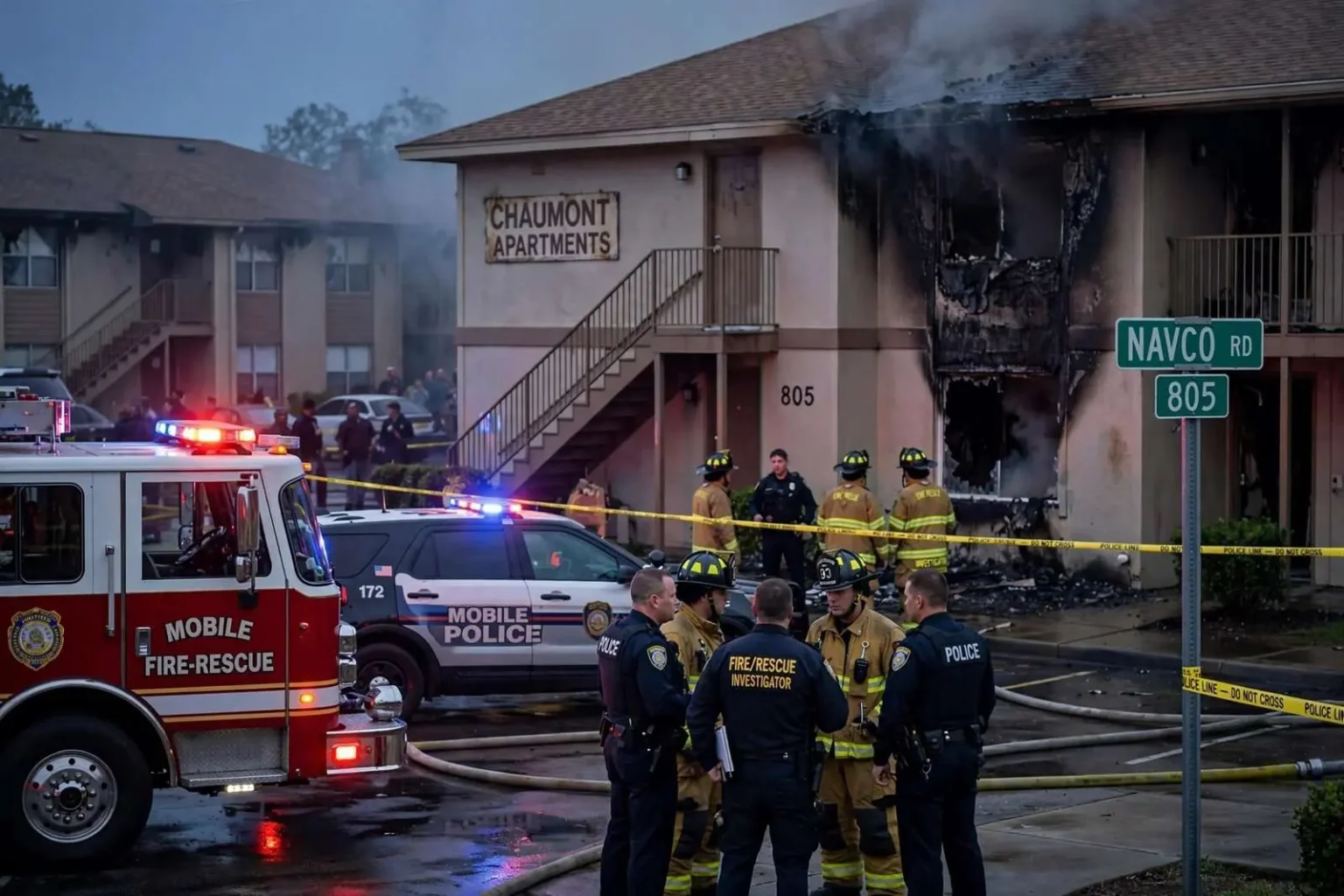
An early-morning fire at Mobile's Chaumont Apartments on Navco Road became a homicide case in July 2014 after crews found a woman who had been stabbed inside the burning building.
An early-morning fire at a Mobile apartment complex in July 2014 turned into a homicide investigation after crews discovered the body of a woman who had been stabbed and left inside the burning building, authorities said at the time. The case joined a short list of Mobile deaths in which fire was used not only as a weapon’s aftermath but as its concealment, and it immediately drew the resources of two city departments that rarely investigate the same scene.
A pre-dawn call
The Mobile Police Department and the Mobile Fire-Rescue Department were called to the Chaumont Apartments at 805 Navco Road at about 4:30 a.m. on a Friday, responding to a report of a structure fire. Dispatchers routed the first crews to the scene within minutes, and firefighters arrived to find smoke and flame coming from one of the complex’s units in the dark, with neighboring residents in the buildings around it potentially at risk.
As firefighters worked to bring the flames under control, they found the body of a woman who was suffering from a stab wound. The discovery changed the character of the emergency on the spot: a call that had gone out as a fire became, in the space of a few minutes, a death investigation, and protocols that split the two departments’ responsibilities went into effect before the fire was even fully extinguished.
What investigators said happened
The woman, who had not been publicly identified in the hours after the fire, was taken to a local hospital, where she later died of her injuries. Authorities withheld her name pending notification of family, a standard practice that left neighbors and reporters with only the outline of what had happened at the complex in the hours before sunrise.
Investigators said early evidence pointed to a deliberate act rather than an accidental blaze. According to detectives, the person responsible was believed to have known the victim. Authorities said they believed the suspect stabbed the woman and then set the apartment on fire, an account that transformed what might have been treated as a routine fire call into one of the most serious cases city investigators would handle that week.
Fire investigators and homicide detectives approached the question of origin from both directions. A fire’s burn patterns, its point of origin and the presence of any accelerant could tell investigators whether the blaze was set and where; the medical examination of the victim’s body would establish the nature of her wounds. Together, the two lines of evidence would determine whether the case was prosecuted as arson, homicide, or both.
A combined police and fire response
Cases like this one required close coordination between the two departments. Fire-Rescue crews focused first on extinguishing the flames and protecting neighboring units in the Navco Road complex, while police worked to secure the scene so that evidence would not be lost. Officers held back residents and onlookers, kept firefighters’ corridors clear and made sure no one moved through the burned unit before investigators could document it.
Once the fire was out, the apartment became a crime scene, and homicide detectives took over the painstaking work of reconstructing the sequence of events. Water and smoke had damaged the interior, but scenes like this one still yield evidence: the point where the fire started, the path the attacker took, and any physical traces the fire failed to destroy. Fire-Rescue investigators remained part of the team, because the arson and the killing were, in the authorities’ account, a single crime with a single author.
The Chaumont Apartments sit along a residential stretch of south Mobile, and a pre-dawn fire in a multi-unit building carried obvious risks for other residents. Families were roused and moved away from the burning unit while crews worked, and several neighboring apartments sustained smoke or water damage. No additional injuries were reported in connection with the blaze.
Appeal for information
In the hours that followed, Mobile police asked members of the public to come forward with anything they might have seen or heard around the time of the fire. Investigators urged anyone with information to call the department at (251) 208-7211. The early-morning hour cut both ways: fewer witnesses were awake, but those who were — residents leaving for early shifts, drivers passing along Navco Road — might hold the single detail that fixed a timeline.
Detectives noted that in cases involving a victim and a suspect who were acquainted, tips from neighbors, relatives and friends often proved decisive. Investigators know that pre-dawn violence usually has an audience of one kind or another: a dog that barked, headlights in the parking lot, raised voices that sounded like an argument. Even small details — an unfamiliar vehicle, raised voices, or someone leaving the area in a hurry — could help investigators establish a timeline and identify a person of interest.
The department’s tips line operated around the clock, and investigators reviewing the case would pull from every channel: the calls that came in directly, the records of any 911 calls made as the fire began, and the accounts officers gathered door to door in the complex in the days after the fire. Apartment complexes, with their shared parking areas and sightlines between buildings, often produce more witnesses than single-family streets — residents who noticed a stranger, a parked car, or an argument in the days before.
Limited details in the early stage
In the early stages of such investigations, police typically release only limited information to avoid compromising their work, and that was the case here. Officials confirmed the location, the approximate time and the fact that the death was being treated as a homicide, while withholding other details as detectives followed leads. The victim’s identity, the precise cause of the fire and the basis for believing the suspect knew the victim all remained, for the time being, inside the investigation.
The restraint was deliberate. Every detail a department releases prematurely gives a suspect a way to test the investigation — to learn what witnesses have seen, or to shape an account that fits the public record. In a case where the authorities said the killing was followed by an attempt to destroy the scene, that discipline mattered more than usual, and the information that reached the public in the first days was confined to the broad outlines of what happened at 805 Navco Road.
A difficult case for the community
The violence of the crime, and the attempt to conceal it by fire, made the case especially disturbing for the Navco Road neighborhood and for the city as a whole. A fire in an apartment building puts dozens of households at risk; a fire set to hide a killing puts the entire neighborhood on notice that someone among them may have witnessed something. For the family of the woman who died, the loss was compounded by the circumstances in which she was found — a death that began as a private act of violence and ended on a public stage of smoke and sirens.
Arson-homicide cases occupy a difficult place in prosecution as well. Fire destroys evidence even as it creates it, and the charge a prosecutor ultimately brings depends on how much of the sequence investigators can reconstruct. That work — laboratory analysis of fire debris, the medical examiner’s report, the canvass of witnesses — unfolds over weeks and months, long after the last engine has left the scene.
As reported at the time, the investigation remained open while detectives worked to identify the victim, determine a motive and build a case against whoever was responsible. Police continued to encourage anyone with knowledge of the events at the Chaumont Apartments to contact them directly, and the department reiterated that even a fragment of information — a name, a description, a time — could be the piece that resolved the case.
The work of the medical examiner
Alongside the detective work, the case moved into the offices of the Alabama Department of Forensic Sciences, whose pathologists conduct autopsies for Mobile County. The autopsy would establish the precise nature of the stab wound and the time of death, while toxicology and the examination of fire effects would help answer the question that mattered most legally: whether the woman died of the stabbing, the fire, or both — and whether she was alive when the fire was set. Those findings, though rarely made public in an investigation’s early days, form the spine of any arson-homicide prosecution.
Investigators also documented the scene photographically and physically before anything was disturbed, mapping the burned unit as it stood after the fire. In cases where a suspect might someday stand trial, the scene record — photographs, diagrams, debris samples, the positions of doors and furniture — becomes the only version of the apartment that will ever exist. Everything the jury sees months later is built from what investigators preserved in the first hours.
How Mobile investigates fire deaths
The joint response followed a structure Mobile has used for decades: Fire-Rescue determines whether a fire was incendiary, and police determine who is responsible. Fire-Rescue’s investigators are trained to read a burned building — how fire traveled, whether it burned hotter or faster than a natural fire would, whether flammable liquid was introduced — and their findings effectively set the direction of the police work that follows.
When the two determinations converge, the case moves toward the District Attorney’s office, where prosecutors decide how to charge it. Capital murder charges can attach when a killing is committed in the course of another felony — arson among them — which is one reason authorities treat every fire death with the possibility that a second crime is hiding inside it. The July 2014 case carried exactly that profile: a death, a fire, and, in the authorities’ account, a suspect who used the second to cover the first.