
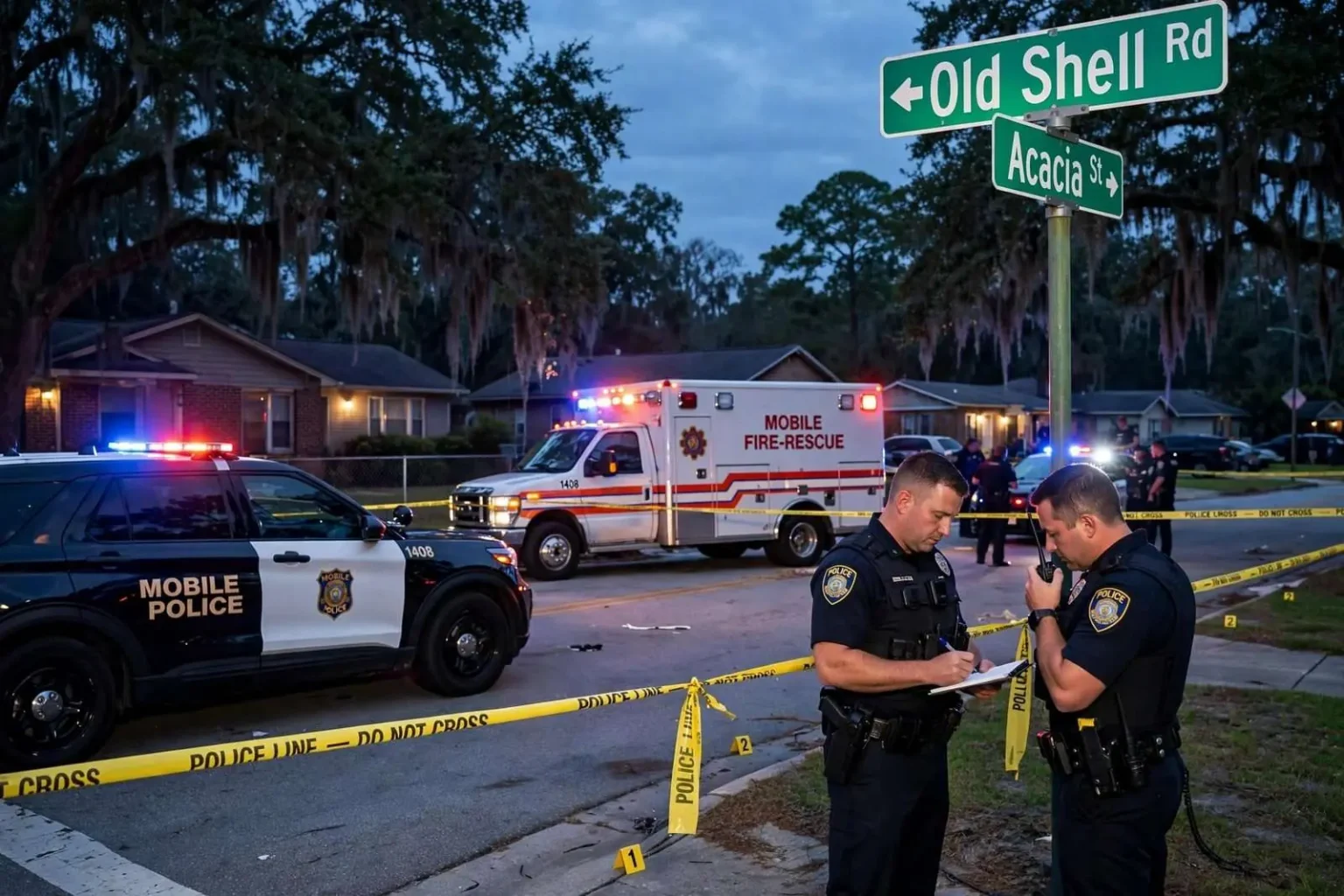
MOBILE, Ala. — A 30-year-old woman was shot near the intersection of Old Shell Road and Acacia Street, according to Mobile Fire-Rescue Department officials. The shooting left her with a life-threatening wound and set off an investigation that continued for days without an arrest.
Mobile police said a man fired multiple rounds, striking the woman. Medics treated her at the scene before transporting her for treatment of a life-threatening gunshot wound. She was listed in critical condition when she left the scene; authorities did not immediately release an update on her condition.
Investigation underway
The shooting occurred the evening of July 18, 2020, along Old Shell Road, one of Mobile’s busiest east-west corridors, in a residential stretch between Spring Hill Avenue and the city’s Midtown neighborhoods. Police did not immediately announce any arrest or identify a suspect, and investigators had not said whether the victim and shooter knew each other.
The location matters to how the case will be worked. Old Shell Road carries thousands of vehicles a day past the intersection with Acacia Street, a residential block where homes face the corridor directly. A shooting there at that hour — in the evening, with traffic and neighbors still active — means potential witnesses: drivers who passed, residents who heard the shots or saw someone running, and the businesses and doorbell cameras that dot the corridor. Detectives working a case like this canvass all of it, collecting footage and knocking on doors in the hours after the shots are fired, when memories are freshest.
The multiple rounds fired also give investigators physical material to work with. Shell casings mark the shooter’s position; the trajectory of the rounds that struck the victim and any property they hit helps reconstruct the scene; and gunshot residue patterns can indicate distances. Combined with the canvass and any surveillance video, that evidence forms the picture detectives will need before a suspect can be named — and it explains why no arrest was announced even as the victim fought for her life at the hospital.
The response on the scene
When shots are reported on a busy corridor, the first arrivals are typically patrol officers, who secure the scene, and medics with Mobile Fire-Rescue, who treat the wounded. In this case, medics treated the 30-year-old woman at the scene before transporting her — a sign that her injuries demanded immediate intervention even before the drive to the trauma center. She was listed in critical condition when she left the scene, the most serious classification short of death, and one that reflects wounds to vital structures.
Police work at a shooting scene proceeds on parallel tracks: keeping the crowd of onlookers back so evidence is not trampled, interviewing everyone who saw or heard anything, and preserving the physical record before it degrades. Evening light in July gives responders more time than a nighttime shooting would, and every additional minute of usable daylight is worth evidence that would otherwise be lost.
Old Shell Road and the neighborhood around it
The stretch of Old Shell Road between Spring Hill Avenue and Midtown is one of Mobile’s most recognizable corridors — a lane of older homes, churches and neighborhood businesses that funnels commuters between the Spring Hill area and the city’s center. Acacia Street intersects it in a quiet residential pocket, the kind of block where a shooting is an anomaly rather than a pattern. The area’s residents have generally regarded the corridor as safe in the way busy urban streets are: busy, watchable, and rarely the site of gunfire.
That character shapes the community’s response to a case like this. Neighborhood associations along the corridor and in Midtown have historically worked closely with MPD’s precinct officers, and a shooting on their block mobilizes the same network of doorbell cameras, message threads and watch groups that produce tips in most Mobile investigations. For a case with no named suspect, that network is often where the break eventually comes from.
What police were saying — and not saying
In the days after the shooting, the public record was deliberately spare: the victim’s age, the location, the time of day, the fact that a man fired multiple rounds, and her critical condition at transport. No arrest, no suspect description, no statement about motive, and no word on whether the victim and shooter knew each other.
That silence is procedure rather than evasion. In a case where the shooter’s identity is unknown, investigators protect the details that only the shooter would know — the number of shots, the direction of fire, the precise wording of anything the shooter said — because those details screen out false confessions and confirm which tips are genuine. Updates on the victim’s condition are likewise withheld at the family’s request or while her condition remained uncertain. The case remained under investigation by the Mobile Police Department, and each of those blanks was a working question, not a dead end.
How to help
Anyone with information about the shooting was encouraged to contact Mobile police or Mobile Area Crime Stoppers, which accepts anonymous tips. The Crime Stoppers model exists precisely for cases like this one, where a witness may know the answer but fear being tied to the case: tips submitted through the program are anonymous by design, rewards are offered for information leading to arrests, and the tipster’s identity is protected even if a case goes to trial.
For the investigators, the path forward runs through the neighborhood: the camera footage from the corridor’s homes and businesses, the recollections of drivers who passed the intersection that evening, and the whispers that reach detectives after the initial canvass fades. Cases on busy corridors are solved at a higher rate than shootings in isolated places precisely because of the crowd that was there when it happened.
Gun violence and its victims in Mobile
The shooting of a 30-year-old woman on a busy residential corridor fits a pattern Mobile police have worked for years: most of the city’s shootings involve men, which makes a female victim stand out statistically and broadens the investigative questions detectives must ask. Was she targeted? Was she near someone else the shooter intended to hit? Was the shooting domestic, or a dispute that had nothing to do with her household? Investigators had not said whether the victim and shooter knew each other, and each possible answer sends the case down a different road.
The medical picture adds its own urgency. A critical-condition transport means the victim reached the hospital within the window where trauma surgery can save a life, and Mobile’s medics train on exactly that calculus — treat at the scene only what must be treated, then move. The absence of a follow-up condition update in the days after the shooting left the community without an answer to the question everyone on the corridor was asking, and families of gunshot victims in Mobile know that such silence can cut either way.
What the first hours decide
Homicide and shooting investigations are won or lost in the first hours. The canvass that began that evening — officers walking Old Shell Road and Acacia Street, collecting doorbell video, interviewing whoever came to the door — is the foundation on which everything later rests. Physical evidence is collected the same night: casings, projectiles, any damage to homes or vehicles, and the measurements that let analysts reconstruct where the shooter stood and in what direction the rounds traveled.
Detectives then chase the timeline backward and forward — who the woman was with that evening, where she had been, whether anyone saw a person leave the area on foot or by car. Corridor cameras along Old Shell Road and the connecting streets provide the independent record that witness memories cannot, and reviewing hours of that footage is the painstaking work that followed the initial canvass.
The weeks after a shooting like this
For the residents of the blocks around Old Shell and Acacia, the aftermath of an unsolved shooting follows a familiar rhythm. Patrol presence increases for a few weeks. The neighborhood watch threads circulate the little that is known. Rumors fill the gaps the official silence leaves — and detectives caution against them, because false leads consume investigative time that a real tip deserves.
The case’s future depends on the two assets every Mobile shooting investigation leans on: the physical evidence collected that evening and the community’s willingness to say what it knows. Mobile Area Crime Stoppers remains open around the clock for anonymous tips, and the Mobile Police Department’s investigators continue to work the file until someone is charged or the evidence runs out. The 30-year-old woman wounded near Old Shell Road and Acacia Street on the evening of July 18, 2020, was left in critical condition; who fired the rounds that struck her, and why, remained the questions detectives were working to answer.


