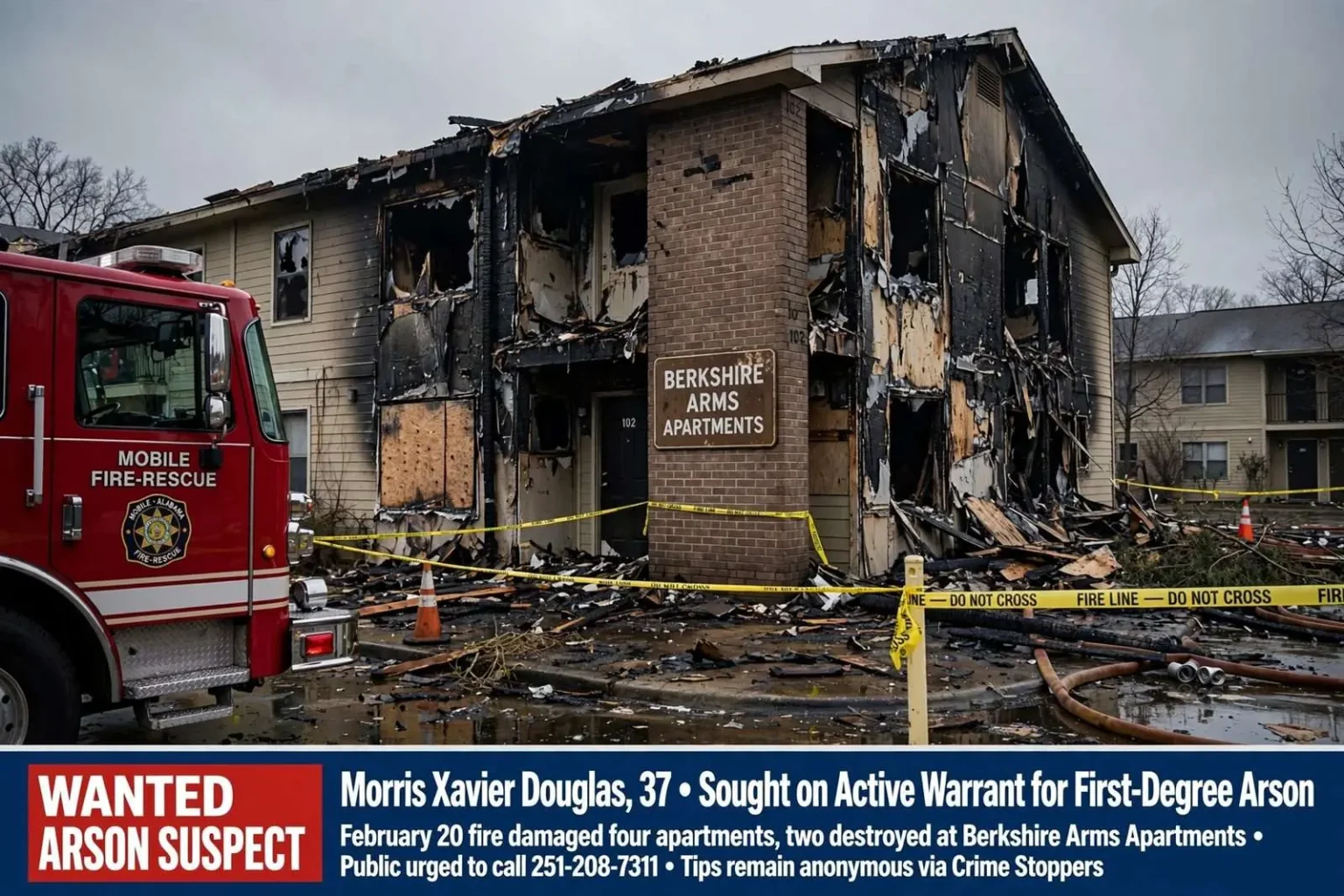
Mobile Fire-Rescue is asking for the public’s help locating a man investigators have identified as a suspect in an apartment fire that damaged several units at the Berkshire Arms Apartments earlier this year. According to the department’s Arson Unit, Morris Xavier Douglas, 37, has been identified as a suspect in the February 20 fire at the apartment complex. The blaze damaged four apartment units, two of which were destroyed, and one resident reportedly lost all of her belongings in the fire.
Mobile Fire-Rescue’s Arson Unit handles the investigation of suspicious fires across the city, working alongside the department’s fire investigators and, when warranted, coordinating with law enforcement on arrests. Arson is among the most serious offenses on Alabama’s criminal code, and first-degree arson under state law carries the potential for decades in prison when a person knowingly sets fire to an occupied structure. An active warrant for first-degree arson has now been issued for Douglas, according to Mobile Fire-Rescue, which says he is also wanted for questioning by the department’s Arson Unit as the investigation continues.
The February 20 fire at the Berkshire Arms Apartments displaced residents and destroyed personal property, including family keepsakes that cannot be replaced. Fires that move through multi-unit apartment buildings are especially damaging because flames, smoke and water can spread between connected units before crews can bring the fire under control. In this case, four units were damaged and two of those were destroyed outright, meaning families in both the burned units and the adjacent apartments faced disruptions to housing, transportation and daily routines in the weeks that followed.
Investigators have not said what they believe sparked the blaze, citing the open case. That silence is typical of active arson investigations, in which releasing a suspected cause or point of origin too early can compromise interviews, evidence testing and any eventual prosecution. Officials have likewise not said whether anyone was injured in the fire, and no arrest has been announced since the warrant was issued.
How the warrant works and what comes next
An active warrant means that once Douglas is located, he can be taken into custody and booked into Mobile County jail to answer the first-degree arson charge. Because the case remains open, investigators have not detailed what led them to identify him as a suspect, how they connected him to the scene, or whether additional charges could follow. Individuals facing first-degree arson charges are generally prosecuted by the Mobile County District Attorney’s Office once an arrest is made, and the outcome of any prosecution would be decided in Mobile County circuit court.
Fire officials emphasize that identifying a suspect is only one step in a longer process. Evidence collected at the scene, witness statements and tips from the public all feed into the case file, and investigators say even small details — a vehicle seen near the complex, a description of a person leaving the area, or information about a dispute or prior incident at the property — can help move a case forward. Tips from the public have historically played a key role in resolving arson cases in Mobile.
Anyone with information about Douglas’ whereabouts is urged to call the Mobile Fire-Rescue Department at 251-208-7311. Callers who wish to remain anonymous can also provide information through regional crime-stoppers channels, which pass tips to investigators without requiring a name. Residents are asked not to approach the suspect themselves, since arson warrants are executed by law enforcement officers trained for that work.
Apartment fire safety for Mobile residents
Beyond the investigation, the Berkshire Arms fire is a reminder of how quickly multi-family housing can be affected by a single blaze. Fire officials recommend that apartment residents know at least two ways out of their building, keep hallways and stairwells clear, test smoke alarms monthly, and never disable an alarm while cooking. Renters should also make a record of their belongings — photos or a simple video walkthrough on a phone — so an insurance or renters’ policy claim can be documented quickly if a fire occurs.
Mobile Fire-Rescue says its Arson Unit continues to investigate fires across the city and reminds residents to report suspicious activity near vacant or occupied buildings. Unsecured vacant structures are a recurring concern in arson cases, and the department asks residents who notice repeated loitering, forced entry points, or signs someone may be staying in an abandoned building to report it promptly. Fast reporting of smoke, flames or suspicious behavior gives crews and investigators their best chance to protect lives, property and evidence in the neighborhoods they serve.
For now, the department’s message is straightforward: the February 20 fire at Berkshire Arms left four units damaged, two destroyed, and one resident with the loss of everything she owned, and the man identified as the suspect in that fire remains wanted on an active first-degree arson warrant. Investigators are counting on the public to help close that gap between the fire and the arrest.
The Berkshire Arms complex sits in west Mobile, part of the stretch of apartment communities that house a large share of the city’s renters along and near Airport Boulevard and Cody Road. When a fire tears through even a handful of units in a complex of that size, the effects ripple outward: displaced families crowd in with relatives, property managers face weeks of repairs, and nearby residents are reminded how quickly a single incident can touch dozens of lives. Multi-unit fires also strain emergency resources, since a single alarm can bring engines, ladder trucks and medic units from across a battalion to one address.
Under Alabama law, first-degree arson applies when a person knowingly sets fire to an occupied building, a classification that reflects the danger to human life rather than the value of the property alone. That is why a fire in an occupied apartment complex — where families are sleeping just on the other side of a shared wall — is charged more severely than a blaze in an unoccupied structure. The charge does not require proof that anyone was hurt; the risk to occupants is what elevates the offense.
For the families affected by the February fire, recovery has meant more than waiting on the investigation. Displaced residents typically lean on a combination of help from their own networks, the American Red Cross of Alabama and the Central Gulf Coast, which responds to local house and apartment fires with emergency lodging and immediate needs, and any renters’ insurance they may carry. Fire officials note that renters’ policies are inexpensive and are often the difference between a family that can replace clothing and furniture quickly and one that starts over with nothing — a reality underscored by the resident who reportedly lost all of her belongings in this fire.
Behind the scenes, an arson case like this one moves through a methodical sequence. Investigators document the scene, diagram burn patterns, collect debris samples for laboratory testing and interview residents and neighbors in a canvass around the complex. Once a cause is narrowed down, the question becomes who had access, motive or opportunity, and that is where public tips often matter most. Investigators say people sometimes hold a piece of information they assume is too small to matter — a name they heard, a car they noticed, a conversation they overheard — only to learn later that it filled the gap that solved the case.
The department’s standing reminder to report suspicious activity near vacant or occupied buildings carries particular weight in a city of Mobile’s size, where older commercial structures and turnover in rental properties can leave buildings sitting empty between tenants. Fires in vacant buildings spread to occupied ones more often than residents realize, and early reports give crews the best chance of stopping a small fire before it becomes a neighborhood emergency.
Until the warrant is served, Mobile Fire-Rescue’s Arson Unit says the case remains active, and the department’s request is unchanged: anyone who knows where Morris Xavier Douglas may be should call 251-208-7311 and let investigators take it from there.
The economics of apartment fires also matter to the wider community. When units are destroyed, landlords lose rental income while they rebuild, displaced tenants may leave the area entirely, and insurance claims can take months to resolve. Neighborhoods where a damaged building sits vacant too long see knock-on problems, which is why fire departments and code enforcement offices encourage property owners to secure fire-damaged structures quickly and to communicate openly with tenants about timelines. In the case of Berkshire Arms, the damage to four units — with two destroyed — represents not just a headline number but a rebuild project measured in months and a handful of households whose housing plans changed overnight.
Mobile Fire-Rescue, which serves the city’s roughly 190,000 residents out of stations spread across the city, treats public cooperation as a force multiplier for its investigators. A department cannot station an officer at every vacant building or watch every complex at night, but a resident who knows what is normal on their street and calls when something is not can effectively extend the department’s reach. That is the dynamic investigators are counting on now as they ask the public to help locate the man identified in the February 20 Berkshire Arms fire.