Mobile Weighs $240,000 in Repairs to Keep Aging Fire Stations in Service
Mobile officials moved to confront a backlog of repairs at aging Fire-Rescue buildings, with the City Council set to weigh roughly $240,000 in projects ranging from new shower tiles to sprinkler and security upgrades.
Mobile officials moved to address a growing backlog of repairs at the Fire-Rescue Department’s aging buildings, with the City Council set to consider roughly $240,000 in facility work, according to documents provided to council members. Some of the spending could be approved as early as the council’s Tuesday meeting, when members were scheduled to vote on a series of requests. The package was assembled from separate funding sources and contracts, but together the items amount to a down payment on a maintenance debt that has been accumulating at the city’s firehouses for years.
Shower Tiles and Budget Transfers
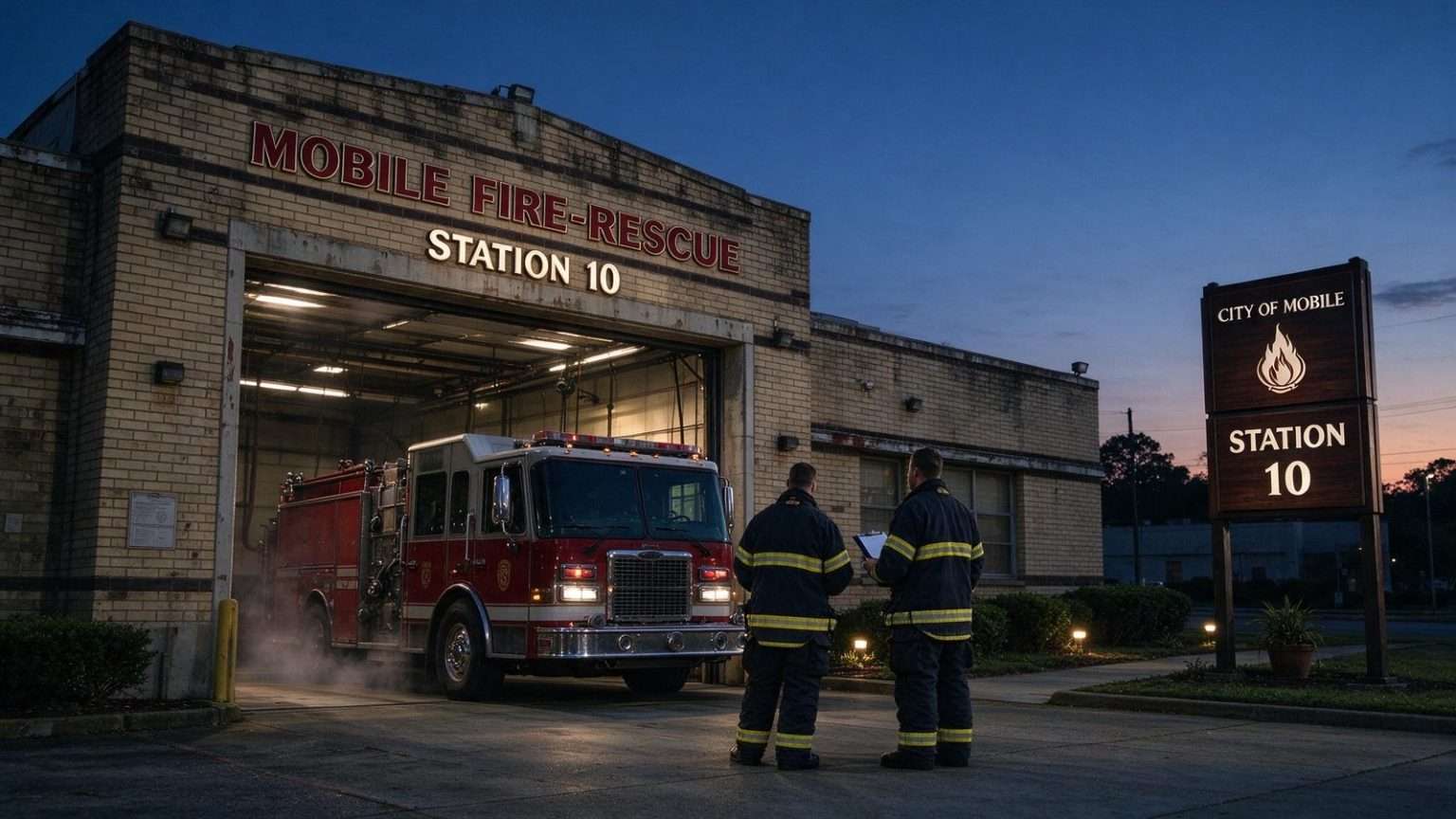
Among the items before the council was $13,080 for new tile inside two showers at Fire Station 10, along with a set of budget transfers intended to chip away at the department’s larger list of building needs. The shower project illustrates the unglamorous character of firehouse maintenance: a station’s showers and bunk areas are in near-constant use by crews working 24-hour shifts, and water intrusion in an occupied building never stays cosmetic. Left alone, failed tile becomes rotted subfloor, and a small repair becomes a reconstruction.
The budget transfers accompanying the request matter as much as the tile. Transfers move money between appropriated accounts — typically from a general maintenance line to a specific project — and they are the mechanism by which a city patches an unbudgeted need without amending the whole budget. Each transfer the council approves is also, in effect, an acknowledgment: this repair was not planned for, and the plan has to bend around it.
A List of ‘Critical’ Needs
Brad Christensen, the city’s architectural engineer, laid out the priorities in an email to council members. He described a number of “critical” repairs that he said should be addressed at the department’s older stations. Roof repairs at Fire Station 11 had already been funded, Christensen noted, but other projects remained outstanding. The items he flagged included security-system improvements at the Central Fire Station and renovations at Stations 23 and 14 as well as the Central Fire Station itself.
“Many of the Fire Department facilities are old, in bad shape, and are in desperate need of repair,” Christensen wrote to council members. It is a blunt assessment for a city engineer to put in writing, and council members who received it understood the context: fire stations are among the most heavily used buildings a city owns, operating every hour of every year, and deferring their maintenance does not make the need disappear — it compounds it. A roof that leaks for three more winters does not cost three more years of roofing invoices; it costs interior damage on top of the roof.
The age profile of the station network is the underlying driver. Stations scattered across Mobile’s older neighborhoods — downtown, the peninsula communities, the close-in residential districts — were built for a smaller department with smaller apparatus. Bay doors, floor loading, sleeping quarters and plumbing systems designed decades ago are all now in service around the clock, and each passing budget cycle that funds engines and ladders before buildings leaves the buildings further behind.
Sprinklers, Security Systems and a Museum Upgrade
Beyond the building repairs, the council was set to vote on $51,222 to replace sprinkler heads and install Knox Caps on existing fire-sprinkler systems. That contract, awarded to VFP Fire Systems, would be paid out of the city’s Building and Grounds account. The work is compliance maintenance as much as repair: sprinkler heads have service lives and standards change, and a head that is corroded, painted over or past its rated age may not activate as designed. Replacing them citywide is the kind of invisible work that never draws a ribbon-cutting but determines what happens when a fire starts in a public building at 3 a.m.
Knox Caps are the fire service’s quiet answer to a chronic problem. The lockable caps fit over the standpipe and sprinkler connections on the outside of a building, so that firefighters with the department’s Knox key can charge a system in seconds while vandals, vagrants and thieves cannot open it. Unprotected FDC connections — the fittings firefighters hook hoses into — are a known vulnerability: debris, tampering or mechanical damage at that connection can disable a building’s entire sprinkler system precisely when it is needed. Installing the caps citywide is cheap insurance against that failure mode.
Council members were also scheduled to consider a contract with Johnson Controls Inc. to upgrade the existing fire and security system at the History Museum of Mobile, one of several city-owned buildings folded into the broader push to modernize aging systems. The museum — housed in the city’s old City Hall complex in the historic district, a building with its own significant age — holds collections and archives that are irreplaceable, and a fire or security system that functions on 1990s technology is a risk to both the artifacts and the structure. Modern detection and monitoring tie directly into fire dispatch, shrinking the interval between a first alarm and the first engine.
Why Fire Stations Wear Out Faster
The requests reflected a challenge familiar to many older cities: fire stations built decades earlier continue to house crews and equipment around the clock, and the wear shows in ways ordinary buildings never see. Apparatus bays are the harshest rooms in municipal architecture — diesel exhaust, road salt and moisture, ten-ton trucks moving in and out through doors that cycle dozens of times a day. Living quarters run the opposite duty cycle: constant occupancy, round-the-clock cooking and laundry, and plumbing and HVAC systems that never get the overnight break a normal building gets.
There are operational consequences that go beyond maintenance aesthetics. Deteriorating stations cost the department in response terms: apparatus bays too tight for modern engines, shower and decontamination facilities that fall short of modern health standards for crews exposed to hazardous materials, and security systems that predate the era in which station access control became a concern. Fire chiefs across the country have catalogued the same list — and the pattern in Mobile’s request package, small items across many stations, is the classic signature of a system maintained by patching rather than by a capital plan.
A capital maintenance plan — a multi-year schedule of roof, HVAC, plumbing and security work with funding attached — is what fire-service planners generally recommend in place of year-to-year triage. It spreads costs predictably, lets the department schedule work around staffing, and gives the council a way to see the whole backlog rather than approving it item by item as emergencies. Whether Mobile moves in that direction is the larger question the $240,000 package only begins to answer.
What the Vote Means for the Budget
For the council, the Tuesday votes are individually small but collectively telling. A $13,080 tile job and a $51,222 sprinkler contract will not move the city’s budget on their own; what they test is the city’s appetite for a sustained facilities program at the Fire-Rescue Department. Every member knows the political arithmetic of the choice: station repairs are invisible to most constituents until they fail, while the taxes or cuts that fund them are visible immediately. Maintenance is the classic orphan of municipal budgeting, which is precisely how a network of firehouses ends up, in the city engineer’s words, in bad shape and desperate.
The alternative costs are not hypothetical. A station forced offline for emergency repairs means apparatus relocated, response times in that district stretched, and overtime paid to cover the gap — expenses that dwarf the preventive work. Industry estimates consistently put deferred maintenance’s eventual cost at a multiple of the timely repair, and fire stations, with their heavy-use bays and living quarters, sit at the expensive end of that curve. The money the council is asked to approve this week buys comparatively little; what it buys is time to plan the larger program properly.
Where the Department Stands
Mobile Fire-Rescue operates a network of stations spread across the city’s geography, from the downtown central station to neighborhood houses on the peninsula, in Spring Hill, out Toulminville, down Airport Boulevard and across West Mobile — a deployment designed so that no substantial part of the city waits long for the first engine. That coverage model is only as good as the buildings it runs out of. A station that cannot house its crew comfortably loses recruitment power; a bay that cannot take the newest apparatus locks the department into buying equipment that fits the building rather than the mission.
Christensen’s memo, and the itemized requests that followed it to the council, amount to a first public inventory of that problem. The funded roof at Station 11 shows the process working — a need identified, funded and crossed off. The outstanding items at Stations 23, 14 and the Central Fire Station, the citywide sprinkler work and the museum systems upgrade show how much remains. Council members will vote on the individual items this week; the larger question — whether Mobile begins a real, funded, multi-year plan for its firehouses — will be answered in the budgets that follow.
What is not in dispute is the direction of the trend. Buildings age on a schedule that ignores budget cycles, and the Fire-Rescue Department’s facilities have been aging faster than the city has been repairing them. The $240,000 before the council is a start — and, as the engineer’s memo made plain to the members voting on it, only a start.