Uncollected Storm Water Fees and Camera Plans Weigh on Mobile’s Budget
As Mobile searched for revenue, officials revisited a 2009 storm water ordinance that was adopted but never collected, along with plans for red-light cameras at 20 intersections to help fund police and fire pensions.
Facing a stubborn budget squeeze, the city of Mobile found itself revisiting a source of revenue it had approved years earlier but never actually collected — and weighing new measures, including cameras at busy intersections, to shore up its finances.
A Fee on the Books, but Not in the Bank
On March 10, 2009, the city amended Storm Water Ordinance 65-007, assessing fees on residential and commercial properties based on a formula that assigned “equivalent runoff units” according to a property’s size and use. If collected, the fees would generate more than $10 million a year. The catch, as officials acknowledged, was that despite adopting the ordinance, the city had never collected the money.
The equivalent runoff unit system is the standard approach for storm water utilities nationwide. Each parcel of land is measured by how much rainwater it sends into the drainage system: a paved parking lot or a warehouse roof sheds nearly everything that falls on it, while an undeveloped acre absorbs most of its rainfall. Under that logic, the property that burdens the drainage system the most pays the most, spreading the cost of maintaining culverts, ditches and detention ponds across the properties that actually use them.
There was more to it than an oversight, according to Barbara Drummond, the city’s executive director for administrative services and community affairs. Much like a garbage collection fee, storm water fees were “cumbersome” to collect, whereas the sales tax relied on a system already in place.
Drummond’s distinction gets at a persistent problem in municipal finance. Sales taxes collect themselves at the register, flowing through merchant reports and state remittance systems that require little additional infrastructure. A storm water fee, by contrast, has to be billed to every parcel owner, tracked against property records, disputed property by property and pursued through collections when it goes unpaid. Building that apparatus costs money up front, which is precisely why ordinances get adopted and then quietly left unenforced when budgets are tight.
City Council President Reggie Copeland’s recently disbanded advisory committee on city finances had rediscovered the ordinance and recommended its enforcement, projecting nearly $10.5 million in storm water fees by 2016-17 — almost $3 million from residences and about $7.5 million from commercial properties.
The split surprised some readers of the committee’s work. Commercial properties, with their large roofs and expansive pavement, account for the overwhelming share of the projected revenue, meaning a full enforcement program would fall heaviest on the businesses that generate the city’s sales tax base. That tension — between raising money and keeping the city competitive for commercial investment — shaped much of the debate that followed.
Cameras at the Intersections
Drummond said much remained unsettled about how best to address the city’s financial conundrum. Even so, plans were moving forward to increase employee health insurance contributions — city workers were said to pay just 18 percent of the average paid by workers in other Alabama jurisdictions — and to seek legislative approval to install cameras at 20 major intersections to ticket motorists who ran red lights.
The health insurance piece illustrates how personnel costs dominate a city budget. When a workforce pays a fraction of what peer municipalities contribute, the difference compounds year after year, both in direct premium payments and in the long-term liabilities the city carries for its employees. Adjusting employee contributions is among the least popular options available to any council, but it is also one of the few that delivers recurring savings without cutting services.
To estimate the revenue, the city studied results in Montgomery, where such a program was already in effect. Montgomery’s experience gave Mobile’s analysts a comparable Alabama jurisdiction — one with similar traffic patterns, court systems and legal framework — rather than relying on national averages from cities with different traffic laws.
Proceeds would be split 80/20, with 80 percent devoted to offsetting the $126 million unfunded liability on the police and firefighter pension and 20 percent toward maintenance and administration. The pension number is the figure that drove the urgency. An unfunded liability of that size means the city has promised retirement benefits to its police and fire personnel that its pension fund assets cannot yet cover, and every year of delay allows the gap to grow. Directing camera revenue at that liability was the plan’s central justification.
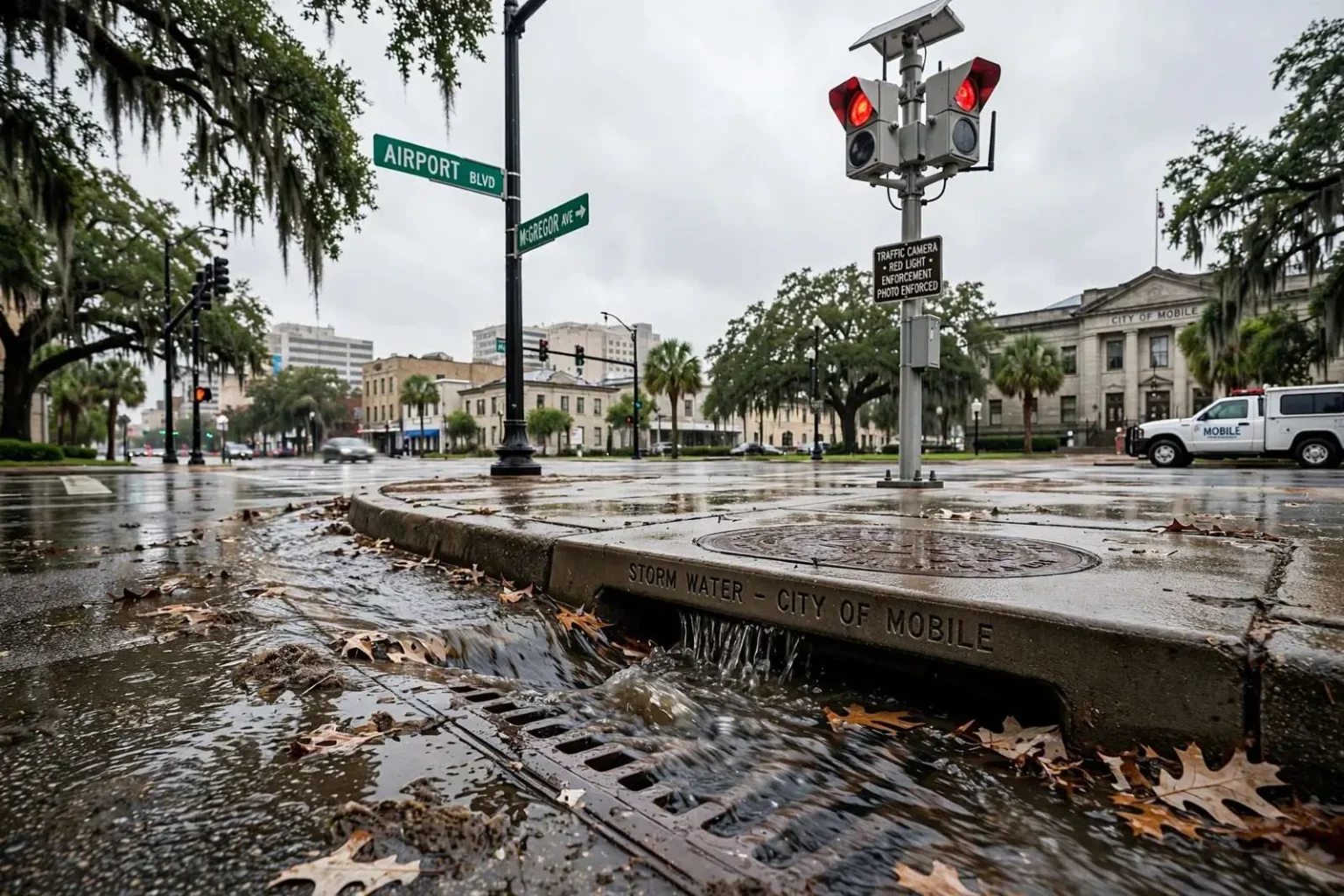
Among the intersections mentioned for cameras were Airport Boulevard at McGregor Avenue, Airport at University Boulevard, and Cottage Hill at Hillcrest Road, each carrying tens of thousands of vehicles daily. Those corridors are among the busiest in west Mobile, where successive waves of commercial development have concentrated traffic onto a handful of arterial roads. Airport Boulevard alone functions as the city’s central east-west spine, and its intersections with McGregor and University sit at the heart of the retail district that anchors the city’s sales tax collections.
Red-light camera programs generate revenue through civil citations mailed to vehicle owners captured by the cameras, with violations documented photographically. Supporters describe them as a traffic safety tool that happens to pay for itself; critics see a revenue machine that changes driver behavior in only one place — the intersection with the camera — while shifting rear-end collisions upward as drivers brake abruptly to avoid a ticket.
A Second Attempt
It would mark the second time the city had pushed for traffic-light cameras. The first effort had failed amid objections that included the argument that the program amounted to racial profiling.
That history hung over the renewed proposal. Camera programs nationwide had attracted lawsuits and legislative backlash by the time Mobile revisited the idea, with disputes over due process, ticket responsibility and the private vendors that operate the systems under contract. The profiling objection added a local dimension, reflecting concerns about where cameras would be placed and which neighborhoods would feel the weight of automated enforcement.
The Legislative Hurdle
Because traffic enforcement in Alabama runs through state law, Mobile could not simply bolt cameras onto its intersections on its own authority. The plan required approval from the Legislature, a step that gives Mobile’s delegation effective veto power over any automated enforcement program within the city. That structural reality has shaped municipal finance debates in Alabama for decades: the state’s cities depend on local legislative delegations for the authority to raise money in ways that fall outside their standard toolkit.
For Mobile, the dependency is familiar. The city has periodically sought local legislation on everything from occupational-type measures to traffic enforcement, and each request passes through a delegation whose members answer to constituencies well beyond the city limits. A camera program that had already failed once locally faced the additional challenge of persuading legislators that the second attempt would be run more carefully than the first.
The Budget Context Behind the Search
The pressure driving these proposals was not a single-year shortfall but a structural squeeze familiar to cities across the Gulf South. Sales taxes recover quickly when the economy grows, but they fall just as fast in a downturn, and they provide no natural cushion for the pension and health care obligations that keep growing regardless of the economic cycle. A city that leans on sales tax revenue, as Mobile does, must either grow its retail base continually or find new sources when obligations outpace collections.
The storm water ordinance represented the most tantalizing option on the table precisely because it required no new legislation — the city had already adopted it. Enforcing an existing ordinance is administratively difficult, as Drummond noted, but it is legally straightforward. The cameras, the health insurance changes and the pension restructuring all carried political and procedural costs that the fee collection did not.
Storm water utilities in peer cities offer a preview of what enforcement would mean. Cities that operate funded storm water programs bill the fee monthly or annually, maintain dedicated drainage crews and can point to visible projects — culvert replacements, flood mitigation, ditch maintenance — paid for with the proceeds. In Mobile, drainage complaints have been a recurring feature of neighborhood meetings, particularly in low-lying areas where heavy Gulf rains overwhelm older infrastructure. Advocates for enforcement argued that $10 million a year could fund exactly the drainage work residents already expect the city to perform.
Weighing What Remains
As officials weighed the options, the underlying reality was plain: a city government straining to close its gaps was looking hard at revenue it had left on the table and at new tools that had proven contentious before. Each candidate remedy carried its own constituency and its own opposition — employees on the insurance question, motorists and civil libertarians on the cameras, commercial property owners on the storm water fees — and none of them could close the pension gap alone.
What the debate made clear is that Mobile’s budget questions were less about finding money than about choosing which form of friction the city was willing to impose on itself. The uncollected fee required no vote, only the will to collect it. The cameras required permission the city had already been denied once. The insurance contribution increase required pushing costs onto the city’s own workforce. Every path had a price, and the city’s leaders were deciding, publicly and imperfectly, which price was worth paying.