Stan the New Man: A 30-Year FBI Veteran Takes a Seat on the Fairhope City Council
Dan Stankoski spent three decades at the FBI supervising violent crime, domestic terrorism and civil rights cases. Now he's on the Fairhope City Council worrying about the next bottleneck on Highway 181.
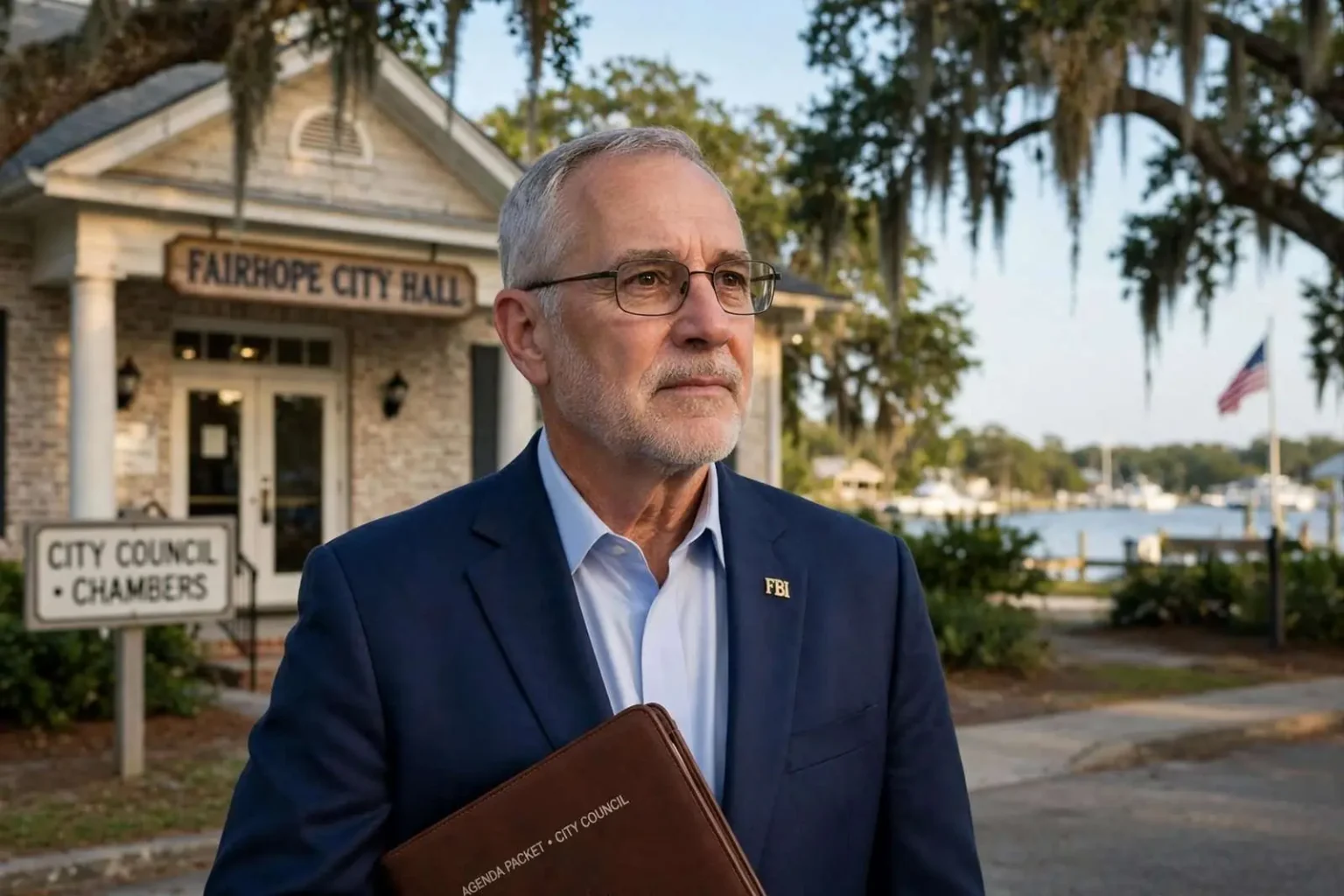
FAIRHOPE — The newest member of the Fairhope City Council may be the most overqualified man ever to sit on the Tree Committee. Dan Stankoski spent 30 years with the Federal Bureau of Investigation, where he served as a supervisor for the Violent Crime Task Force and worked in the Domestic Terrorism Division, the Civil Rights Division and the Foreign Counter-Intelligence Program. If a threat ever sails up Mobile Bay and interferes with Fairhope’s voters, the city now has someone on the council who has personally handled each piece of that problem. In the meantime, he is learning the far less glamorous business of municipal government.
The range of his federal career is worth pausing over. Supervising a Violent Crime Task Force means coordinating the federal and local officers who chase bank robbers, fugitives and the worst of the region’s street crime. Work in the Domestic Terrorism Division put him inside the bureau’s response to homegrown threats in the years when that division was rebuilding itself. The Civil Rights Division’s caseload, at its height, ran from hate crimes to police abuse investigations. And the Foreign Counter-Intelligence Program — the oldest and most secretive of the FBI’s missions — deals with spies, recruitment attempts and the quiet war over secrets that never makes a courtroom.
None of it, as he has discovered, prepares a man for deciding where a sidewalk goes. Fairhope, the small city on the eastern bluffs of Mobile Bay, governs itself through monthly council meetings, committee work and a civic culture in which residents show up and speak their minds on everything from zoning to parking. Stankoski has traded surveillance work for agenda packets.
The “part-time” job
Stankoski works full-time as an investigator in the Federal Public Defender’s Office in Mobile, is a full-time family man — wife Cheryl, two sons, a daughter and a grandchild — and serves part-time on the council. It is that last category that has surprised him.
“The time requirements for this ‘part-time job’ have been a bit of a surprise to me,” he said. “The two monthly meetings, the committee meetings, the work sessions — I take annual leave from my full-time job in Mobile for all of that. But add to it all the time I spend because I’m new and I’m learning the systems, and then returning phone calls and answering letters. It adds up. But as I get into it and with a lot of hard work, it should smooth out.”
Like every Fairhope council member, Stankoski sits on the Finance Committee. As the newcomer, he did not get to choose his other assignments: Tree Committee, Recycling, Recreation and Sister Cities. He may be better suited to Recreation than the assignment sheet suggests. Longtime FBI colleague and friend Joe Mahoney offered a scouting report. “Stan, in addition to being a great guy and hard worker, is a tremendous athlete,” Mahoney said. “I remember him being a state-ranked tennis player all through the ’80s and ’90s.”
The Sister Cities assignment, an odd-sounding one in a town of Fairhope’s size, is in fact a genuine program: the city has long maintained sister-city relationships as part of its civic identity, and the committee’s work keeps those ties — student exchanges, cultural visits, correspondence between municipal officials — alive. Stankoski’s counterintelligence years, one might argue, are not entirely wasted there either.
Money first, then growth
Stankoski describes himself as fiscally conservative, and his stated first priority is unglamorous. “It’s time for Fairhope to look at finances, see what we’ve got and where we want to go,” he said.
The reason is the second priority. Baldwin County was in the middle of a building boom, and Fairhope had seen a 14.6 percent increase in housing permits even as Riviera Utilities and Baldwin EMC curtailed expansion of service. Rooftops were arriving faster than the infrastructure meant to serve them.
“I want to be proactive in terms of looking five to seven years down the road and be prepared for the additional needs, such as public safety and infrastructure,” he said. “Look at the bottleneck on 98 now. If the right planning and groundwork isn’t in place, you’ll have the same situation on 181 in a couple of years. There are serious issues with growth and you have to be proactive.”
The warning proved prescient. Two decades on, both U.S. 98 and Baldwin County 181 remain central to every conversation about Eastern Shore traffic.
The utility detail in his remarks mattered more than it might seem. Riviera Utilities, Fairhope’s municipal electric, gas and water provider, and Baldwin EMC, the member-owned electric cooperative serving much of lower Baldwin County, were both constraining how fast they could extend service to new subdivisions. For a growing city, that meant development pressure would keep coming while the capacity to serve it lagged — a gap that shows up eventually in traffic, school crowding and the cost of catching up on roads and drainage. A council member who understands the tension between permit counts and utility capacity is, in effect, reading the city’s future from its billing maps.
The road warning also read the county correctly at the time. U.S. 98 through Fairhope had already become the symbol of Eastern Shore congestion, and State Route 181, running north-south through the county’s fast-growing center, was the corridor every planner knew would inherit the next wave of development. Two decades later, widening projects and interchange debates on both routes remain fixtures of Baldwin County politics, and the growth Stankoski described has only continued, making Baldwin County one of the fastest-growing counties in Alabama year after year.
The character witnesses
What is striking about Stankoski is not the résumé. It is the testimony from quarters where a career federal agent would ordinarily expect no kindness at all.
Defense attorney Bob Clark — known as “Cowboy,” a man who wears a “Lawyer from Hell” lapel pin and for whom the word irreverent is an understatement — has built a career persuading juries to see the accused in a sympathetic light. Asked about law enforcement agents generally, Clark tends toward language unfit for print. Asked about Stankoski, he turned uncharacteristically plain.
“He did his job, did a good job and never took it personally,” Clark said. “He was always straight.”
An even less likely source of praise was Pauline Anders, the former council member Stankoski defeated in the recent election. Her assessment of the man who beat her: “Stankoski is a good man.”
That single sentence, offered without qualification by a defeated opponent, says a good deal about both of them — and something about the political culture of Fairhope besides. The city has long cultivated a self-image of civic gentility, and an outgoing official who blesses her successor is one of the ways that image is maintained in practice, not just in brochures.
Elsewhere on the Baldwin County political grapevine: Republican Attorney General Troy King appeared likely to draw opposition in the 2006 elections. Rick Kuykendall, a lawyer of 25 years’ standing and a behind-the-scenes Democratic power broker, acknowledged he was considering a run. Mobile County District Attorney John Tyson, another Democrat, was also reported to be interested. A call to Tyson was not returned.
The attorney general’s race was shaping up as one of the more interesting statewide contests of the cycle. King had been appointed to the office after his predecessor moved to the Court of Criminal Appeals, and like any appointee who inherits a statewide seat, he had yet to face voters on his own. A challenge from a Baldwin County lawyer with two and a half decades of practice behind him would have given the race a Gulf Coast flavor and tested whether Democrats could compete in the county’s growing river of new arrivals.
Kuykendall’s profile as a possible candidate said something about the state’s Democratic bench. Behind-the-scenes power brokers rarely step forward, and when they do it is usually because the party’s obvious names have declined. Tyson, for his part, was one of the longest-serving district attorneys in the state’s largest county, with a prosecutorial record that made him credible in a law-enforcement office, though a race statewide would have meant leaving a job he had held through some of Mobile’s most prominent trials.
Neither the grapevine nor the speculation settled anything; a call not returned is a story that ends where it began. But the episode illustrated how Baldwin County politics worked in that era — names floated at Rotary lunches and in lawyers’ offices, waiting to see whether someone else flinched first. For Fairhope, meanwhile, the immediate question was simpler: whether its new councilman, who had spent three decades handling problems most cities never see, could also handle the ones every city does — budgets, roads, trees and the pace of growth on the Eastern Shore.
Stankoski’s own account of the adjustment suggests he intends to try. “It adds up,” he said of the workload, “but as I get into it and with a lot of hard work, it should smooth out.” Fairhope, a city that takes its committees seriously, now has a councilman who supervised task forces for a living and treats a Tree Committee assignment with the same discipline. Whether that turns out to be overqualification or simply the right fit for a fast-growing city will be measured, as these things always are, one budget season and one road project at a time.