Dinner & a Movie: Pork Chops Over Farro Salad and ‘Would You Rather’
This week's Dinner & a Movie plates seared pork chops over a corn-and-kale farro salad with plum salsa, alongside 'Would You Rather,' a dark thriller not meant for the whole family.
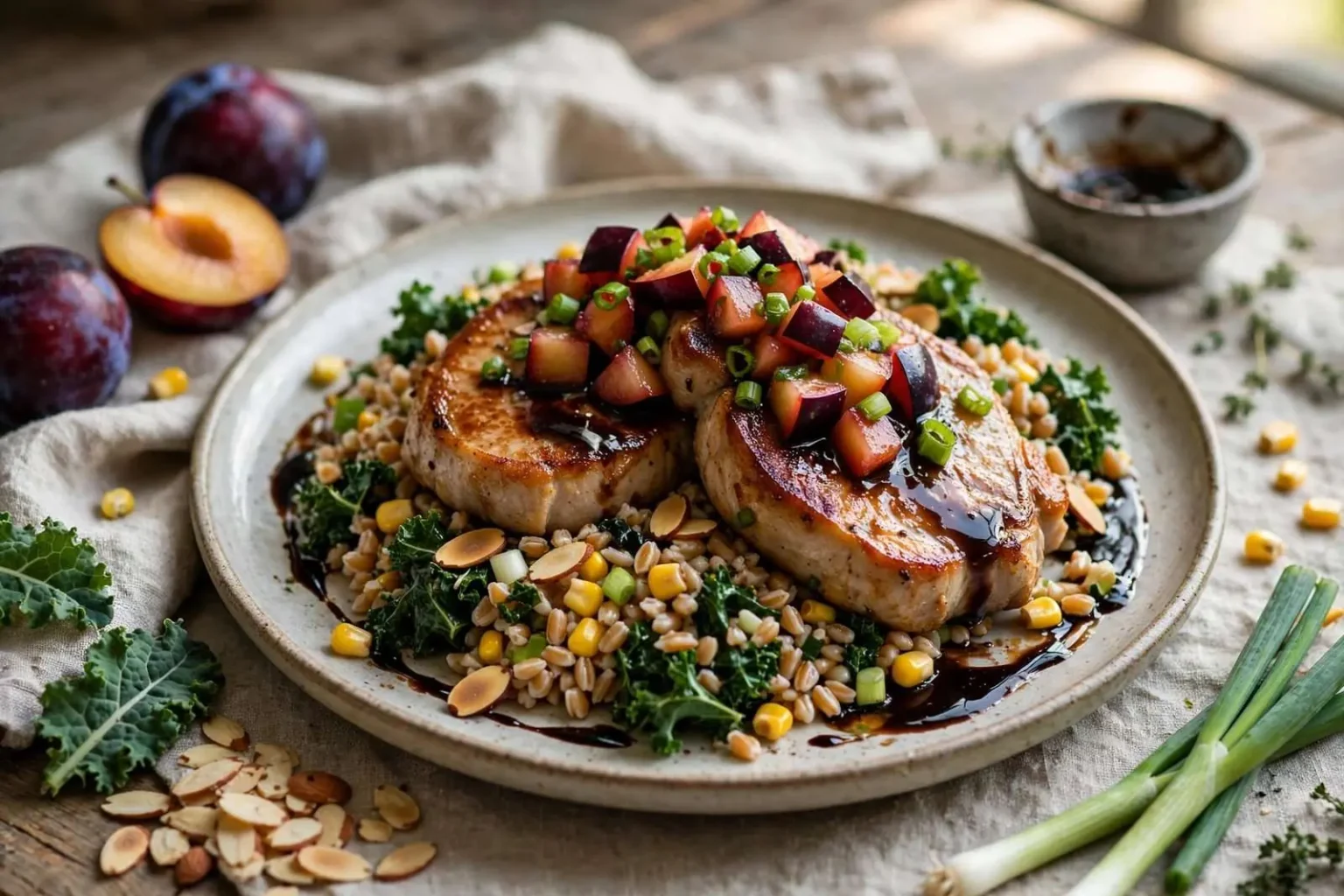
This week’s Dinner & a Movie leans hearty and seasonal: seared pork chops set over a corn-and-kale farro salad, brightened with a quick plum salsa and a balsamic pan sauce. The film, on the other hand, is a dark and violent thriller best saved for after the kids are in bed.
The pairing works on the principle every regular reader of this column knows well: a plate with enough warmth and substance to settle the table before the movie unsettles everything else. Late-summer produce is at its peak in this menu — sweet corn, tender kale and tree-ripened plums all show up at Gulf Coast markets in the same few weeks — and the recipe is built to let them carry the meal while the chops do the savory lifting.
In the kitchen: Pork Chops Over Farro Salad
You will need two boneless center-cut pork chops, half a cup of farro, scallions, a bunch of kale, an ear of corn, a plum, balsamic vinegar, butter and sliced almonds.
Cook the farro. Meanwhile, slice the corn off the cob, slice the scallions, chop the kale and dice the plum. Saute the corn and white scallion parts, then add a splash of water and the kale and cook until wilted. Fold the vegetables, almonds and half the vinegar into the farro and dress with olive oil. Season and sear the pork chops a few minutes per side until golden, then rest them five minutes.
In the same pan, add the remaining vinegar and a little water, reduce by half and swirl in butter for a quick sauce. Toss the plum with the green scallion tops for a salsa. Plate the farro, top with a chop, spoon on the salsa and pour the sauce over all. It is a satisfying plate that balances sweet, tangy and savory in a single forkful.
A few notes on the components, for cooks who have not worked with them. Farro is an ancient wheat grain with a chewy bite and a nutty flavor that holds up under dressing far better than rice or couscous; simmer it in generously salted water until tender but still firm, then drain, and it behaves like the best kind of grain salad base. It is a staple of central Italian cooking, where it has been grown since antiquity, and it has moved steadily onto American restaurant menus and grocery shelves over the past decade.
The corn and kale treatment here is worth remembering beyond this recipe. Sauteing kernels straight off the cob concentrates their sugar, and wilting kale with a splash of water — rather than blanching it first — keeps the greens from going watery while softening their bitterness. Together with the scallion whites they make a quick warm vegetable fold that can top any grain.
The plum salsa is the dish’s surprise. Diced ripe plum tossed with scallion tops needs nothing more than a pinch of salt to become a sweet-sharp counterpoint to the seared meat, the way a fruit salsa cuts through rich proteins all across Southern cooking — think peach with pork, or blueberry with duck. Choose plums that yield gently at the shoulder; fruit that is rock-ripe will dissolve into the salad, while underripe fruit will taste of nothing.
The balsamic pan sauce is the technique piece. After the chops rest, the pan holds browned bits that carry most of the flavor; adding the remaining vinegar and a splash of water dissolves them, and reducing by half concentrates the vinegar’s sweetness into a glaze. A knob of butter swirled in off the heat gives the sauce body and gloss. The whole operation takes two minutes and turns a simple sear into something that reads as deliberate.
Cook the chops with restraint. Center-cut chops a half-inch to an inch thick need only a few minutes per side over medium-high heat; they are done when the meat has firmed and the interior just loses its blush. Overcooked pork is dry pork, and the five-minute rest is not optional — it lets the juices redistribute so they stay in the meat when it is cut.
At the movies: ‘Would You Rather’
In “Would You Rather,” directed by David Guy Levy, a young woman whose brother is dying agrees to compete in a sadistic dinner-party game hosted by a wealthy man who promises to pay for the cure. Each round forces the desperate contestants into a lesser-of-two-evils choice, and the stakes only climb from there.
The ensemble includes Brittany Snow, Jeffrey Combs, John Heard, June Squibb and Robin Lord Taylor, all doing fine work. Snow carries the film as the reluctant contestant whose need is real and whose options shrink by the minute, while Combs turns the host into a study in urbane menace — a man who treats cruelty as entertainment and etiquette as a weapon. Heard and Squibb give the supporting rounds genuine texture, playing players with histories and pressures of their own rather than disposable victims.
The premise taps into a durable strain of thriller — the dinner party from hell, where civilization’s manners barely mask appetite and cruelty. The game format gives the film its engine: because every round presents a choice rather than a random attack, the characters are made complicit in each other’s suffering, and the tension comes as much from watching people rationalize as from watching them suffer. It is a structure that keeps the audience doing arithmetic alongside the contestants, weighing each option and dreading the next question.
What elevates the picture above its premise is the desperation at its center. The contestants are not thrill-seekers; they are people backed into corners by medical bills, debt and family obligations, which is exactly the pressure the host knows how to exploit. The horror lands because the incentives are believable — no supernatural element, no contrived setup, just money offered at the precise moment it cannot be refused.
This is a dark, suspenseful, borderline sadistic film with a surprise twist at the end that makes it worth the watch – though it is emphatically not for children or the squeamish. Our verdict: two thumbs up, with a warning label attached.
Making the Evening Work
Serve the pork chops, and steel yourself for a tense evening. The meal’s sweetness — corn, plums, balsamic — is the right counterweight to a film this grim, and the farro salad holds well if dinner needs to be plated early and eaten slowly while the tension builds. Finish the kitchen work before the movie starts; you will not want to be up and about during the third round.
For households that screen films with an audience of mixed tolerances, this is a night to split the party. The movie belongs firmly in the after-bedtime category, and anyone at the table who leans away from psychological cruelty should be offered a different queue and a second helping of farro salad instead. The dish, at least, hurts no one.
Leftovers, for what it is worth, are the meal’s quiet bonus. The farro salad improves overnight as the grain absorbs the dressing, and a leftover chop sliced over the next day’s salad — or tucked into bread with a smear of the plum salsa — makes a lunch that outclasses anything from the office vending machine. Cook the full half cup of farro even for two; the grain keeps for days and the recipe scales up without adjustment.
And a closing word on the column’s ongoing thesis: that dinner and a movie are best planned together, as one evening’s arc. A heavy thriller calls for a grounding meal — something with grain, greens and fruit, served at a real table, eaten at a real pace. The ritual matters. It slows the household down before the film speeds the pulse up, and it reminds everyone involved that the evening’s second half, however dark, is still entertainment — chosen freely, unlike the choices on the screen, and survivable by everyone at the table.
Next week’s pairing leans lighter — a spring pasta and a comedy — but this week belongs to the chops and the chill. Cook the farro, sear the pork, dim the lights, and remember the warning label: two thumbs up, with the squeamish advised to wait for next week.
One more word on farro for shoppers: it comes in whole, semi-pearled and pearled forms, and the difference is mostly time. Pearled farro cooks the fastest and is what most supermarkets stock; whole farro rewards patience with a firmer bite and deeper flavor. Either works in this salad, so buy what the store has and taste for doneness rather than watching the clock — the grain should swell and soften but never split or go mushy.
Kale shoppers face a similar choice between the curly variety and the flat-leaf lacinato type, and either suits the dish. Remove the tough central rib before chopping — fold each leaf in half along the stem and strip it away with a knife stroke — then chop the leaves roughly. Chopped small, the kale wilts in the time it takes the water to evaporate; chopped large, it stays leathery. The almond garnish should be toasted until it smells nutty, whether done in a dry skillet or in the oven while the farro simmers, since raw almonds disappear into the salad instead of punctuating it.
Wine pairings are simple for a plate like this: a crisp white with enough acidity to meet the balsamic — a Pinot Grigio, a dry Riesling or an Alabama-grown Seyval from one of the state’s small vineyards — or, for a red drinker, a light Italian number served slightly cool. Skip anything oaky or heavy; the meal’s charm is its brightness, and the film will supply all the weight the evening needs.