150th Battle of Mobile Bay Commemoration Aims for Education and an Economic Boost
With thousands of visitors expected at Fort Morgan and Fort Gaines, organizers of the three-day 150th Battle of Mobile Bay commemoration hoped the coastal event would deliver both an economic surge and a lasting lesson.
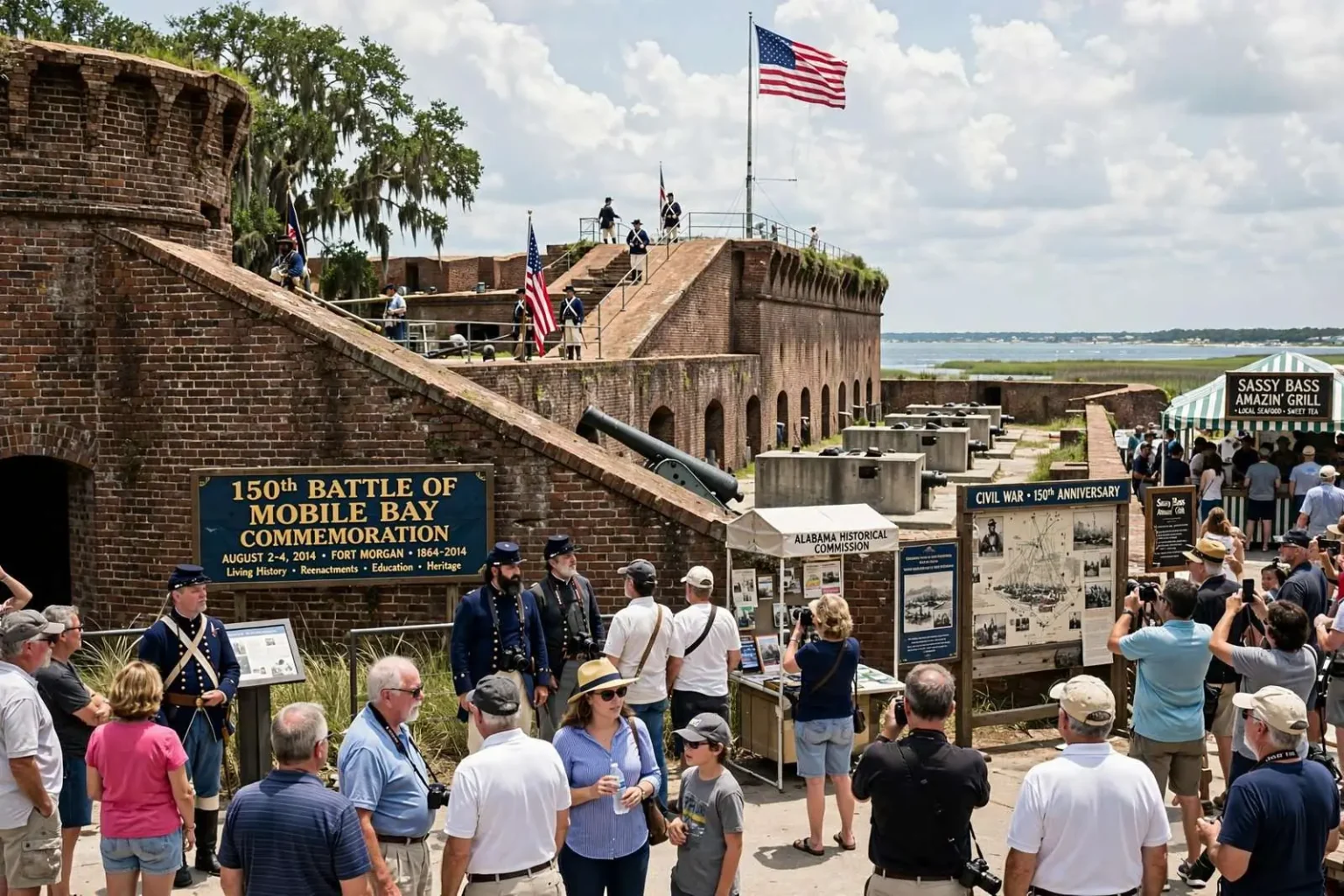
With thousands of visitors expected at Fort Morgan and Fort Gaines for a three-day commemoration marking the 150th anniversary of the Battle of Mobile Bay, local leaders hoped the weekend would deliver an economic surge along with an eye-opening history lesson. The observance arrived during an already busy stretch on the coast, which was hosting vacationing families, concertgoers at The Wharf and youth baseball teams competing in a regional tournament at Orange Beach. For a Baldwin County economy that depends heavily on summer travel, the convergence of so many events in a single weekend was a welcome alignment of history and commerce.
The original battle being commemorated remains one of the most famous naval engagements in American history. On August 5, 1864, a Union fleet under Rear Adm. David G. Farragut fought its way past the forts guarding the mouth of Mobile Bay, sank the Confederate ironclad CSS Tennessee in a lopsided duel, and closed the port that had served as one of the last major gateways for blockade runners supplying the Confederacy. It was in that engagement that Farragut was said to have issued the order remembered as “Damn the torpedoes, full speed ahead,” a phrase that has been attached to the battle ever since. The victory gave the Union control of the bay, though the city of Mobile itself did not surrender until the closing weeks of the war the following spring.
The two forts that anchored the battle’s opening act still stand on opposite sides of the ship channel. Fort Morgan, completed in the 1830s on the tip of the Fort Morgan peninsula, and Fort Gaines, built on the eastern end of Dauphin Island, were designed as a matching pair to protect the bay entrance. Their brick walls took part in the 1864 fight, and both were later pressed into service during the Spanish-American War era and both world wars, which is why visitors today find not only the original masonry works but also concrete batteries scattered across both sites.
A boost for the coastal economy
“It is definitely having an impact,” said Herb Malone, president of Gulf Shores and Orange Beach Tourism, who noted that even rental properties away from the beach were feeling the effect. Malone’s organization markets the Gulf Shores and Orange Beach area as one of the state’s premier destinations, and a heritage event of this scale drew a different kind of visitor than the typical sun-and-sand vacationer, adding overnight guests in parts of the county that do not always see peak-season demand.
Missy Zak, vice president of marketing for Meyer Real Estate, said the company’s 1,400 rental properties were trending at 93 percent occupancy, with the Fort Morgan peninsula itself near 89 percent and weekend promotions still available. The Fort Morgan figures were particularly notable because the peninsula sits at the far western end of the county, away from the high-rise condominium corridors of Gulf Shores and Orange Beach, and its rental inventory consists largely of houses and low-rise units that depend on drive-in family travel. An event that pushed occupancy there into the high 80s in the middle of a competitive summer season was, by any measure, a strong result.
Restaurants braced for crowds as well. The event’s exclusive food vendor was Sassy Bass Amazin’ Grill, based on the Fort Morgan peninsula, a homegrown operation that gave the weekend a distinctly local flavor and kept visitor spending inside the community. For small businesses along State Highway 180 and the peninsula’s handful of commercial stops, three days of thousands of history-minded guests meant a weekend that felt more like a holiday than an ordinary August Saturday.
Preservation with a long horizon
Stephen McNair, director of historic sites at the Alabama Historical Commission, hoped the commemorations would pay dividends for years. Sponsored by the commission and the Coastal Alabama Business Chamber, the events were funded by a $400,000 grant, half of it directed toward long-term capital improvements at the historic properties. The Alabama Historical Commission, the state agency charged with preserving Alabama’s historic places, owns and operates Fort Morgan as a state historic site, and the chamber’s involvement reflected the business community’s recognition that heritage tourism is a durable part of the coastal economy rather than a one-weekend curiosity.
“We have an obligation that we take very seriously to make sure that as much of that money stays local and makes as large an economic impact in Baldwin County as possible,” McNair said. That commitment shaped the way the improvements were planned, with contractors and suppliers drawn where practical from the local area so that grant dollars circulated through county businesses before the commemoration even began.
At Fort Morgan, the improvements included safety upgrades ranging from new stairs and handrails to brick and mortar repairs, a new flagpole, entrance sign and walkways. Much of that work addressed basic visitor access across a site whose original builders in the nineteenth century never contemplated thousands of guests climbing over them in a single afternoon. New stairways and handrails made the fort’s elevated passages safer for families with children and older visitors, while masonry repairs protected the original brickwork from the salt air and storms that constantly test structures on the Gulf.
“The safety repairs won’t be completed until early 2015 and we hope these repairs will last at least 50 years,” he said. The long timeline underscored the commission’s view of the fort as a permanent public asset: money spent on stairs and mortar in 2014 was intended to serve visitors for the next half-century and beyond, through future anniversaries that will mark the battle’s 175th and 200th years.
A weekend of battles and ceremony
McNair said he expected a total of 20,000 visitors over the three days, with a possible one-day peak of 10,000 for Saturday’s re-enactments. Organizers built the schedule so that each day offered a different experience, balancing battle re-enactments with music, ceremonies and living history demonstrations designed to give newcomers genuine context rather than spectacle alone.
“Our objective is to make it as family friendly and exciting as possible but also as accurate as possible,” he said. “We feel that there’s truly something for every age and every interest level in the Civil War.” Accuracy was a recurring theme for the organizers, who worked with re-enactment groups that study uniforms, drill and period equipment, a standard that separates serious commemorations from casual entertainment.
Activities on the Fort Morgan side began Friday night with artillery firing at the Water Battery and period music performed by Bobby Horton, a Alabama-based musician widely known for his recordings of Civil War-era songs performed on period instruments. Saturday featured a commemorative ceremony and military salute, with music by the 151st Army Band, an Alabama National Guard unit, and a keynote speech by U.S. Rep. Bradley Byrne, R-Fairhope, whose district includes the Baldwin County coast. The formal remarks connected the 1864 battle to the generations of service members who have trained and served on the same ground in the century and a half since.
Later that day came the Siege of Fort Morgan infantry battle, an evening grand bombardment with artillery and aerial pyrotechnics that gave spectators a sense of the fire the fort absorbed during the siege. Sunday brought another infantry battle and a surrender ceremony that included a salute to the colors with Gov. Robert Bentley and his wife, Dianne, closing the weekend with the kind of formal acknowledgment that the 150th anniversary of a pivotal state and national event deserved.
Commemorations across the channel at Fort Gaines
Commemorations at Fort Gaines on Dauphin Island began Saturday, with stories of Civil War photographer Matthew Brady, a period church service and a talk on Col. Charles Anderson, commander of Fort Gaines. Anderson was the Confederate officer who surrendered the fort to Union forces after a short siege, and his story illustrated the hard choices faced by garrison commanders when the fleet outside the walls proved overwhelming. Brady’s photography, meanwhile, gave audiences a window into how the war was recorded and transmitted to the public in an era when images of battle were still a novelty.
Dauphin Island’s role in the weekend highlighted the two-community character of the commemoration. Visitors could stand in the brick casemates of Fort Gaines in the morning and, if they caught the ferry across the channel, walk the ramparts of Fort Morgan that afternoon, retracing the route of the battle in miniature. The ferry connection between the two sites has long been one of the region’s more scenic tourist experiences, and anniversary crowds gave it a period-appropriate purpose.
From a visitor’s perspective
From a visitor’s perspective, Malone said the famed battle had always intrigued travelers, some of whom planned trips specifically to see Fort Morgan and Fort Gaines. He called the weekend a “unique, one-time event,” a phrase that captured both the historical stakes and the marketing reality: a 150th anniversary happens once, and coastal leaders understood that guests who came for it would leave with memories that ordinary beach weekends rarely produce.
Revenue from ticket sales at Fort Morgan was to benefit the Alabama Historical Commission, which owns and maintains the fort and surrounding park. That arrangement meant the event supported the site twice over, once through grant-funded capital improvements and again through gate receipts that fund ongoing operations. For a state historic site that must generate much of its own operating support, a weekend of 20,000 visitors was more than a commemoration; it was a demonstration of how heritage tourism can sustain the very places that make it possible, in Baldwin County and across Alabama.