Gulf Shores and Dauphin Island Beaches Earn National ‘Superstar’ Water-Quality Honor
Two Gulf Shores beaches and the public beach on Dauphin Island were named national water-quality 'superstars' in an annual study, ranking among the cleanest of thousands of coastal beaches nationwide.
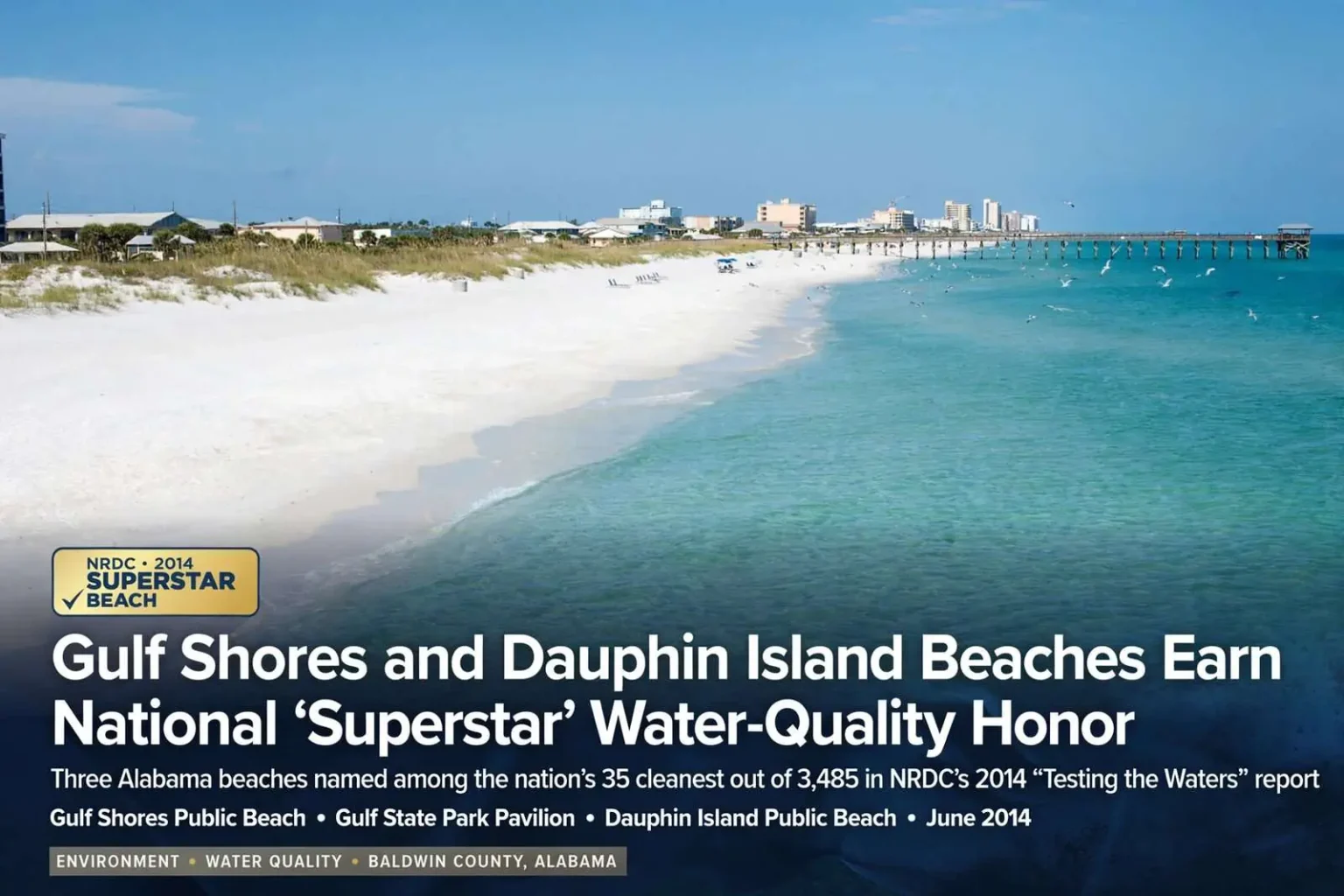
Three stretches of Alabama’s coastline earned national recognition for clean water, standing out among thousands of beaches surveyed across the country.
In an annual water-quality study, the Natural Resources Defense Council named two Gulf Shores beaches and the public beach on Dauphin Island as “superstars,” a designation reserved for the nation’s most consistently clean coastal waters.
The recognition came in the environmental group’s report, “2014 Testing the Waters: A Guide to Water Quality at Vacation Beaches.” The council singled out Gulf Shores’ public beach and the Gulf State Park Pavilion, along with Dauphin Island’s beach, placing them among just 35 superstar beaches selected after an analysis of 3,485 coastal sites nationwide.
To be counted among 35 out of 3,485 is to sit at the very top of a national distribution — the equivalent, in beach terms, of a perfect attendance record maintained across four consecutive years of sampling. For the two Baldwin County sites and the barrier-island beach on the west end of Mobile Bay’s mouth, the honor arrived just as the coast’s most important season was gearing up.
Gulf Shores’ public beach sits at the heart of the city’s tourist district, within walking distance of the shops and condominiums that anchor the strip along Highway 182, and it absorbs a larger share of the state’s beachgoing public than any other single stretch of sand on the Alabama coast. The Gulf State Park Pavilion lies a short drive east, on the protected acres of Alabama’s largest state park, where the pavilion grounds offer parking, picnic shelters and one of the widest public access points between the city and the Florida line.
Dauphin Island’s public beach occupies the western end of the island, the long sand spit that guards the entrance to Mobile Bay. The island’s beaches face the open Gulf on one side and the quiet waters of the bay on the other, drawing families, birders and anglers in numbers that swell each summer from a small year-round population into a seasonal town.
Pride along the coast
Gulf Shores Mayor Robert Craft welcomed the honor. “As a city, we take great pride in our beaches,” Craft said in a prepared statement. “Our staff works extremely hard to provide some of the country’s most pristine beaches to our residents and visitors. Receiving this ranking from the NRDC is an exceptional honor and is truly a credit to our entire team.”
The mayor’s credit to “our entire team” referred to the municipal crews whose work is largely invisible when it succeeds — the daily grooming of the sand, the maintenance of public access points, the coordination with state and county agencies whose sampling programs document the water quality in the first place.
Tourism is the economic engine of Gulf Shores and its neighbors along the Pleasure Island and Baldwin County coast, and the beach is the product. City officials have long treated the quality of the water and the sand not as an amenity but as infrastructure — the asset on which the city’s lodging tax collections, restaurant business and real estate values all ultimately rest.
How the rankings worked
To qualify as superstars, beaches had to clear a demanding standard. The council selected sites that had not exceeded the previous national bacteria threshold of 104 enterococcus colony-forming units per 100 milliliters of water between 2009 and 2012 by more than 2 percent, and that also had not exceeded the newer, stricter Beach Action Value by more than 2 percent in the most recent year.
Enterococcus is the indicator organism the federal government uses to judge the safety of recreational salt water. It is not usually dangerous itself; rather, its presence in a water sample signals that fecal contamination has found its way into the water — from storm drains, from sewage overflows, from the waste of animals washed off streets and lawns — and that pathogens able to make swimmers sick may be present alongside it.
That newer benchmark, the Beach Action Value, sets a more protective threshold of 60 enterococcus colony-forming units per 100 milliliters, reflecting the Environmental Protection Agency’s tightened water-quality guidance. The EPA’s revised recommendations, issued after years of epidemiological study, gave states a more conservative yardstick for deciding when to post an advisory and keep swimmers out of the water.
The distinction between the two thresholds matters for how a beach’s record reads. A site can pass the older, looser national standard for years while occasionally tripping the newer one; the superstar designation required passing both — a five-year clean bill under the old standard and a current one under the stricter measure. That double test is why so few beaches out of so many made the list.
Exposure to bacteria, viruses and parasites in contaminated water, the report warned, can cause a range of illnesses, from ear, nose and eye infections to gastrointestinal and respiratory problems. The risks are greatest for children, the elderly and swimmers with weakened immune systems, and they rise when swimmers submerge their heads or swallow water in the hours after an advisory has been posted.
Monitoring along the Alabama coast is a cooperative effort, with samples collected at fixed stations through the swimming season and results posted publicly, so that a family planning a beach day can check the status of the water before it leaves the house. It is that sampling record — built station by station over years — on which national rankings like the NRDC’s depend.
A mixed picture statewide
The honors stood in contrast to Alabama’s overall standing. In 2013, the state monitored 97 coastal beaches, and 11 percent of samples exceeded the Beach Action Value. Alabama ranked 17th out of 30 states in beach water quality.
A middling rank, in a report that covers everything from the Great Lakes to the Gulf, is neither a warning nor a triumph. But the state-level number hid a sharp split: the Gulf-facing beaches that anchor the tourism economy consistently posted some of the cleanest samples, while bay and sound beaches — where water circulates more slowly and stormwater has farther to travel — accounted for most of the trouble.
The report also flagged the state’s lowest-performing sites in 2013. Among them were May Day Park on Mobile Bay in Daphne, which exceeded the bacteria threshold in 19 percent of its samples; Fowl River at Highway 193 in Mobile County (19 percent); Pirate’s Cove in Josephine on Arnica Bay (19 percent); Volanta Avenue in Fairhope on Mobile Bay (19 percent); Orange Beach Waterfront Park on Wolf Bay (18 percent); and Spanish Cove in Lillian on Perdido Bay (18 percent).
The pattern in that list is instructive for anyone who swims on the Alabama coast. Every one of the flagged sites sits on a bay, a river mouth or a lagoon — the sheltered waters inside the barrier islands and peninsulas — rather than on the open Gulf. Enclosed waters receive the runoff of their own watersheds and exchange it with the sea only slowly, so contamination lingers where Gulf beaches flush with each tide.
According to the council, the leading cause of beach closings nationwide is stormwater runoff, with untreated sewage spills and overflows frequently prompting advisories and closures.
Stormwater is the Gulf Coast’s particular vulnerability. Rain that falls on streets, parking lots and lawns does not soak in; it runs off, gathering bacteria, oils and fertilizer on its way to the nearest drain or creek, and the nearest drain or creek on the Alabama coast tends to empty into the same waters where people swim. Heavy summer thunderstorms — a daily feature of the season — can push bacteria counts over the threshold within hours and leave advisories posted for days afterward.
Sewage overflows add a second, less frequent but more serious pathway. Aging collection systems, overwhelmed by the same heavy rains, occasionally release untreated waste into creeks and bays, and utilities are required to report the spills and health officials to warn the public downstream. Every advisory of that kind, the NRDC’s authors noted, is a measure of infrastructure that has not kept pace with development.
The full report was made available online with an interactive map pinpointing more than 3,000 beaches along the Atlantic and Pacific coasts, the Gulf of Mexico and the Great Lakes, allowing a reader to look up any listed beach’s sampling history — the number of samples taken, how many exceeded the standard, and how the site compared with others in its state.
A draw for visitors
For Gulf Shores and Dauphin Island, both anchors of Alabama’s coastal tourism economy, the superstar designation offered a marketable point of pride heading into the busy summer season. Clean water is central to the appeal of the state’s beaches, and a national nod on that measure carried weight with the families and vacationers who fill the shoreline each year.
The timing mattered as much as the honor. The report arrived in early summer, as lodging bookings along the coast build toward their July and August peak and as the destinations compete with Florida Panhandle resorts that draw from many of the same drive-in markets across the Southeast. A third-party, national designation is the kind of credential a destination marketing office cannot buy, and Gulf Shores’ and Dauphin Island’s promoters could quote it all season without fear of contradiction.
The recognition also underscored the ongoing work behind the scenes, from monitoring programs to stormwater management, that helps keep the water safe for swimmers along a coast where the beach is both a way of life and an economic engine.
That work is never finished. Every new rooftop and parking lot added along the coast enlarges the impervious surface that funnels rain — and whatever rain carries — toward the beach, and every aging sewer line is a potential overflow waiting for the next August downpour. The communities that earned superstar status in 2014 did so because their waters sat far from those pathways, and because the agencies and city crews whose names appear on no beach sign kept sampling, grooming and repairing through the off-season.
For the swimmers, the practical message of the report was simple: the Gulf beaches of Alabama, tested against the strictest standard the federal government offers, ranked among the cleanest in the United States — and the bay waters, however calm and inviting on a summer morning, deserved a quick check of the advisory board before the first plunge.