Investors Plan a 655-Lot Community Near Bon Secour Village in Gulf Shores
A locally managed fund paid $3.295 million near Bon Secour Village in Gulf Shores and unveiled plans for a 655-lot community around three lakes, tied to the city's push for a waterway entertainment district.
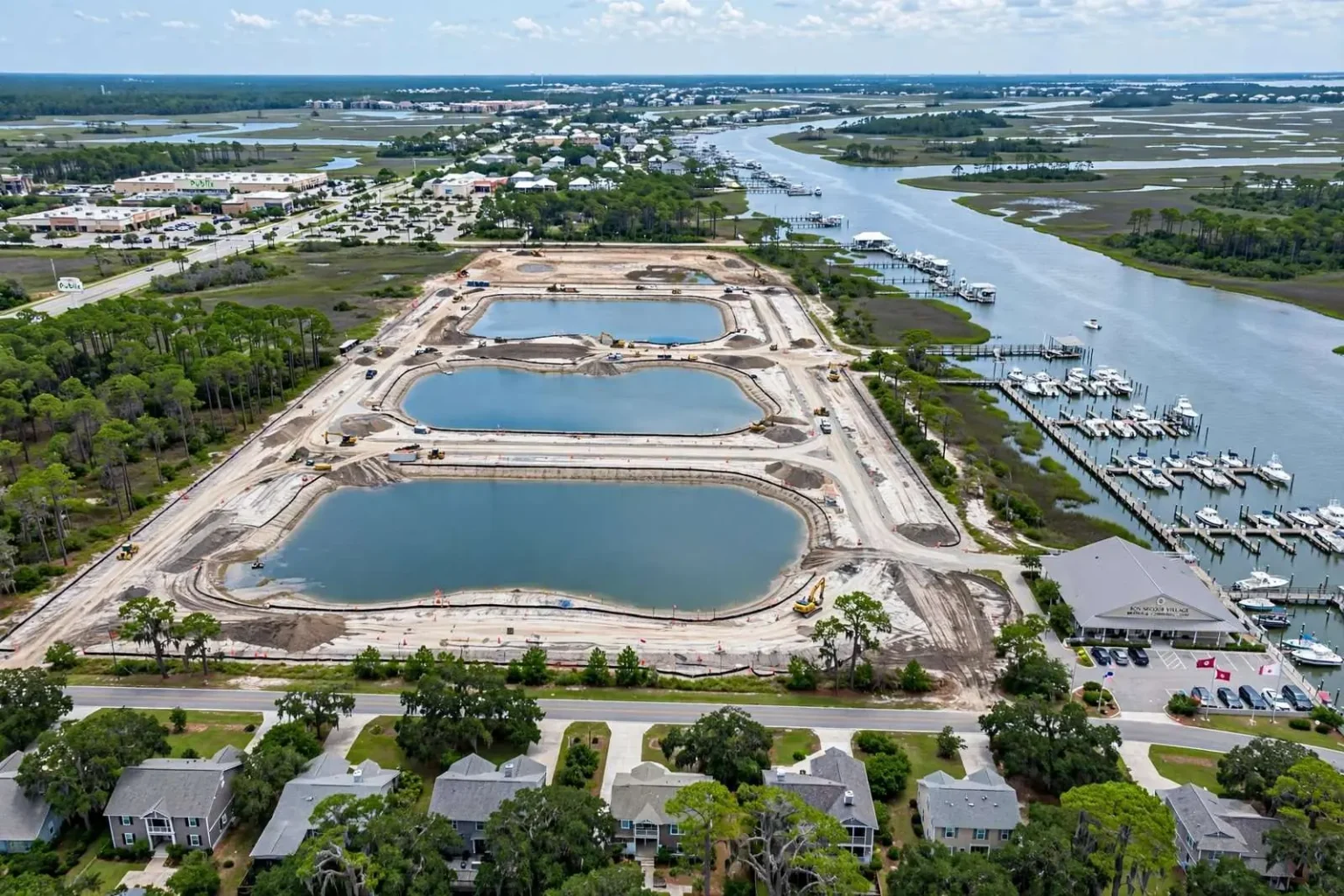
A locally managed investment fund paid $3.295 million for 254 acres at Bon Secour Village, on the Intracoastal Waterway in Gulf Shores, and announced plans to develop a 655-lot residential community, with construction expected to begin in mid-summer. The purchase is one of the larger residential land acquisitions on the Baldwin County side of the waterway in recent years and signals renewed builder confidence in the Gulf Shores market.
“Seeing the success others are having down here in conjunction with the entertainment district is one of the things that sold us on this,” said Nathan Cox of the Gulf Coast Opportunities Fund, which paid cash for the property. “The city sees this as an area of growth.” The fund also held a contract to purchase Bon Secour Village’s conference center and 60-slip marina, a total of 37 acres.
The Gulf Coast Opportunities Fund was formed by Bienville Capital Management principals Ralph Reynolds, Cullen Thompson and Billy Stimpson, along with Cox — all natives of Mobile — who had raised $61 million to buy distressed properties in Baldwin County and coastal Florida. The fund’s strategy of acquiring foreclosed and bank-owned assets at post-recession prices has made it an active buyer along the coast, and the Bon Secour Village tract is its largest single residential play to date.
A land swap and an entertainment district
Gulf Shores Mayor Robert Craft tied the project to the city’s broader ambitions along the water. “Our No. 1 focus for the city is development of a waterway entertainment district,” Craft said, pointing to the success of Lulu’s and Tacky Jack’s and noting that an Acme Oyster House had moved “from a possibility to a probability.” He said the city had a $1 million grant from BP earmarked for improving the area, including roadways and lighting, to make it more pedestrian friendly.
The waterway district, anchored by the restaurants and marinas along the Intracoastal on the city’s north side, has become the centerpiece of Gulf Shores’ planning efforts as the city works to knit the canal-front properties into a walkable destination rather than a string of separate landings. The BP grant money, part of the compensation streams that followed the 2010 oil spill, is directed at exactly that kind of infrastructure.
Charter Landing Inc. sold the land to the fund and also donated 10 acres, with 384 feet of frontage on the waterway, to the city in exchange for 10 acres of rights-of-way, according to Ken Montgomery, the Orange Beach owner of Charter. In April 2011, Charter had bought the bank-owned property — 842 acres on the north side of County Road 4 and 66 acres on the south side — for $4.5 million.
The swap gives Gulf Shores a rare piece of public frontage on the Intracoastal at the heart of its entertainment district plans, while clearing rights-of-way that will serve the new residential development. City officials have said the donated acreage will stay linked to the marina property under contract by the fund.
Craft said officials were in no rush to decide its use. “It could be a park or something bigger and broader,” he said, adding that the city might also sell it for commercial use. One reason for the swap, he said, was to create a buffer between future development and the existing homes in Bon Secour Village — a concern the city has heard from residents as the waterway corridor has filled in.
What the new community would look like
The new project, laid out around three large lakes, had not been named, but Cox said it would not be called Bon Secour Village. It was to be built on 247 acres on the north side of Baldwin County Road 4, consisting primarily of traditional single-family homes along with some communities for residents 55 and older.
Home prices were expected to range from the low $200,000s to $400,000 and up, with a first phase of 139 lots. A first-class amenities package on 7 acres along the waterway was planned to include a clubhouse, pool and tennis courts, available to homeowners in Bon Secour Village as well to create a sense of community between the existing subdivision and the new one.
The lake-centered layout reflects a common approach in Baldwin County master-planned communities, where stormwater management requirements and the flat coastal terrain make lakes both a drainage necessity and a selling point. Lots backing the water typically command premiums, and the three-lake plan spreads that value across much of the 655-lot footprint.
Charter, meanwhile, still had 34 lots available in Bon Secour Village South and another 70 homes in the planning stages, to be built around an approved 56-slip marina, Montgomery said. Lots in the South section, which already had paved roads and street lights, started at $49,900. “If you buy in here you have access to the waterfront,” Montgomery said, noting the location was 3.4 miles from the beach and less than two miles from a Publix and shopping.
The proximity argument is central to how the project is being marketed. County Road 4 connects the Bon Secour Village area directly to Gulf Shores’ beach districts to the south, while thePublix-anchored retail at the intersection with State Highway 59 covers daily needs without a drive through the city’s summer traffic. For buyers weighing the waterway side of Gulf Shores against neighborhoods closer to the beach, the combination of frontage access, lower price points and shorter errands is the pitch.
Local builders and the rebound
The developers hoped to draw local builders into the project. Cox pointed to signs of renewed demand for new single-family homes in Baldwin County, noting that his company, Truland Homes, had broken ground on 100 houses the previous year. “There were over 1,000 housing starts last year in Baldwin County compared to less than 750 in 2011,” he said.
Those numbers track with the broader recovery that has taken hold across the county since the recession and the 2010 oil spill rolled through the coastal economy together. Baldwin County has long been one of Alabama’s fastest-growing counties, and homebuilders who survived the downturn have reported steadily strengthening traffic as the national housing recovery reached second-home and retirement markets along the Gulf.
The fund’s approach — buying distressed land in bulk at bank-sale prices, then partnering with builders — mirrors deals playing out across coastal Alabama and the Florida panhandle. Projects that stalled mid-development during the downturn are being finished in phases, with infrastructure already in the ground reducing the risk for builders who take lots. The Bon Secour Village area, which began as a Charter Landing development with its own marina, conference center and mix of housing, is a case study in that pattern: the bones of the community survived the bust, and new capital is completing the plan.
What it means for Gulf Shores
For the city, the project arrives alongside the entertainment district investments on the waterway and the steady growth of the beachside economy to the south. A 655-lot community brings hundreds of new households to the County Road 4 corridor over the build-out period, with the school enrollment, traffic and utility demand that follow. City officials have generally welcomed north-side residential growth as a way to balance the tourist economy with permanent residents who support services year-round.
The 55-and-older components also fit a market segment that has grown along the coast, as retirees from the Midwest and elsewhere continue to choose Baldwin County for its tax climate, coastal access and hospital infrastructure. Combined with the traditional single-family product, the mix is designed to give the community a range of buyers rather than depending on one market.
Construction on the first phase of 139 lots was expected to begin in mid-summer, with model lots and amenity work along the waterway to follow. If the absorption matches the builders’ hopes, the lakes, clubhouse and marina connections that anchor the plan will give the north side of Gulf Shores one of its largest residential communities — and give the waterway entertainment district the permanent population that restaurant and retail investment there has been counting on.
The wider Bon Secour and Oyster Bay corridor has seen the same dynamics play out parcel by parcel. Land that traded at peak prices before the downturn moved through bank ownership at a fraction of those values, and buyers with cash — like the Gulf Coast Opportunities Fund — have been positioned to set the terms. Local officials note that the return of residential construction also restores a cycle that stalled for years: builders buy lots, tradesmen get hired, and the schools and shops that depend on rooftops see demand return.
Cox and his partners have said their interest in the market is long-term rather than speculative. A fund holding distressed assets has every incentive to see them developed and sold rather than parked, and the cash purchase of the 254 acres removes the financing uncertainty that slowed many post-recovery projects. For Bon Secour Village’s existing homeowners, the promise of a completed community — with shared amenities and a finished marina district — is the most tangible benefit of the transaction.