Oil Spill, Day 50: Containment Cap Pulls Thousands of Barrels a Day
Fifty days into the Gulf disaster, the cap fitted over the failed blowout preventer was recovering more than 10,000 barrels a day, but engineers were still venting oil into the sea to keep ice from clogging the pipe.
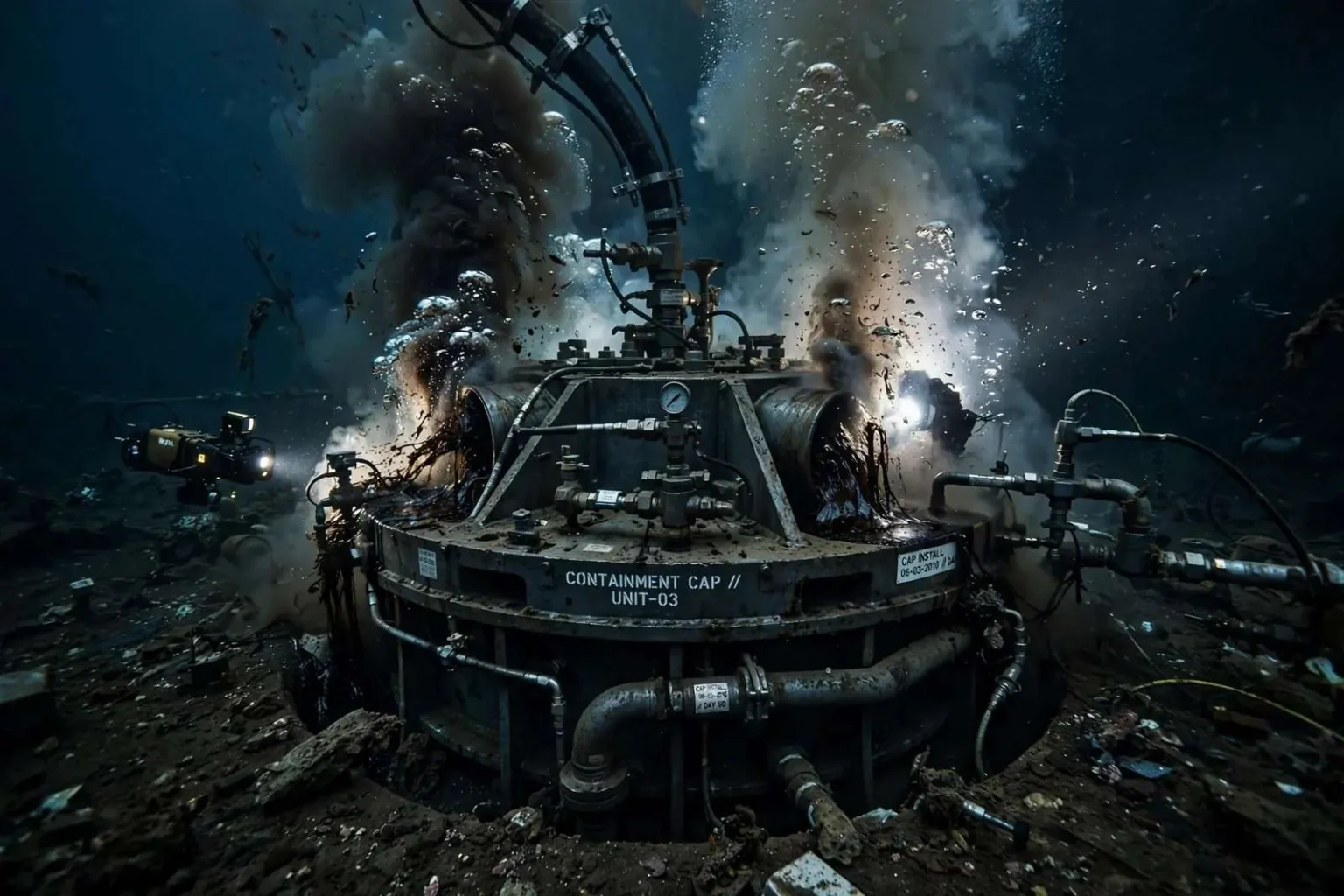
Fifty days after the Deepwater Horizon exploded and sank, the containment cap fitted over the top of the failed blowout preventer was finally recovering a substantial share of the oil escaping from the Macondo well — though how substantial depended on an estimate of the total leak that nobody could pin down.
The Numbers
Before the cap was installed, BP was recovering roughly 400 barrels of oil a day.
With the cap in place, the figures climbed quickly:
6,077 barrels on the cap’s first day of operation, the previous Friday. 10,495 barrels on Saturday. 11,100 barrels on Sunday.
Low-end estimates of the total leak ranged from 12,000 to 19,000 barrels per day — meaning that even at its best performance, the cap was capturing something well short of all of it, and possibly not much more than half.
That ambiguity defined the whole episode. The recovery figures came from metered flow on the surface ship — hard numbers. The leak rate, by contrast, had never been directly measured; the government’s estimates had climbed repeatedly since the April 20 disaster, and the absence of a reliable flow figure meant every daily recovery total could be read two ways: as progress, or as evidence of how much was still escaping. The difference between a 12,000-barrel well and a 19,000-barrel well was, at the capture rates then being achieved, the difference between capturing nearly all of it and capturing barely half — and nobody ashore or afloat could say which.
Why Oil Is Still Venting on Purpose
The oil moves up to a recovery ship under the natural pressure of the well, assisted by intense suction from pumps on board.
To keep the cap from blowing off the blowout preventer, and to keep seawater from entering it, the vents on the cap have deliberately been left partially open so that pressures can be controlled.
That decision has an ugly optical consequence — video showed oil still billowing from the cap — but it serves a technical purpose.
If cold seawater mixes with oil under high pressure inside the cap, ice crystals form and block the suction pipe. That is what defeated an earlier containment dome.
The failure of the first dome had taught engineers the central constraint of deepwater capture at that depth: a mile down, the water is near freezing, and the gas escaping with the oil — combined with seawater under pressure — forms hydrate crystals that behave like ice slush and can choke a riser in hours. The giant dome lowered over the leak weeks earlier had been rendered useless by exactly that process within days. The new cap’s deliberately leaky design was the workaround: by letting some oil escape, engineers kept the internal pressure low enough that seawater could not be forced inside, and the flow that did enter stayed warm enough to reach the surface as liquid.
So far, the pressure of oil shooting out of the vents has kept the water out, and operators were continually adjusting the vent valves to recover as much oil as they could without triggering a freeze-up.
It was engineering by live adjustment — valve turns measured against temperature readings and flow rates, with a freeze-up meaning days of lost progress. The daily recovery totals that climbed through the weekend reflected those adjustments succeeding, one cautious increment at a time.
A Heavier Cap Is Coming
At the end of the month, BP planned to swap the current cap for a heavier, better-sealing version then under construction.
The new arrangement would feed oil from the well into a floating pipe suspended about 300 feet below the surface — a design intended to survive hurricane season, since surface vessels can disconnect and run from a storm.
The suspended-riser concept addressed the operational weakness of the current setup. As long as capture depended on a ship holding position over the well, any Gulf storm — and hurricane season was weeks away — would force a shutdown and a return to uncontained flow. A buoyant riser moored mid-water, with flexible connections the surface ship could release and later reattach, meant the recovery system could ride out weather without abandoning the well entirely.
The replacement cap was expected to be capable of collecting as much as 20,000 barrels a day.
That capacity figure was itself a statement about the leak. A system designed to capture 20,000 barrels a day was being built on the assumption that the well could produce at least that much — well above the low-end estimates then in circulation, and a tacit admission that the government’s higher flow-rate estimates were the ones the response was now planned around. If the new cap worked as designed, the daily arithmetic that had made the containment story so grim — recoveries compared against an unknown total — would for the first time favor the responders.
The downside was significant: during the changeover, the flow from the blowout preventer would be unrestricted for several hours, and no oil at all would be recovered until the new cap was seated and operating properly.
Those hours were the source of intense public anxiety. Removing the current cap meant returning, briefly, to the worst imagery of the entire spill — oil gushing unobstructed from the blowout preventer, live on the feed — with no guarantee the new cap would seal any better than its predecessors had. Engineers argued the swap was unavoidable: the current leaky cap could never capture the whole flow, and every day of partial capture was also a day of partial escape. The trade was several hours of total freedom for the well against the prospect of capturing nearly everything thereafter.
The Only Permanent Fix
Everything else remained a stopgap.
The well would be sealed for good by the two relief wells being drilled to intercept the original bore roughly 18,000 feet below the sea floor. Those were expected to reach their target in mid-August.
The relief wells were the one piece of the response with a known engineering pedigree. Drilling a well to intersect another a mile beneath the Gulf floor — after a total of roughly 18,000 feet measured below the seabed — is precise, slow work, and the intercept could fail and require a second attempt even once the bit arrived. Until then, every cap, riser and containment scheme was temporary management of a well that only the relief wells could actually kill. The mid-August target meant the Gulf Coast was facing two more months of daily containment arithmetic, whatever the improved hardware achieved.
The two-well approach also built in redundancy: either relief well could complete the kill, so a mechanical problem on one rig did not reset the calendar. But redundancy could not shorten the drilling, and the mid-August date stood as the earliest realistic end to the crisis no matter what the caps recovered.
What It Meant on the Alabama Coast
Day 50 found South Alabama in a grim holding pattern.
Tar balls and oil sheen had reached Gulf Coast beaches. Fishing grounds were closed across large stretches of the northern Gulf, idling the shrimp and oyster fleets out of Bayou La Batre, Coden and Bon Secour.
The closures cut at the identity of the communities they hit. Bayou La Batre — the shrimp capital immortalized in film, a working waterfront of small boats and processing houses — Coden and Bon Secour had spent generations building seasons around the waters now closed by federal fisheries managers. Deckhands, processors, dock workers and the network of suppliers behind them faced an open-ended loss of income at the height of the season, with compensation systems still being assembled faster than the claims arrived.
Rental cancellations were mounting in Gulf Shores and Orange Beach at the start of what should have been the profitable summer season.
The beach economies were suffering a subtler version of the same wound. With tar balls arriving and the national broadcast dominated by the live spill feed, summer visitors were cancelling reservations in droves — revenue that would not return if the spill persisted, and bookings made months earlier evaporating in phone calls. Baldwin County’s beach towns had bet everything on a strong summer after the recession year; Day 50 found them watching the same well video as everyone else, calculating what a compromised season would do to businesses that lived on ten concentrated weeks.
Watching the Feed
For coastal residents watching the live video feed of oil pouring from a pipe a mile beneath the surface, the arithmetic of barrels recovered versus barrels escaped had become a daily and unwelcome ritual — and the answer, at the halfway point of a summer nobody would forget, was that the well was still winning.
The live feed had changed the character of the disaster. Never before had the public watched an industrial catastrophe in real time, unedited, around the clock — and the feed made every engineering setback immediate and every recovery figure personal. The daily totals, the vent adjustments, the promises of a better cap all arrived as commentary on a picture everyone could see for themselves: oil still rising, seven weeks after the rig burned and sank with eleven of its crew, into waters that Alabama’s seafood industry and beach towns depended on.
Where the Response Stood
By Day 50, the response had sorted itself into three tracks, each with its own clock.
The containment track — the cap, the daily meter readings, the heavier replacement under construction — was producing measurable but partial progress, limited by hydrates, pressure and geometry. Its best case, a 20,000-barrel-per-day system on a suspended riser, lay at the end of the month, behind the riskiest maneuver of the response so far: a changeover that would briefly free the well entirely.
The relief wells remained the only exit. Targeting an intercept 18,000 feet below the sea floor, on a mid-August schedule, they were the difference between managing the disaster and ending it. Everything public officials said about the timeline ultimately deferred to those two drill strings and the precision work still ahead of them.
And along the shore, the impact track ran on its own calendar, indifferent to the engineering milestones. Tar balls do not wait for a cap changeover; fisheries closures do not lift because a riser was installed; rental calendars in Gulf Shores and Orange Beach emptied whether or not the Sunday recovery total beat Saturday’s. Day 50 found that track in its worst stretch — oil on the beaches, fleets idle, the summer season leaking away — with no visible endpoint, because the only true endpoint lay two months and 18,000 feet down.
The halfway point of the crisis, if it could be called that, thus offered a paradox: the response was finally, measurably working — thousands of barrels a day rising from a seabed no dome had touched — and it was still not enough, on the water or on the shore. The cap was winning its battle against the hydrates, the heavier one was coming, the relief wells were drilling. The well, for fifty days, had answered everything.