Judge Sets $200,000 Bail for Mobile Teen Charged in Killing of Former Williamson Player
A Mobile judge set $200,000 bail for an 18-year-old charged in the shooting death of a former Williamson High School linebacker and new father, killed on a dead-end street in a neighborhood police call a violent hot spot.
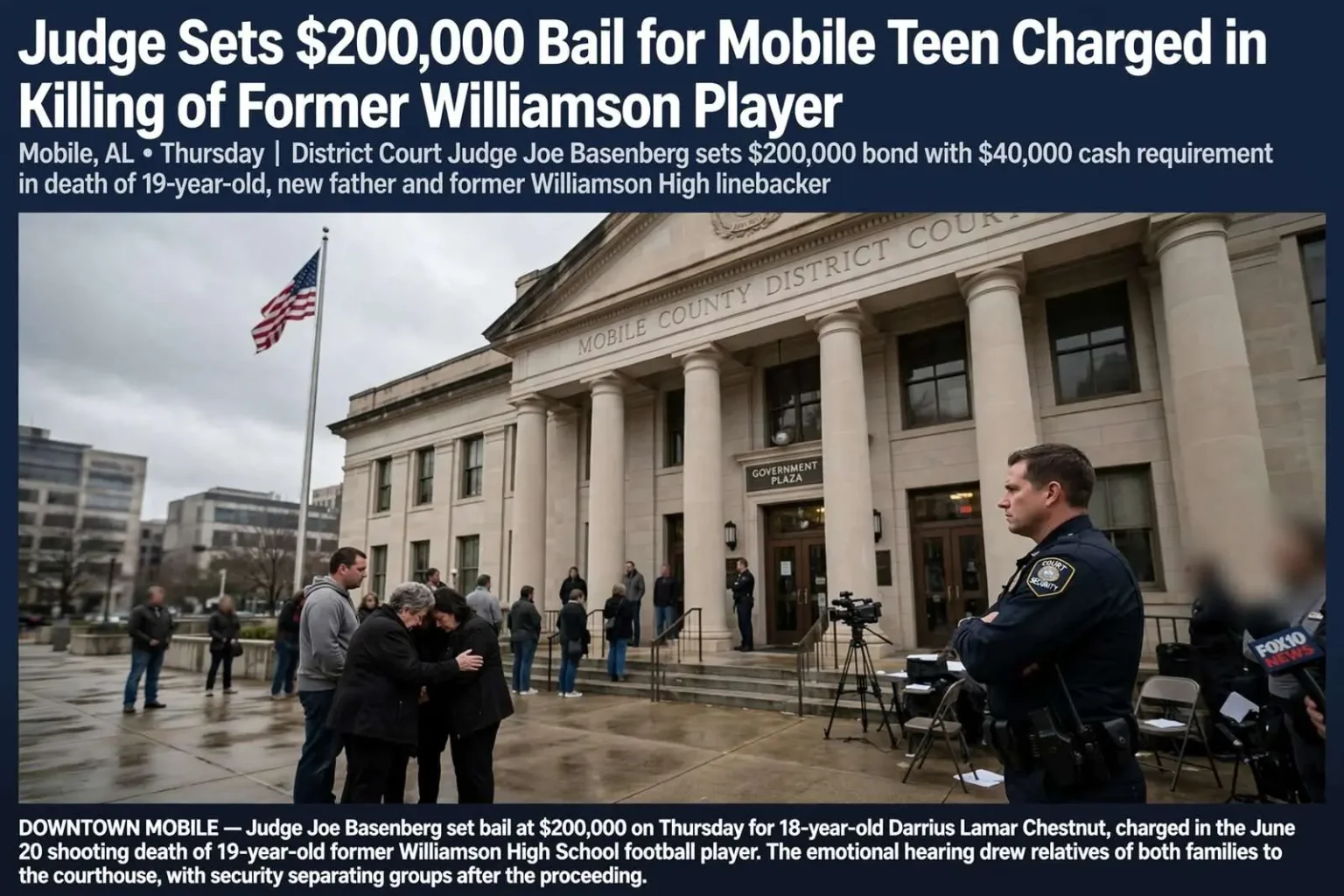
A Mobile judge set bail at $200,000 for a teenager charged in the killing of a 19-year-old former high school football player and new father, capping an emotional hearing that drew relatives of both families to a downtown courtroom. The ruling, handed down on a Thursday by District Court Judge Joe Basenberg, required at least $40,000 of the total to be posted in cash before the defendant could be released. The hearing was one step in a case that began with a June 20 shooting and now moves through the court system under the scrutiny of two grieving families.
The defendant, 18-year-old Darrius Lamar Chestnut, had been arrested late Tuesday in connection with the June 20 shooting death of the young man, whose surname was Populus. Officers found the victim on a dead-end street and pronounced him dead at the scene. The three-day gap between the shooting and the arrest reflected the pace of an active homicide investigation, with detectives working to piece together what happened before charging a suspect.
A Promising Young Life Cut Short
According to his coach, the victim had been a three-year starter at linebacker for Williamson High School through 2012 and had recently welcomed a baby boy. His death at 19, so soon after becoming a father, added a layer of grief to a case that had already unsettled the neighborhood where it occurred. Teammates and coaches remembered a player who anchored the defense for three full seasons, and the news that he had become a parent in his final weeks made the loss harder for those who knew him to accept.
Williamson High School has been a fixture of its community for generations, and former players hold places across Mobile’s public life. The death of a former starter in his teens touches that whole network — the coaches who trained him, the classmates who watched him play and the neighborhood that follows its high school teams closely. The family now raising a baby without a father is left to carry that loss in the most personal terms.
Chestnut, authorities said, had no prior arrests known in Mobile County. At the time of his arrest, he listed a home address on Seneca Street, between South Ann and Ross streets. Those details, presented in court, sketch a defendant with no documented criminal history facing the most serious charge the system handles — a combination that bond hearings in Mobile encounter regularly and that judges must weigh against the gravity of the allegation itself.
Tension in the Courtroom
The bond hearing underscored the raw emotions surrounding the case. Family members of both the defendant and the victim packed Judge Basenberg’s courtroom, and court security officers had to escort the two groups out of Government Plaza separately after the proceeding to keep them apart. The separation was a precaution, not a formality: in cases where the accused and the victim’s family share a community, the courthouse can become a second stage for grief and anger that begins on the street.
In setting the $200,000 figure with a $40,000 cash requirement, the judge established a threshold that Chestnut would have to meet to secure his release while the case moved forward. The structure matters as much as the number: a bond that is partly secured by property and partly payable in cash ensures that a defendant cannot simply sign a bondsman’s paperwork to walk out, and it gives the court a financial hold on the defendant’s appearance at trial. Such conditions are common in serious violent-crime cases, balancing the presumption of innocence against concerns about public safety and the risk of flight.
Bond hearings in Mobile County’s district courts are typically brief proceedings, but their outcomes shape the months that follow. A defendant who makes bond waits for trial at home, able to work with counsel and support his family; one who cannot waits in the county jail, sometimes for a year or more before the case resolves. The $40,000 cash component set here puts release beyond the reach of most families without outside help, which means Chestnut is likely to remain in custody as the case advances unless that figure can be met.
The proceeding also gave the public its first structured look at the state’s account of the case. Prosecutors outlined the arrest, the charge and the circumstances of the June 20 shooting, while the defense presented the defendant’s ties to the community and his lack of prior arrests. District Court judges in bond matters weigh those presentations quickly, without the full record a trial will eventually develop, and the figures they set reflect both the charge’s severity and what the early evidence suggests about risk.
Questions About the Location
The killing took place on Ridge Street, in an area police have described as a known hot spot for violent crime. Yet the details of why the two young men were there remained unclear. A resident of nearby Webb Avenue, another street police identify as troubled by violence, said neither the defendant nor the victim was believed to live in the area. Authorities had not publicly explained what brought either man to Ridge Street, or what precipitated the shooting.
That uncertainty left open key questions about the circumstances of the crime even as the legal process advanced. Investigators typically release few details in the days after an arrest, both to protect the integrity of the case and because accounts given early in an investigation often change. But the absence of a public explanation has its own cost in a neighborhood that wants to know how a 19-year-old came to be shot dead on a street where neither he nor the accused apparently lived.
The case carried echoes of a broader concern in parts of Mobile, where certain streets have become associated with repeated violence and where young people, sometimes with no known ties to those blocks, can find themselves caught up in deadly encounters. Police in such areas walk a difficult line: heavy patrols are meant to suppress the violence residents suffer, but the blocks flagged as hot spots are also home streets for families who have no part in the activity that brought the reputation. The Ridge Street shooting revived exactly that tension — a young man from elsewhere, killed on a street known for trouble, and a neighborhood left again to absorb it.
For the family of the victim, a former athlete and brand-new father, the loss was immediate and devastating. The baby boy the victim had recently welcomed will grow up without the parent whose football career once filled Friday nights, and the relatives who packed the courtroom on Thursday did so as the first official act of what will be a long legal reckoning with that absence. Their presence, and the separate escort they required leaving Government Plaza, made plain how much the case already weighs on both sides of the docket.
With bail set, the matter moved toward the next stages of the criminal justice process. Chestnut faced the prospect of a lengthy path through the courts, while the community absorbed the loss of a young man remembered by his coach as a standout on the football field and, in his final weeks, a new parent. The process ahead includes preliminary hearings, possible grand jury action and, eventually, trial proceedings — each stage with its own hearings, and each likely to draw the same families back to the same downtown courthouse.
Investigators had not said whether they expected additional arrests or charges as the case developed. That question matters in a shooting that left so much unexplained: whether others were present on Ridge Street, whether the encounter had a history investigators are still tracing, and whether the file that reaches a grand jury will look like the account presented at the bond hearing. Until those answers emerge, the case stands where Thursday’s hearing left it — a $200,000 bond, an 18-year-old in custody, and a family mourning a new father.
The bail system itself, as it functioned in this hearing, is worth understanding for what it does and does not decide. Setting bond is not a finding of guilt or innocence; it is a risk assessment made in minutes, weighing the charge, the defendant’s record and history, his ties to the community and the perceived danger to the public. Judge Basenberg’s $200,000 total with $40,000 cash sits at the level courts commonly use in homicide cases where the defendant is young and has no prior record but the allegation is gravest. The defendant’s counsel can revisit the bond later with new information, and judges retain the authority to adjust it as the case develops.
The June 20 shooting also becomes part of the year’s statistics in a city that tracks its violence block by block. Mobile police have focused attention on the corridors and street segments where shootings cluster, and each incident adds to the picture those efforts are built on. What the statistics cannot capture is what Thursday’s hearing showed: behind every case number is a courtroom divided between a family planning a funeral and a family facing an accusation, often from the same part of town.
For the former Williamson teammates who learned of the killing, the details have stayed fixed in the reporting: a three-year starter, a linebacker, a new father, dead at 19 on a dead-end street. The criminal process now underway will assign legal responsibility if the evidence supports it, but it cannot restore what the neighborhood lost. That is the reality the bond hearing left in place — the machinery of justice moving forward, and a community reckoning with the permanence of what happened on Ridge Street.