Prichard Police Chief Jerry Speziale Resigns, Citing Personal Circumstances After His Wife’s Death
Prichard Police Chief Jerry Speziale resigned after less than a year, with city officials pointing to personal circumstances following the death of his wife as he returned to New Jersey.
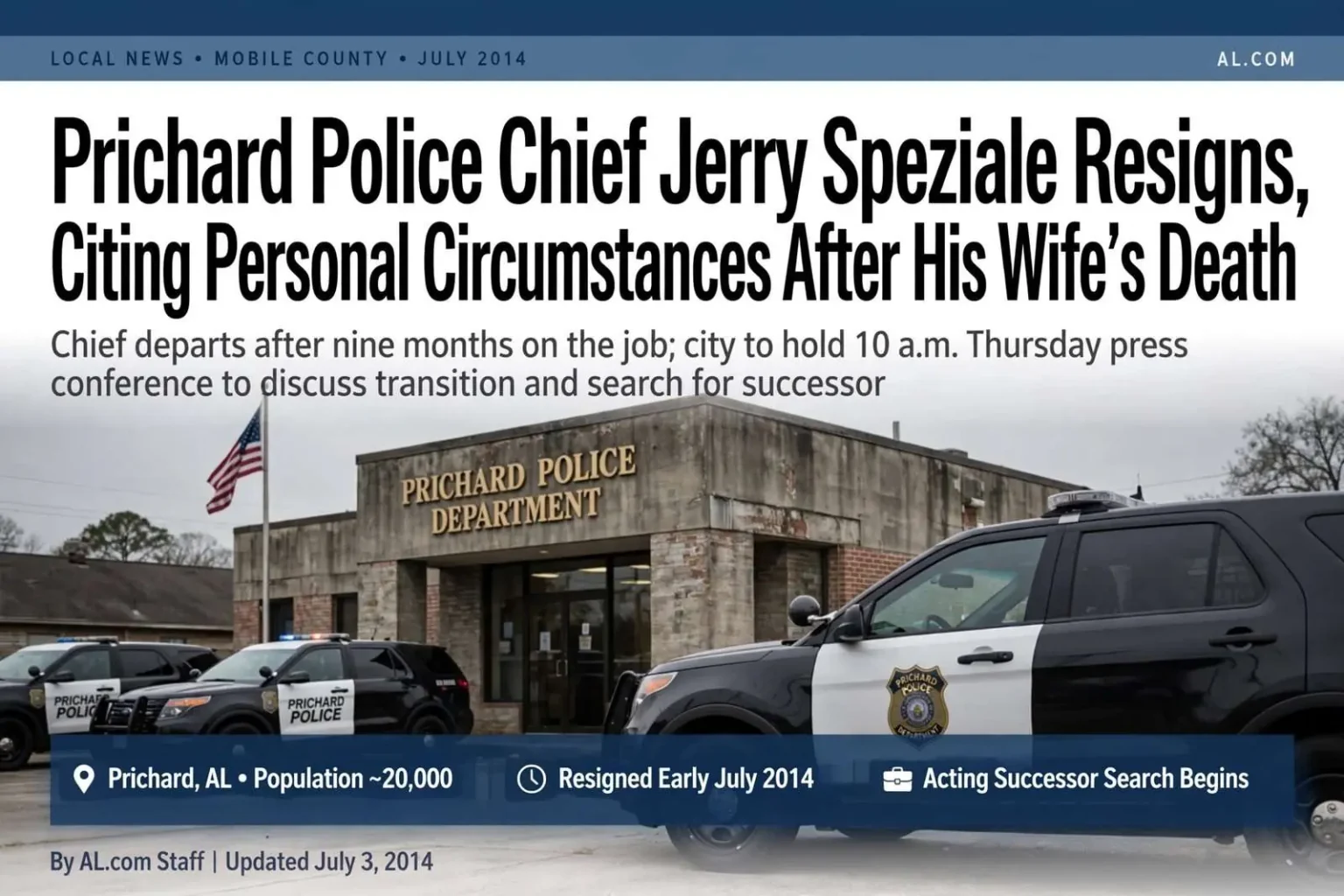
Prichard’s police chief, hired less than a year earlier after a lengthy national search, resigned in early July 2014, with city officials citing “personal circumstances beyond his control” in a news release announcing his departure. Chief Jerry Speziale had led the Prichard Police Department for roughly nine months. The city said a press conference would be held at 10 a.m. Thursday to discuss the resignation and to begin the search for a new chief, putting an abrupt end to a tenure that had begun with more attention and ambition than any police appointment in the small city’s recent memory.
Prichard, a city of roughly twenty thousand residents just north of Mobile in Mobile County, has long struggled with the challenges that confront older, smaller industrial cities across the Gulf South: an aging housing stock, strained municipal finances and crime rates that outpace the city’s resources. Landing a chief with a national reputation through a competitive search was, for Prichard’s leadership, a statement that the city intended to compete for talent rather than settle for what it could afford, and the announcement of his resignation landed accordingly hard.
A difficult year
According to the release, city officials had known for months, since the death of Speziale’s wife, that the chief was “having an extremely difficult time coping with the transition and aftermath of such a difficult loss.” The statement noted that Speziale had been separated from his two young children following his wife’s death. The children were to have joined him in the area at some point, but that plan had been overtaken by the family’s circumstances, leaving the chief to run a demanding department while grieving and living apart from his children.
“Public safety remains our No. 1 priority,” the release read, “and as such, we have already begun the steps to address and fill this most crucial position to the satisfaction and safety of our citizens.” The city’s framing made clear that whatever sympathy officials felt for the chief’s situation, the work of the department would not pause, and the search for his replacement would begin before the week was out.
Returning north
Speziale was returning to New Jersey to become the acting police director of Paterson, an appointment that officials in that city had announced earlier in the week. Paterson, one of New Jersey’s largest cities, offered the chief a return to a jurisdiction where he was already known, close to the family and community his children needed around them. For a law enforcement executive, moving from a small Gulf Coast department to a major northern city’s top job was a striking reversal of the usual career trajectory, and it said much about the reputation Speziale carried with him from his years in New Jersey policing.
His return marked the end of a brief but high-profile tenure in Prichard, where his hiring had been seen as something of a coup for a small city with limited resources. The national search that produced him had signaled that Prichard’s leaders wanted more than a caretaker, and the chief’s early months suggested they had gotten one. Speziale had spoken publicly about ambitious plans for the department, and his visibility in the community had raised expectations that the city’s long-running public safety problems might finally be bending.
He said he had reduced crime significantly during his nine months in Prichard and described a vision built around technology, mobile precincts and community policing. “What we need is technology and mobile precincts and more community policing,” he had said, framing his approach as a model he intended to carry forward. The three elements went together in his formulation: technology to target enforcement where it was needed, mobile precincts to put officers and command staff physically into the neighborhoods they served, and community policing to build the trust that makes residents willing to report and cooperate.
The vision was tailored to a city like Prichard. With a compact footprint and a department small enough that a chief can know most of his officers personally, the city could adopt new approaches faster than a large metro agency, provided it had leadership committed to the effort. Mobile precincts, in particular, addressed a problem familiar to older cities whose station houses sit far from the neighborhoods where crime is concentrated, and community policing answered the long-standing gap between residents and the officers patrolling their streets.
What those plans would have produced over a full term in office was now a question the city would never answer. Nine months is barely enough time for a chief to reorganize a department, much less demonstrate measurable, sustained change, and the crime reductions Speziale cited, whatever their size, had not yet accumulated into a track record that would survive his departure.
What came next
For Prichard, the sudden vacancy at the top of its police department created immediate questions about continuity and leadership. City officials emphasized that filling the position quickly was essential to maintaining public safety, and they signaled that the process would begin right away. Whether the city would promote from within to hold the department steady while a full search proceeded, or install an interim chief from outside, was among the decisions the Thursday press conference was expected to address.
The resignation also raised practical matters that would take time to resolve, from the terms of the chief’s contract to the transition of day-to-day command. A nationally recruited chief typically arrives with a multi-year agreement, relocation terms and departure provisions, and sorting out those obligations while maintaining command discipline in the ranks required care from the city’s administration. Those details were expected to be addressed as the city moved forward and prepared to introduce new leadership.
Above all, the announcement was framed with a measure of compassion. Rather than dwelling on the abruptness of the exit, the city’s statement acknowledged the personal grief that had shaped the chief’s decision, describing a man struggling with profound loss and the strain of being apart from his children. In an era when departures of public officials often arrive wrapped in accusation, Prichard’s leaders chose to describe a bereaved father rather than a departing employee, and the tone of the release set the register for how the community received the news.
As Prichard prepared for its Thursday press conference, residents were left to absorb the news that the leader they had recruited with such fanfare would not be staying — and to await word on who would step in to guide the department next. For a city where every change at the top of the police department carries the weight of public safety expectations, the identity of the next chief would be scrutinized as closely as the last one had been.
A chapter that began with optimism
The departure closed a chapter that had begun with unusual optimism. When the search concluded the previous fall, city leaders had celebrated landing an experienced, nationally known officer, and residents had reason to hope for a turnaround in public safety. That the tenure ended so soon, and for such painful personal reasons, lent the announcement a note of sympathy rather than rancor.
The episode also illustrated the precarious economics of small-city police leadership. A city of Prichard’s size competes for chiefs against departments many times its scale, and when it wins, it must hold that leader against the pull of family, career and offers from larger agencies. Nine months of progress can be undone by a single vacancy in the chief’s chair, which is why Prichard’s officials moved to reassure residents that the search for a successor was already underway and that the department’s mission, day in and day out, would continue without interruption.
Prichard’s long road with public safety
To understand why a single police chief’s arrival and departure mattered so much in Prichard, it helps to see the city’s circumstances. Situated between Mobile’s northern neighborhoods and the industrial corridor along Mobile Bay’s upper reaches, Prichard grew rapidly in the middle decades of the twentieth century as workers settled near the shipyards and factories of the coast, then lost population and tax base in the decades that followed. By the time Speziale arrived, the city had already endured some of the most publicized municipal financial troubles in Alabama, including a pension crisis that pushed the city into bankruptcy court and left its budget deeply constrained for years afterward.
Those constraints shaped everything a Prichard police chief could do. A department operating on a thin budget cannot simply hire its way out of a crime problem or buy its way into the newest technology, which is why the chief’s emphasis on reorganizing what the city already had, through mobile precincts, targeted enforcement and community relationships, rather than on expansion, fit the city’s reality. It also explains why the loss of a chief capable of that kind of reorganization was felt so keenly: the pool of candidates willing and able to take on the job for a city of Prichard’s means is not deep.
The city’s leadership had treated the national search as an investment, and the outcome underscored the risk built into such investments. A candidate recruited from out of state brings skills and visibility, but he also brings a life that can be upended by events a city government cannot control, as the death of Speziale’s wife demonstrated. For all the planning that goes into a police chief search, the most important variable, the candidate’s own circumstances, lies entirely outside the city’s hands.
What Prichard could control was the response, and the early signals suggested the city intended to move deliberately rather than in panic. Officials committed to beginning the search immediately, pledged that public safety remained the top priority, and scheduled the press conference at which the transition plan would be laid out. Residents of a city that has endured fiscal crisis, population loss and persistent crime have learned to judge their institutions by how they handle setbacks, and the weeks after the resignation would show whether Prichard’s police department could sustain the momentum its departing chief claimed, and how quickly the city could put a new leader at the top of it.