A Disputed ‘159 Percent’ Drop: Prichard Watchdog Group Questions Claims About Crime Under Departing Chief
As Prichard officials praised outgoing Police Chief Jerry Speziale for a claimed 159 percent crime drop, a community group demanded the statistics and questioned whether the figure held up.
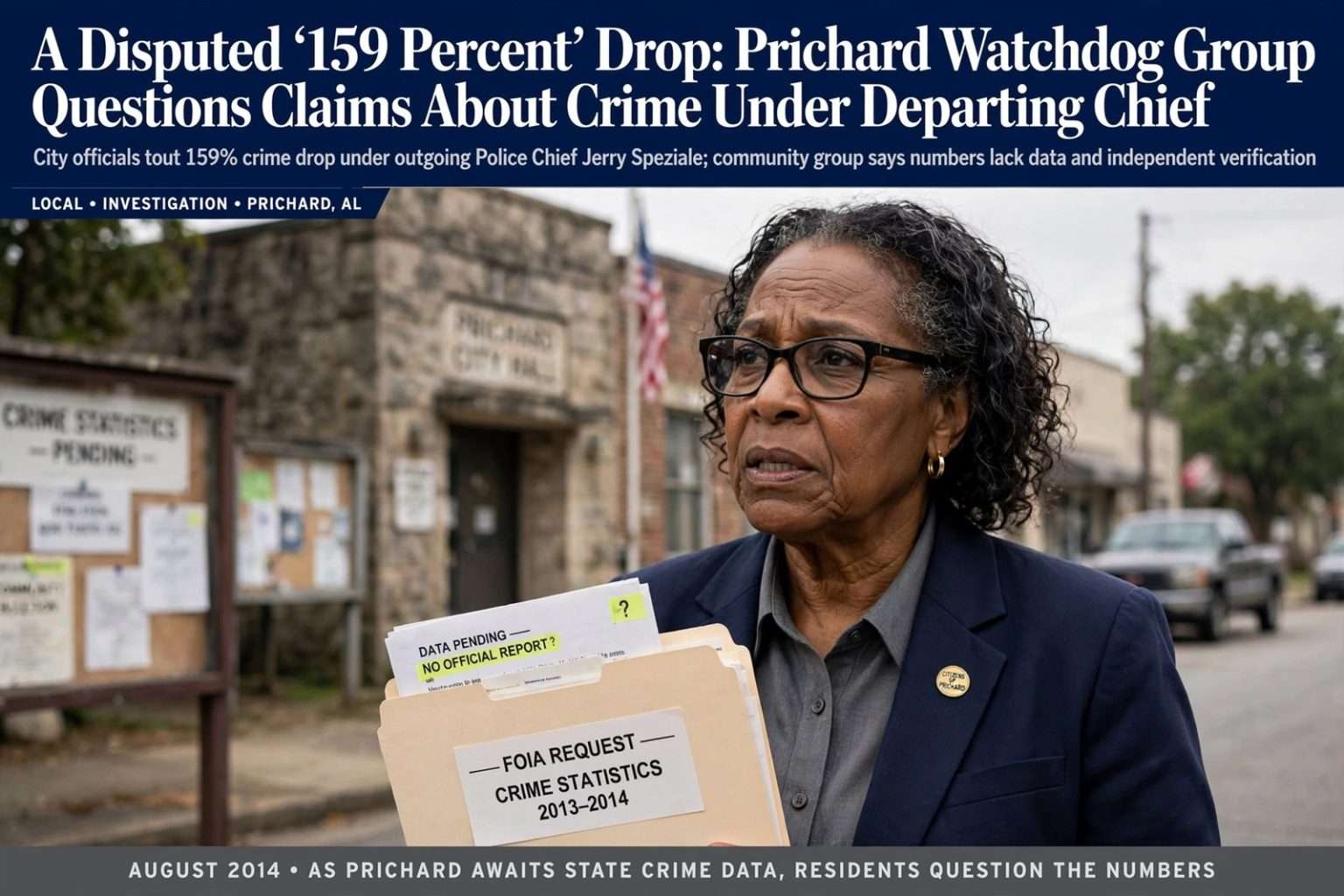
City officials in Prichard praised outgoing Police Chief Jerry Speziale for reducing crime during his tenure, pointing to what they described as a 159 percent drop from October 2013 to July 2014. But a prominent community group questioned both the number and the lack of data behind it, setting off a dispute that captured everything difficult about measuring crime in a small city.
The claim arrived as Speziale was leaving the department, and it was presented as the capstone of a tenure that began when city leaders went to the East Coast to recruit him the year before. A drop of that magnitude, advertised in percentage terms, made headlines. Whether it could survive scrutiny was another question entirely.
A Watchdog Pushes Back
Severia Campbell-Morris, president of the United Concerned Citizens of Prichard, said she was not persuaded. The city, she noted, had been asked more than once to produce crime statistics supporting the claim. City spokeswoman Melanie Baldwin said the information was still being compiled.
Some television outlets reported the figure, which Campbell-Morris called “very inaccurate information.” She found the timing curious, coming less than a month after Mobile Police Chief James Barber said he was diverting some resources to help address problems in Prichard. Barber’s announcement had acknowledged, from outside the city limits, that Prichard’s crime problem was real enough to warrant help — a framing at odds with the celebratory numbers that followed so soon after, and one more reason the watchdog group wanted to see the actual data before accepting the verdict city officials were offering.
“Speziale is saying that he relieved this city of all crime and into the future,” Campbell-Morris said. “We have a lot of hot spots in the city that have not been addressed properly.” While crime may have declined, she said, without published statistics it was difficult to know. “That was just incorrect information,” she added.
The criticism landed at a moment when Prichard residents had reason to want proof rather than promises. The city of roughly 22,000 in Mobile County has long wrestled with crime rates well above state averages, strained municipal finances and a rotating cast of leadership, and community organizations like Campbell-Morris’ have functioned for years as the closest thing to an independent audit of what City Hall says.
Why the Data Lagged
The Alabama Criminal Justice Information Authority compiles annual crime statistics for cities and counties across the state. At the time, the most recent available report covered 2012, considered outdated by most agencies, with the 2013 report due that month. Nothing authoritative covering much of Speziale’s tenure was expected until roughly a year later, leaving the 159 percent figure without an official reference point.
That lag is a structural feature of crime data, not a bureaucratic excuse. Departments submit incident numbers to the state on a calendar that runs well behind the street, and statewide reports arrive a year or more after the events they count. Any claim about a decline made in the middle of the period is, by definition, unaudited — the department is grading its own paper.
The gap leaves residents in an impossible position when a claim is contested. If a city says crime fell and has no published figures to show, skepticism is reasonable; if the state’s numbers arrive later, they may not measure the same period the city described. Until the state’s reports filled in the record, the debate over whether crime had truly fallen, and by how much, could not be settled on the data.
Residents and analysts who follow crime data in Alabama know the routine well. A city announces a dramatic improvement, the announcement makes the evening news, and the underlying figures arrive months later — if at all. Departments have legitimate reasons for moving fast: grant applications, accreditation reviews and political moments all reward a good headline. But the sequence inevitably favors the claim over the evidence, and it falls to councils, community groups and reporters to keep asking for the raw counts until they appear.
An Unusual Figure
The percentage itself drew scrutiny. A drop of more than 100 percent is a striking way to describe a reduction, though large 159 percent swings do appear in other contexts. Various reports over the years had cited 159 percent increases in areas ranging from homebuyer interest in foreclosures to corporate net profits and charity care spending.
In those contexts, the arithmetic is straightforward: a number that rises from a small base can grow by multiples, and a 159 percent increase simply means the new figure is more than two and a half times the old one. Applied to a decline, however, the language becomes confusing — a category of crime cannot fall by more than everything there was to begin with. Figures like that typically emerge when the percentage describes a change measured against a moving baseline, an aggregate of multiple categories, or a comparison across periods that differ in length or coverage.
In short, the number was attainable in some measurements, but its use to describe a crime decline invited questions about how it was calculated. If Prichard officials could produce the underlying data, the discrepancy would resolve itself; without it, the figure floated free of any source a resident could check. That is precisely the kind of gap between announcement and documentation that watchdog groups exist to point out.
A Group Often at Odds With City Hall
Campbell-Morris’ organization had frequently questioned the administration of Mayor Troy Ephriam, including its handling of the search that brought Speziale from the East Coast to Prichard the previous year. The chief had arrived with a résumé built in larger northern departments, and his hiring was presented as a turning point for a city that had cycled through leadership in its police ranks.
Yet on this occasion, she expressed sympathy for the mayor over the manner of the chief’s departure. “The chief left without notifying the mayor with regards to him leaving,” she said. “We thought that could’ve been dealt with a little bit better than that. At least make the man aware about it.”
That gesture toward Ephriam was notable precisely because it came from a critic. A watchdog that opposes an administration on most questions can still acknowledge an affront to basic professional courtesy, and her comment suggested the grievance over the departure crossed the usual lines of city politics. In a city Prichard’s size, where the mayor, council and police chief all operate in close public view, a chief leaving without notice to the mayor is the kind of thing residents talk about.
The departure also raised practical questions about continuity. Whatever had driven the crime numbers during the chief’s tenure, the strategy behind them left with him, and departments that lose their leadership mid-reform often struggle to hold gains. Neighboring departments, including Mobile’s, had been drawn into the effort to stabilize Prichard’s streets, and the coordination those arrangements required depended on relationships that personnel changes complicate.
The Larger Question of Trust
The dispute captured a broader tension in Prichard, a city that had long struggled with crime and public trust. Residents wanted assurance that improvements were real and lasting, not framed by a single eye-catching statistic. A percentage without a table behind it does the opposite of reassure; it suggests the number exists to be announced rather than examined.
Percentage claims deserve particular care when the underlying counts are small. In a city of Prichard’s size, a category of serious crime can swing by single incidents from one month to the next, which makes percentage changes look enormous even when the real-world difference is modest. Ten offenses falling to four is a 60 percent drop on paper; in the lived experience of a neighborhood, it may be barely perceptible. Small-base arithmetic is why serious analysts prefer raw counts and rates per capita to percentages, and why a figure like 159 percent demands the underlying numbers before anyone treats it as fact.
The episode is a case study in how crime statistics function in local politics. A department’s numbers are only as credible as its willingness to show them, and cities that publish their data regularly — even when it is unflattering — build a reservoir of trust that a dramatic claim can draw on. Cities that withhold the data while publicizing the conclusions spend down whatever credibility they have banked.
For Prichard, the path forward ran through the state’s reports. Until the city released the figures, the debate over whether crime had truly fallen, and by how much, would remain unresolved, leaving both officials and skeptics to await the state’s forthcoming reports — and leaving residents to judge their government by whether the numbers, when they finally arrived, matched the announcement.