Riley Appoints Nodine to Vacant Mobile County Commission Seat Days After Runoff Win
Gov. Bob Riley appointed Mobile City Councilman Stephen Nodine to the vacant District 2 seat on the Mobile County Commission in July 2004, days after Nodine won the Republican runoff.
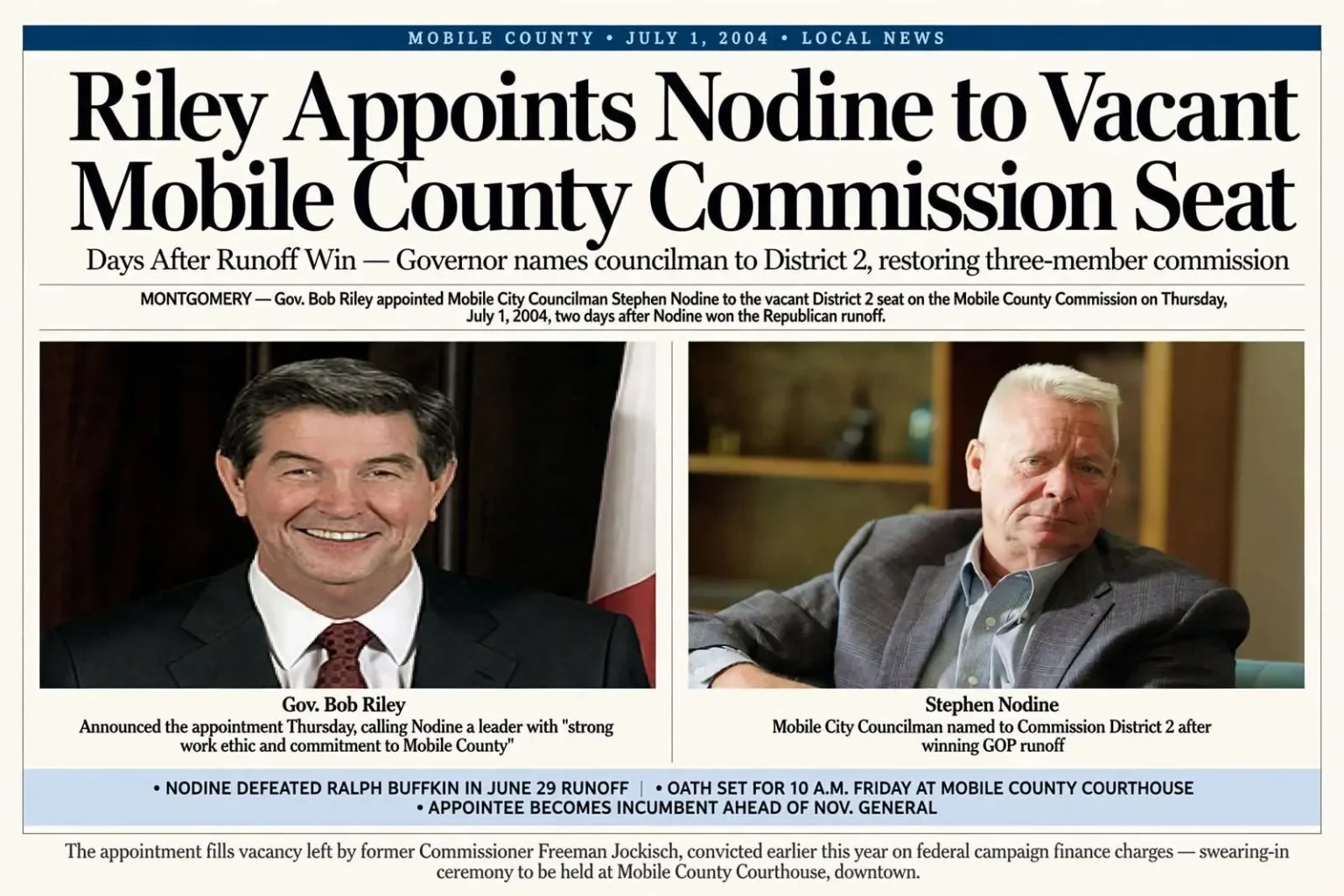
MONTGOMERY — Gov. Bob Riley on Thursday, July 1, 2004, appointed Mobile City Councilman Stephen Nodine to the vacant District 2 seat on the Mobile County Commission, elevating him to the office just two days after he had won the Republican nomination for it at the polls. Nodine had defeated retired businessman Ralph Buffkin in Tuesday’s runoff, capping a contest that began with a three-way primary on June 1 and ran through four weeks of hard campaigning. Austin Rainwaters, the third candidate in the primary, had endorsed Nodine after finishing with 28 percent of the first-round vote — an endorsement that consolidated the anti-establishment side of the field behind Nodine heading into the runoff.
“I have known Steve Nodine for years and have always been impressed by his strong work ethic and commitment to doing what’s right for the people of Mobile County,” Riley said. “Steve will be an outstanding county commissioner and will work hard for the citizens of the Second District.” The appointment married the will of Republican primary voters to the governor’s legal authority to fill mid-term vacancies, a combination that gave Nodine incumbency before the general election had even arrived.
Mobile County Circuit Judge Rusty Johnston was set to administer the oath of office at 10 a.m. Friday in the ceremonial courtroom on the second floor of the Mobile County Courthouse downtown. The swearing-in was open to the public, with a reception to follow — the kind of ceremony Mobile County has used for decades to mark the transfer of its top county offices, held in a courtroom that has hosted generations of the county’s political leadership.
How the seat came open
The vacancy traced back to the conviction earlier in 2004 of former Commissioner Freeman Jockisch in federal court on charges stemming from the mishandling of campaign finances. Jockisch suspended his re-election campaign and asked to be removed from the ballot, though some absentee ballots bearing his name had already been distributed — a complication that sent election officials looking for an attorney general’s opinion. The episode illustrates the procedural knots that mid-candidate withdrawals create: absentee voting in Alabama begins well before Election Day, and once ballots are in the mail, a candidate’s name cannot simply vanish from them.
With Jockisch gone, local Republican Party leaders had recommended in May that whoever won the GOP primary or runoff should be the governor’s appointee to fill out the unexpired term. The recommendation was a shrewd piece of internal party governance. Alabama law gives the governor wide discretion in filling vacancies on county commissions, and a governor could, in principle, name anyone. By committing in advance to honor the primary outcome, county party leaders ensured the seat would be filled by a candidate who had actually faced the voters — and spared themselves the infighting that an open-ended vacancy appointment would have produced.
Riley’s decision followed that advice exactly, which had the practical effect of letting voters — rather than the governor alone — choose the person who would occupy the seat immediately. Nodine walked into the commission chamber as an appointee, but one whose appointment had been ratified at the ballot box two days earlier.
What came next for Nodine
The appointment did not end Nodine’s electoral obligations. He remained the Republican nominee for the seat in the November general election, where he would face Democratic nominee Milton Morrow, who had been unopposed in his own primary. Nodine would run in the fall as an incumbent rather than a challenger — a considerable advantage handed to him by the timing of the appointment. Incumbent county commissioners in Mobile County historically enjoy formidable advantages: a record to point to, constituent service channels already operating, and the fundraising access that comes with holding office during a campaign.
The District 2 seat Nodine inherited covers a wide swath of the county, and the commissioner who holds it sits on a three-member board whose decisions touch nearly every unincorporated resident. Road paving and maintenance, drainage projects, zoning in unincorporated areas, and the county’s share of infrastructure funding all flow through commission votes, and the District 2 commissioner also serves as a de facto advocate for the western and southern communities in the district.
His departure from the Mobile City Council created a second vacancy. Under state law, a special election was required to fill a council seat when the next regular municipal election was more than a year away. Mobile’s next city elections were scheduled for August 2005, which meant District 7 voters would be going back to the polls in a special election that fall — a contest that promised to reshape the council’s balance and draw a field of candidates eager to claim an open seat without facing an incumbent.
The office Nodine inherited
The 2004 appointment marked the beginning of Nodine’s tenure on the Mobile County Commission, a body that oversees roads, county buildings, the sheriff’s budget and the distribution of federal grant money across one of Alabama’s largest counties. Commissioners serve four-year terms and represent districts that, in Mobile County’s case, cover territory ranging from downtown neighborhoods to the fishing villages of the Mississippi Sound. The commission’s workload in the mid-2000s included the county’s rapid suburban growth, the long-running effort to replace the George Wallace Tunnel corridor discussions, and the steady demands of a road program stretched across a county larger than some states’ entire urban cores.
The pace of the transition — primary June 1, runoff June 29, appointment July 1, oath of office July 2 — reflected the compressed timeline the vacancy had created. The commission had been operating with two members during the vacancy, and the third vote mattered for every split decision, from contract awards to road priorities. Filling the seat quickly restored the board’s full strength before the budget season that follows midsummer in county government.
The chain of events that produced the appointment — a federal conviction, a suspended campaign, ballots already printed, a party recommendation and a governor’s signature — is a reminder of how much of American local government is filled not by election alone but by the interaction of courts, parties and executive appointment. Voters in District 2 expressed a preference in the June primary; the governor converted that preference into an officeholder within 48 hours; and the November election would determine whether the arrangement, efficient as it was, received its final ratification at the polls.
The Jockisch conviction and its aftermath
The circumstances that emptied the District 2 seat deserve a closer look, because they shaped everything that followed. Freeman Jockisch had been a fixture in Mobile County government, and his federal conviction on campaign finance charges removed not just an officeholder but a candidate already well into a re-election campaign. His decision to suspend the campaign and ask off the ballot came after absentee voting had begun, forcing the probate office to confront a practical problem: hundreds of voters had already received ballots listing a candidate who would not be on the ballot in any meaningful sense.
The question went to the Alabama attorney general’s office for guidance, one of the routine but consequential functions the office performs for county election officials statewide. Attorney general opinions do not carry the force of court rulings, but they are the working law of Alabama election administration, and probate judges rely on them to keep elections moving on schedule. The eventual resolution — Jockisch off the ballot, votes for him not counted toward a winner — cleared the way for the field that actually campaigned in June.
For local Republicans, the saga left a vacuum that needed managing in two directions at once: the party still had to nominate a candidate for the November election, and the county still had a commission seat sitting empty until January. The May recommendation that the primary winner receive the appointment resolved both with a single decision, aligning the party’s interest in unity behind one nominee with the county’s interest in a fully seated commission.
The commission in context
Understanding what the appointment meant requires understanding the office itself. The Mobile County Commission is the governing body of one of Alabama’s two most populous counties, and its three members divide the county into geographic districts, each electing its own commissioner. The commission adopts the county budget — including the funding stream for the sheriff’s office, which covers patrol, jail operations and the sheriff’s administrative staff — and controls the county road and bridge program outside municipal limits.
The board also distributes federal grant money that passes through county government, sits on regional transportation and planning bodies, and makes appointments to boards ranging from water authorities to industrial development groups. In a county where unincorporated communities from Grand Bay to Wilmer depend on the commission for drainage, paving and zoning decisions, the District 2 commissioner is often the most accessible elected official those residents have.
The timing of the appointment also positioned Nodine for the fiscal work of late summer. County budgets are drafted and adopted in the third quarter of the calendar year, and a new commissioner sworn in on July 2 would face the budget process within weeks — learning the county’s finances not from a briefing book but from line-item debates in open session. Allies of the appointment argued that was exactly the right way for the county’s voters’ choice to learn the job; critics of the arrangement noted that the governor’s signature, not the November election, had made it happen.
Either way, the sequence stood as an unusually clean example of Alabama’s vacancy machinery working as designed. The party laid down its rule in advance, the primary settled the question, and the governor executed the result — leaving only the formality of a November ballot, where Nodine would carry the incumbent’s advantages and Morrow would carry the argument that the seat had never truly been up for a countywide vote.