Facing Talk of a Challenger, Probate Judge Don Davis Rallies Legal Support
Mobile County Probate Judge Don Davis moved early to fortify his political position, enlisting a consultant and a sprawling committee of attorneys as talk of a 2012 challenge circulated in the legal community.
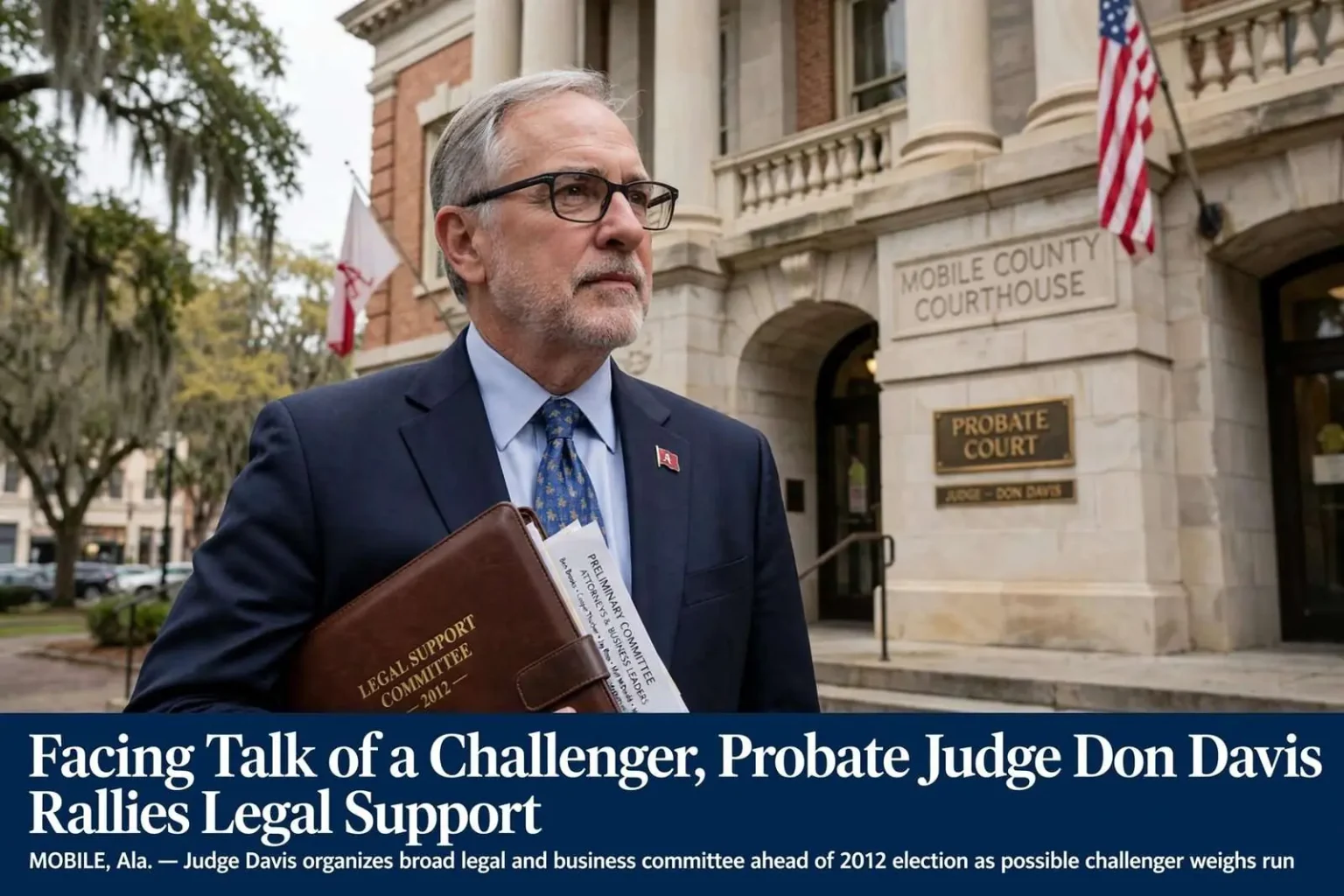
MOBILE, Ala. — With rumblings of a possible challenger in the 2012 elections, Mobile County Probate Judge Don Davis moved quickly to shore up his political position, retaining a campaign consultant and assembling an unusually broad preliminary committee well before the fundraising season opened. The early organizing reflected both the political realities of a countywide judicial seat and Davis’s intention to seek a third term after more than a decade on the bench.
Davis, a Republican first elected probate judge in 2000 and re-elected in 2006, engaged Strategy Inc. to advise his effort. Although he could not begin raising money until June — Alabama’s election law opens the fundraising window for judicial and countywide candidates on a fixed calendar — he had already lined up an extensive roster of supporters drawn heavily from the Mobile County bar and business community.
The head start matters in races that most voters know little about. Probate judge contests rarely generate headlines or television advertising, and name recognition is built through yard signs, bar association networks and the personal experiences of the thousands of families who pass through the probate court each year for wills, estates, guardianships, adoptions and real estate recordings. A committee stocked with prominent attorneys and business leaders signals electability before a campaign has spent its first dollar.
A deep bench of backers
The preliminary committee ran to dozens of names, including prominent attorneys such as Ben Brooks, Cooper Thurber, Jay Ross, Matt McDonald, Mark Erwin, Mike Druhan and Maury Friedlander, along with a wide cross-section of the legal establishment. The roster reached across the practice areas that intersect with probate court — estate planners, real estate lawyers, civil litigators and business counsel — reflecting the breadth of the court’s own docket.
Davis said he was flattered by the number of lawyers and law firms rallying behind him. The legal community’s early support carries particular weight in a probate race, because attorneys are the constituency most familiar with the office’s day-to-day work: they file the estate cases, argue the guardianship disputes and appear before the judge for every commitment hearing and name change the docket produces.
The judge insisted he was not running scared. The feedback he had received from every quarter, he said, from bar association members and people involved in the election process to the real estate community and the general public, was that the court was running well in all regards. After nearly 12 years in office, he added, he was comfortable asking voters for a third term.
A challenger weighs his options
The maneuvering came as attorney Wesley Blacksher acknowledged that he had been encouraged to run for the post and had it under consideration, though he offered no timetable for a decision. The possibility of a contested race gave Davis’s early organizing its urgency, and it promised the county’s voters a rare actual debate about an office most take for granted.
Davis said he took all potential challenges seriously but pointed to what he described as a solid track record. If a challenge did materialize, Davis said, voters could gauge his performance and decide whether he should be given the opportunity to lead the court for another term. He framed the choice as a straightforward referendum on how the court had functioned under his leadership.
Friction with the mental health community
Not everything under Davis’s tenure had gone unchallenged. The probate court had drawn criticism from segments of the mental health community, where advocates had raised concerns about how the court handled the sensitive matters that come before it — the involuntary commitment hearings, guardianships and conservatorships that determine where vulnerable people live and who controls their affairs. Families and advocates on both sides of those disputes had at times complained about the pace and process of the court’s decisions, and the friction had been a recurring undercurrent during Davis’s years in office.
The tension reflects a structural reality of Alabama’s courts. Probate judges decide commitment and guardianship matters with little of the procedural apparatus of a trial court, often on crowded dockets, in hearings that last minutes and involve people at the most difficult moments of their families’ lives. Advocates have long argued for more resources, clearer due process protections and specialized training, while probate judges — typically elected officials without opponents in most cycles — answer mostly to the electorate at large. Any challenger to Davis would likely have made the court’s handling of these matters a theme.
Davis, for his part, pointed to the volume of work the office processes and to the feedback he described receiving from the bar and the public. In his framing, the court’s overall performance — its estate administration, its recording operations, its daily service to the county — was the measure on which his third term should be judged.
Why the probate bench matters
The office Davis sought to keep is one of the most varied in county government. Alabama’s probate courts handle the probate of wills and administration of estates, guardianships and conservatorships for minors and incapacitated adults, involuntary commitment proceedings, adoptions, name changes and marriage licenses. The probate office also serves as the county’s recording office, maintaining the deed records that underpin every real estate transaction in the county — a function that makes the office a daily touchpoint for the title industry, banks and closing attorneys.
In Mobile County, the scale of that docket is among the largest in the state. The county’s population and its busy real estate market mean thousands of recorded documents, hundreds of estate filings and a steady flow of guardianship and commitment cases each year. The judge also administers the office’s budget and staff, making the position as much an executive role as a judicial one.
Probate judges in Alabama run on six-year terms, and incumbents historically have been difficult to dislodge — partly because the office’s work rarely generates controversy that reaches the general public, and partly because qualified challengers must build a campaign apparatus from scratch against a sitting judge’s network. Davis’s early move to lock in the bar’s support was aimed squarely at that dynamic: making an expensive, labor-intensive challenge look even less attractive before it began.
The 2012 election cycle itself framed the timing of every move. Judicial races in Alabama are expensive by national standards, and countywide judicial contests in Mobile County require a campaign that can stretch from spring qualifying through the party primaries and, potentially, a November general election. Hiring Strategy Inc. months before fundraising could begin gave Davis’s effort professional direction during the period when endorsements and commitments are actually secured — the months that determine whether a challenge ever materializes.
Blacksher’s deliberation, meanwhile, put the legal community in its familiar posture of watching and counting. Attorneys who appear before the probate bench were unlikely to commit publicly against a sitting judge until they were certain a credible campaign would exist, and unlikely to dismiss the possibility until Blacksher made his decision. His silence through the spring kept the race — and Davis’s preparations — alive.
For Mobile County voters, the stakes of the race were quiet but real. The probate judge’s decisions touch more families directly than those of almost any other countywide official: the estate that settles a parent’s affairs, the guardianship that places an elderly relative’s care, the commitment hearing that determines whether a family member receives treatment. Whichever way the 2012 election resolved, the early maneuvering had already succeeded in one respect — it made the county’s voters aware, months before the first campaign sign went up, that the office they rarely think about would be on the ballot.
The committee’s composition repaid a closer look from anyone handicapping the race. Ben Brooks, whose name anchored the list, had served in both the state Senate and the Alabama House and brought a legislator’s understanding of how probate law is written; figures like Cooper Thurber and Maury Friedlander represented decades of courtroom practice in Mobile’s civil bar. Campaign veterans read such lists not just for names but for factions: when plaintiffs’ lawyers, defense counsel and real estate practitioners all appear on the same committee, a candidate has assembled the rare coalition that a judicial race requires.
The fundraising calendar added its own pressure. Because judicial candidates could not legally accept contributions until the window opened in June, the months before that were the only period in which a challenger could still decide the race was unwinnable — before money changed the landscape. Davis’s camp understood that calculus: show overwhelming organizational strength early, and the most likely outcome is that no serious opponent ever qualifies. The strategy has a long history in Alabama judicial races, where unopposed incumbents are the rule rather than the exception, and where the cost of contesting a well-prepared judge deters most potential challengers before the first fundraiser is ever scheduled.
What remained for the summer was the formal work of the campaign — qualifying, fundraising events and, if a challenger emerged, the forums and questionnaires through which bar associations vet judicial candidates. Davis’s position entering that stretch was the one every incumbent covets: a decade-plus record, a unified legal community, professional help and a head start no opponent could match. Whether that was enough to deter a challenge, only the qualifying deadline would tell.