Mobile County Health Department Adds Mosquito Sprays Ahead of Holiday Gatherings Amid Chikungunya Concerns
The Mobile County Health Department's Vector Control Division stepped up mosquito spraying before Independence Day gatherings, including extra morning runs and aerial treatments, amid Chikungunya worries.
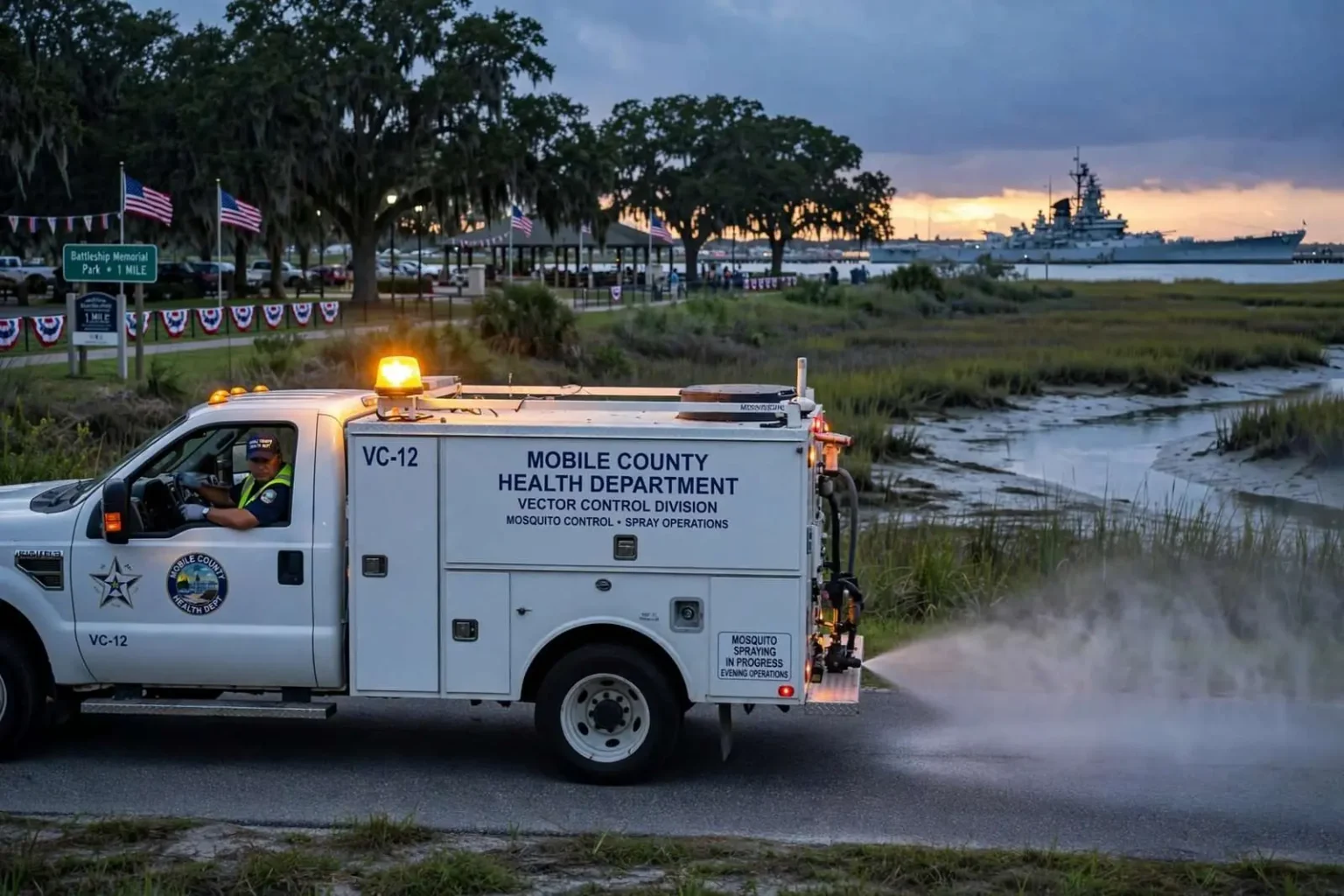
MOBILE, Ala. — The Mobile County Health Department’s Vector Control Division increased its mosquito-control efforts ahead of Independence Day, adding treatments in advance of the crowds expected to gather across the area for holiday celebrations. The stepped-up schedule put spray trucks and aircraft into the field on an accelerated calendar, aimed at knocking mosquito populations down before thousands of residents headed outdoors for fireworks, cookouts and waterfront gatherings.
Spray trucks normally run their routes from 6 to 11 p.m., but the health department scheduled additional morning sprays that week because mosquito activity peaks at both dusk and dawn. The double-barreled schedule covered the two windows when the insects are busiest, and the extra passes were meant to knock down populations before large outdoor events rather than during them — a distinction that matters, since adulticide spraying works best when it lands several hours before people arrive.
The department’s Vector Control Division has run Mobile County’s mosquito program for decades, mapping complaint calls, trapping and identifying mosquitoes for disease testing, and dispatching trucks across the county’s 1,200-plus square miles of cities, suburbs and rural bottomland. On the Gulf Coast, where warmth and rain keep mosquitoes breeding much of the year, the division’s work is a permanent seasonal rhythm rather than a one-week campaign — but holiday weeks, when residents crowd parks, ball fields and backyards, get special attention.
A season of heightened concern
Mosquito control carried added urgency that summer as health officials worked to guard against Chikungunya, a mosquito-borne illness that can cause fever, headaches and severe joint pain. The virus is common in the Caribbean, Asia and Africa, where it takes its name from a word in the Kimakonde language of East Africa meaning, roughly, “to become contorted” — a reference to the stooped posture of patients suffering the disease’s signature joint pain. While rarely fatal, chikungunya can leave victims aching for weeks or months, and there is no specific treatment once a person is infected.
At the time, the cases reported in the United States involved travelers who developed symptoms after returning home rather than people infected domestically. Of 88 cases reported nationally, none were contracted within the country, according to the Centers for Disease Control and Prevention. The pattern was precisely what health officials expected but also what worried them: every traveler returning with the virus in their bloodstream was a potential starting point for local transmission, because the Gulf Coast’s mosquitoes are fully capable of carrying the disease from person to person.
One case had been reported in a Huntsville woman who contracted the illness while visiting Haiti, and a preliminary report suggested a second case might have been diagnosed in a Birmingham patient. Neither Alabama case involved local transmission, but both put the state’s public health machinery on notice that the virus had already arrived on Alabama residents’ travel itineraries.
Officials worried that local mosquitoes could pick up the virus from an infected person and spread it further. The biology of the threat is straightforward: a mosquito bites a viremic traveler, the virus incubates in the insect, and subsequent bites pass the infection onward. In the Caribbean that cycle was already producing thousands of cases that summer, and Gulf Coast communities share the warm climate, the standing water and the mosquito species that make such transmission possible.
Targeting parks and marshes
The health department said public parks would receive extra sprays before the holiday. Its airplane was also set to conduct aerial treatments that week in places that trucks could not reach, including coastal and salt marsh areas. “We are going to spray some coastal and salt marsh areas in advance of where crowds will gather for Independence Day celebrations,” said Jerry Folse, who leads the department’s Vector Control Division. “That includes Battleship Memorial Park.”
Battleship Memorial Park, on Mobile Bay’s eastern shore beside the causeway, is among the region’s most popular holiday destinations, drawing thousands of visitors to tour the USS Alabama and attend Independence Day festivities. It is also, by geography, a natural mosquito habitat — bordered by tidal wetlands and open water where marsh mosquitoes breed in enormous numbers after rains and high tides. Ground trucks have no access to those marshes, which is why the airplane matters: aerial treatment can cover in an hour the kind of terrain that would take a truck fleet days to reach, if trucks could reach it at all.
Salt marsh mosquitoes are a special concern on the coast because of their habits. Unlike the container-breeding house mosquitoes of urban neighborhoods, marsh species can emerge in clouds after a spring tide floods a breeding flat, and they are strong fliers, capable of traveling miles from their hatching grounds in search of a blood meal. Treating the marshes before a holiday weekend, when wind and crowds will carry the biting pressure into adjacent parks and communities, is standard strategy for coastal vector control programs.
The ground trucks dispense low volumes of insecticide at speeds up to 20 mph, according to the department. The machines generate a fine fog of ultra-low-volume spray that drifts through the air and contacts flying adult mosquitoes — the reason the work is done at dusk and dawn, when the insects are aloft and the air is still enough for the fog to hang. The application rates are minuscule by design, calibrated to affect insects rather than people, pets or the environment, and residents along spray routes are generally advised only to stay indoors while a truck passes and to bring in pets’ water bowls.
What residents can do
Public agencies can spray, but vector control officials repeat every season that the most effective mosquito control happens in residents’ own yards. Mosquitoes that breed around homes do so in standing water — flowerpot saucers, clogged gutters, birdbaths, tires, buckets and children’s toys left out after rain. Emptying those containers once a week breaks the breeding cycle before it produces adults, doing work no amount of truck spraying can replace.
Personal protection is the other half of the advice. Health officials recommend repellents containing DEET, picaridin or oil of lemon eucalyptus for anyone spending evening hours outdoors, along with long sleeves and pants during the peak biting windows at dusk and dawn. Screens on windows and doors, and air conditioning where available, remain the simplest defenses for the very young, the elderly and anyone whose health makes a mosquito-borne illness especially dangerous.
Timing matters for residents planning holiday activities, too. Because the spray fog needs still air to hang and drift, a passing truck’s coverage is quickly undone by wind — meaning evening cookouts scheduled on breezy nights get less residual benefit than calm ones. Vector control staff suggest planning outdoor gatherings within a few hours of a scheduled spray pass when possible, and remembering that the treatment’s real value is in what it removes: the adult mosquitoes that would otherwise greet a crowd of celebrants at the park gate.
The holiday-week push reflected a division that operates on several fronts at once. Beyond the trucks and the airplane, Vector Control staff inspect and treat ditches, drainage ways and other breeding sites with larvicides — products that kill mosquito larvae in the water before they ever become flying adults. The division also traps mosquitoes throughout the season and sends samples for testing, surveillance work that tells the department which diseases are circulating and where to concentrate its resources. Complaint calls from residents feed the same map, sending crews to neighborhoods where biting pressure is worst.
The chikungunya watch fit into that existing structure. Because the virus had not yet established local transmission in the United States, the department’s task was preventive: keep adult mosquito numbers as low as possible during the weeks when travelers returning from the Caribbean might arrive home infected, closing the window in which a local mosquito could pick up the virus and pass it along. Every extra spray pass, every treated marsh and every emptied birdbath narrowed that window further.
Travelers themselves had a role to play. Health officials advised anyone returning from the Caribbean or other regions where chikungunya was active to protect themselves from mosquito bites for a period after coming home — an unusual bit of advice designed not to protect the traveler, who might already be infected, but to protect the community from that traveler becoming the source of a local outbreak. The same advice applied to residents who felt feverish after international travel: seek medical care and mention the travel history so physicians could test for mosquito-borne illnesses.
For Mobile County, the convergence of a holiday weekend, crowds at waterfront parks and a new mosquito-borne virus hovering offshore made for a busy week at Vector Control. But the division’s core message changed not at all: mosquitoes are a coastal fact of life, the diseases they carry are a serious matter, and the combination of government spraying and residents’ own yard hygiene is what keeps the Gulf Coast’s summers both outdoors-friendly and safe. The extra evening and morning routes, the aerial passes over the marshes and the treatments at Battleship Memorial Park were simply that familiar mission, scaled up for the busiest outdoor week of the year.