Baldwin County Weighs Loosening Its School Dress Code to Give High Schoolers More Leeway
Baldwin County school board members considered easing the district's uniform policy for high schoolers, allowing jeans and open-toed shoes, with a vote set for late July.
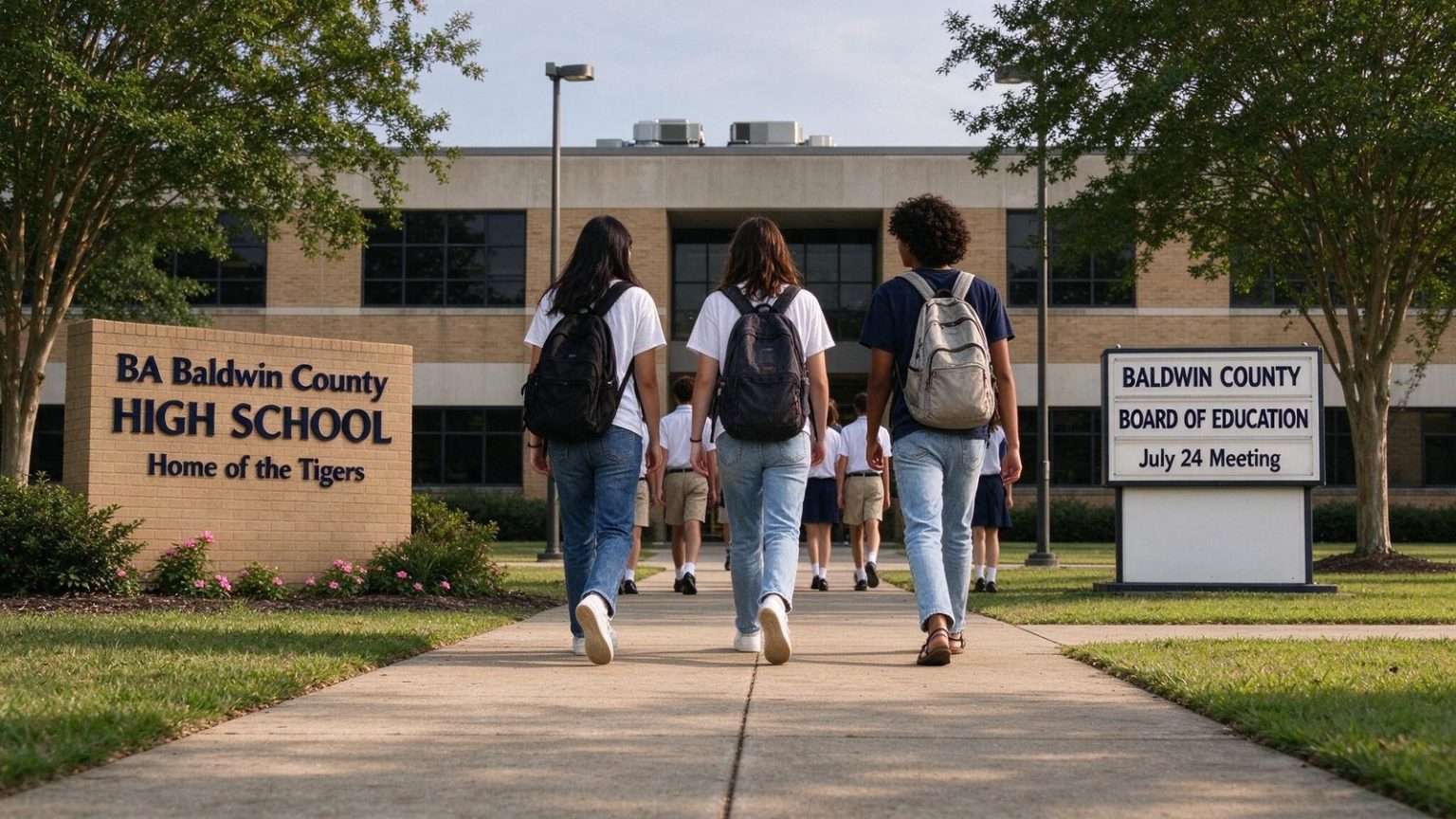
Baldwin County school board members said proposed revisions to the district’s dress code grew out of a belief that high school students needed more freedom than their younger, elementary-age counterparts. Under the uniform policy then in place, all students were required to wear white or navy blue collared shirts; khaki or navy blue pants or shorts; and closed-toe shoes. The proposed changes would let high school students wear jeans or blue denim pants and open-toed shoes, relaxing for the district’s oldest students the rules that had applied uniformly across every grade since the policy’s adoption.
The board was expected to vote on the revisions at its meeting on July 24, giving administrators a month to communicate any changes before teachers reported for pre-school planning and students returned to campuses across one of Alabama’s fastest-growing school systems. Baldwin County’s enrollment had climbed steadily with the population boom along the Eastern Shore and the coast, and any policy that touched every school in the district touched tens of thousands of families at once.
Uniform debates occupy a recurring place in Alabama school politics. The state’s districts have moved in and out of standardized dress over the past two decades, with boards adopting uniforms as tools against gang colors, visible wealth gaps and classroom distraction, and later loosening them when enforcement burdens and family complaints mounted. Baldwin County’s proposed middle path — keeping the uniform framework for younger students while easing it for teenagers — reflected the accumulated experience of districts that had tried both all-or-nothing approaches and found neither durable.
Recognizing a difference in ages
The revised language acknowledged that expectations could reasonably differ by age. It read, in part: “The Baldwin County Board of Education recognizes that in some instances there are acceptable differences in attire for younger children and high school students. Those differences will be noted in this policy.” The sentence, unremarkable as prose, marked a philosophical shift: the district was formally conceding that a rule justified for a second-grader might not be for a senior, and that its policy could say so explicitly rather than pretending one standard fit all.
Board President Norm Moore said many high school students did not support the uniform requirement and had struggled to comply. Teenage resistance to uniforms is among the most reliable phenomena in school administration, manifesting in minor dress-code skirmishes that consume administrator time without improving anything measurable, and Moore’s acknowledgment suggested the board had heard enough of those skirmishes to consider redrawing the line.
“I think, basically, what we’re trying to do is to get something that works well enough for everyone that we can all be focused on education and not on fashion,” Moore said, describing the aim as making the rules simpler and a bit looser. The phrasing captured the board’s practical posture: not surrender on standards, but a search for a code that teachers could enforce in seconds and students could follow without a daily negotiation at the closet door.
Moore acknowledged the change would not please everyone. “Nobody’s going to be totally happy,” he said, but he argued that easing the standards would make the policy easier to follow. Uniform policies tend to disappoint in every direction at once — parents who wanted stricter standards object to any loosening, students who wanted full freedom dismiss the partial concession as token, and teachers in the middle inherit whichever version of the rules their principals choose to enforce. A board president who expects total satisfaction from a dress code has usually never sat on a school board.
“We don’t want our teachers and administrators spending all their time trying to enforce a code that may be a little too strict,” Moore said. The comment went to a cost of dress codes that rarely appears in the policy debate: every minute a principal spends measuring shorts with a ruler or sending a student to the office for sneakers is a minute not spent on instruction or discipline that matters, and schools had been spending a great many such minutes.
The enforcement burden falls unevenly across campuses, too. A strict code functions differently in a small elementary school, where a principal knows every family, than in a high school of two thousand students, where dress violations arrive by the dozens each morning and each one risks becoming a confrontation that derails a class period. Boards that write dress codes seldom attend the morning enforcement line; principals live on it.
Leaving enforcement to schools
Board member David Cox said he had received little feedback beyond support for the idea. “I think it’s worth giving the students and the parents that option,” he said. The relative silence on the proposed change stood in contrast to the heated public comment that dress code revisions often draw, and suggested that the constituency most affected — high school families — had wearied of the issue rather than mobilized over it, or had simply concluded that jeans and sandals were a reasonable place to land.
When students arrived in inappropriate clothing, he said, the issue should be addressed, but enforcement was best left to individual principals. The position devolved real discretion to the campus level, on the theory that a principal who knows a school’s community can judge context better than a paragraph in a central-office policy manual. Decentralized enforcement carries its own risks — inconsistency between schools, favoritism disputes, the family who asks why one campus writes up what another waves through — but it reflects how Alabama school systems actually operate, with boards setting broad frames and principals doing the daily work.
“At just about any school in the county on any given day, you’ll find students whose clothing presents a question,” Cox observed, arguing that the answer to those questions required judgment rather than a single fixed penalty. The comment acknowledged an uncomfortable truth of dress codes: no written policy anticipates every garment, and the system’s real rule has always been whatever the person at the front office decides it is that morning.
The July 24 meeting gave the revision a natural test date in the school calendar. Votes taken in mid-summer allow districts to print updated handbooks, brief teachers during in-service weeks and notify families through registration paperwork before the first bell — a timeline that seems obvious but is frequently missed, producing the familiar spectacle of students sent home on the first day under rules they learned about that morning. Board members said the goal was to have any change in effect, clearly communicated, before campuses reopened.
Baldwin County’s experience with its uniform policy stretched back years, long enough for a full generation of students to have worn navy and khaki from kindergarten through graduation. The policy’s longevity cut both ways in the debate: defenders could point to its familiarity and the routine it built, while critics noted that a rule nobody could remember adopting without controversy was now due for the periodic recalibration every school policy eventually requires.
The district itself is among the largest geographical school systems in the state, stretching from the Mobile Bay communities of Fairhope, Daphne and Spanish Fort across pineywoods crossroads towns to Gulf Shores and Orange Beach on the coast. Its campuses range from beach-town schools serving a tourism economy to rural schools serving farming communities, and a single dress code had to cover both a teenager working a summer job on the Pleasure Island boardwalk and one working on a family farm off U.S. 31.
What the change means for families
For parents, the practical effect of the revisions was financial as much as philosophical. Uniform requirements concentrate back-to-school clothing costs into specific approved items, and families with students in both elementary and high school were effectively shopping from two different rulebooks. Allowing jeans and open-toed shoes for teenagers meant many households could draw on wardrobes their students already owned, reducing the annual August scramble for compliant collared shirts and khakis.
For students, the change acknowledged something they had argued for years: that a dress code’s educational value does not obviously increase with the age of the person wearing it, and that high schoolers preparing for work and college might reasonably be trusted with more discretion over their clothing than second-graders. School systems across the country have reached the same conclusion at different speeds, with many preserving strict uniform codes in elementary grades while granting older students latitude.
The vote itself, when it came, would settle the question only until the next round of complaints arrived from some other direction. Dress codes in growing school systems are living documents, revised as fashions shift, as enforcement problems accumulate and as new board members bring new convictions about what students should wear to learn algebra. Baldwin County’s move to split its rules by age was, in that long tradition, less an ending than an adjustment — an attempt, as the board president put it, to find something that works well enough for everyone, so that the district’s classrooms could be about education and not about fashion.