Army’s First Black Senior Research Scientist to Speak at Mobile’s King Breakfast
Dr. Paul Ruffin, the U.S. Army's first Black senior research scientist, will address the 21st annual Martin Luther King Memorial Breakfast at Bishop State Community College in Mobile.
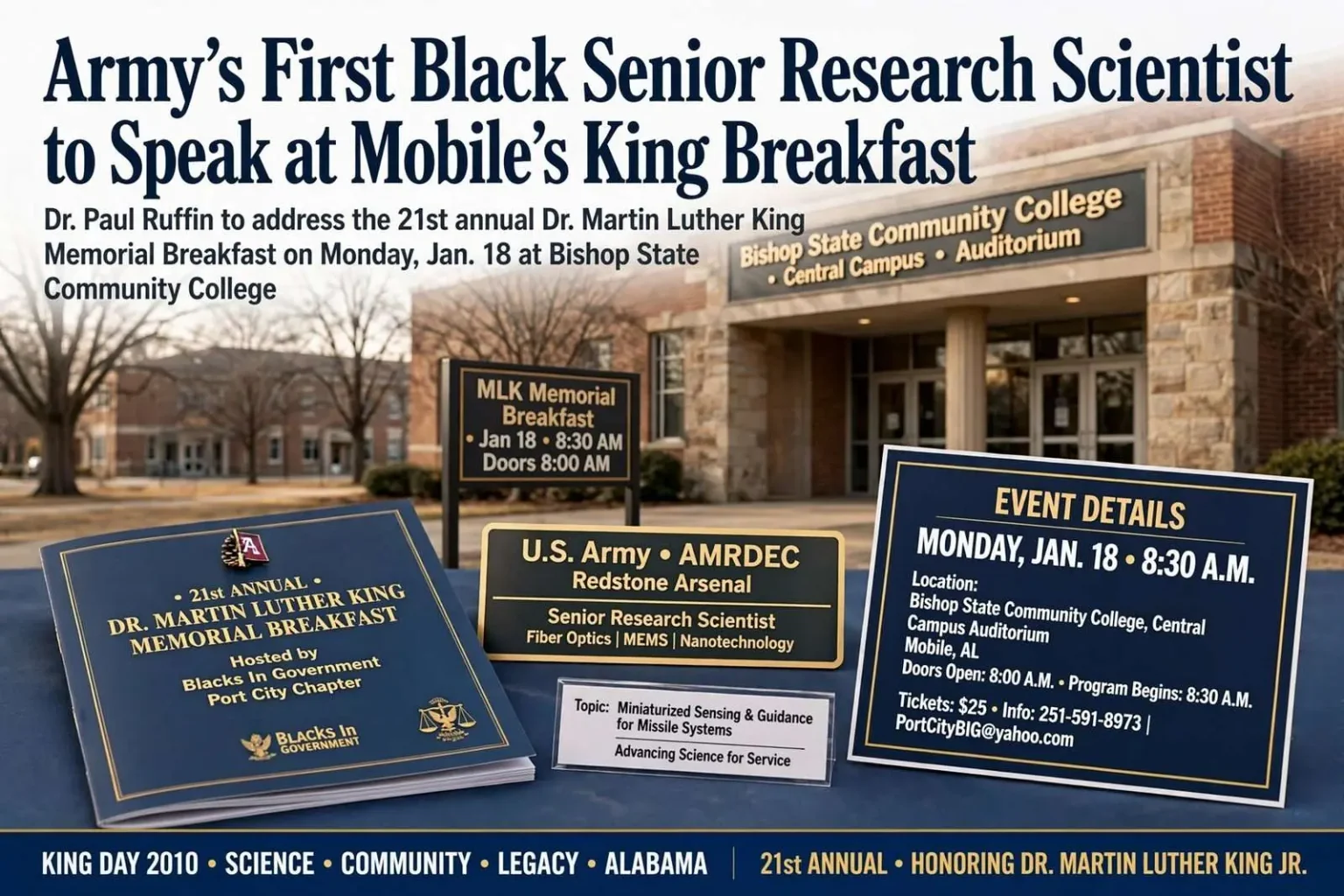
Dr. Paul Ruffin, the first African American to hold the rank of senior research scientist in the United States Army, will address the 21st annual Dr. Martin Luther King Memorial Breakfast in Mobile later this month. The breakfast, hosted by the Port City Chapter of Blacks In Government Inc., is set for Monday, Jan. 18 at 8:30 a.m. in the auditorium of Bishop State Community College’s Central Campus. Doors open at 8 a.m.
The annual breakfast has become one of Mobile’s principal King Day observances, drawing government workers, educators, students and elected officials for a morning of speeches, music and recognition built around King’s legacy. The 21st edition continues a tradition that has outlasted most of the civic events that started alongside it, and the chapter’s choice of speaker follows its practice of highlighting Alabamians whose careers embody the opportunities King’s work opened.
The speaker
Ruffin has spent 27 years as a research physicist at the U.S. Army Aviation and Missile Research Development and Engineering Center at Redstone Arsenal in Huntsville, where his work has centered on fiber optics, micro electro-mechanical systems and nanotechnology — the miniaturized sensing and guidance technologies that underpin modern missile systems.
In July 2003 he was promoted to senior research scientist, the Army’s highest technical grade, becoming the first African American to attain the title. The rank sits at the top of the Army’s civilian scientific career ladder, and reaching it requires a body of research recognized across the defense science community; Ruffin’s record of work on miniaturized optical systems placed him there first among the Army’s Black scientists.
He is a graduate of Alabama A&M University in Huntsville, one of the state’s historically Black institutions. His academic path from an HBCU to the leadership of federal weapons research is itself part of the story the breakfast is built to tell, and he has been a frequent speaker on the value of scientific education for students from backgrounds historically excluded from defense laboratories.
The choice of speaker had a certain logic for a King Day observance in Alabama. Ruffin’s career traced a path that ran entirely inside the state — from an HBCU in north Alabama into the federal scientific establishment at Redstone — and it did so during the decades in which that path was being opened.
Redstone Arsenal, the sprawling installation that anchors Huntsville’s aerospace economy, has been home to the Army’s missile work since the 1950s, and its civilian scientific corps grew through the decades when Huntsville itself was transformed by the space program. Scientists like Ruffin represent the second act of that transformation: careers in the Army’s research establishment open to generations of Alabama graduates who, a generation earlier, would not have been considered for them.
The engineering center where Ruffin works occupies a specific niche in that establishment. AMRDEC’s researchers design and refine the sensors, seekers and guidance packages that make Army missiles accurate, and the center’s work has tracked the industry’s miniaturization from vacuum tubes to fiber optics to systems measured in microns. Senior research scientists there are expected to lead research programs of national significance, and the grade Ruffin holds is reserved for the small number of civilians whose careers meet that standard.
The setting
Bishop State Community College, on Broad Street in Mobile, is itself part of that history. Founded in 1927 as a branch of Alabama State College to train Black teachers, it became a state junior college and, after desegregation, one of the primary paths into higher education for students across Mobile County.
The college’s original mission — producing the Black teachers who staffed the segregated schools of the Jim Crow era — made it an educational anchor for the city long before its doors opened to all students. Generations of Mobile families sent their first college students through its classrooms, and its campus remains a center of community life in the neighborhoods around Broad Street.
The college had recently endured a difficult period, having been at the center of the criminal investigation into financial operations in Alabama’s two-year college system that led to dozens of charges. The investigation, which swept through the state’s community college system in the middle years of the decade, brought leadership changes and scrutiny to campuses across Alabama, Bishop State among them.
Hosting a King Day breakfast was a reminder of the institution’s older and more durable purpose. Whatever the headlines of the preceding years, the college’s auditorium on a January morning filled with the same community the school had served since 1927 — students, teachers, preachers and public employees gathered to honor King’s memory on the campus that trained many of their parents and grandparents.
Blacks In Government
Blacks In Government is a national organization of Black federal, state and local government employees, founded in 1975 to advocate for equity in public-sector employment and to encourage young people into government service. The Port City Chapter serves the Mobile area, where the federal presence — the Coast Guard, the Corps of Engineers, the federal courthouse, and the civilian workforce attached to them — makes for a substantial constituency.
The organization grew out of the experience of Black federal employees in the 1970s, who formed networks to address promotions, discrimination and workplace grievances the formal channels were slow to fix. Its chapters since have doubled as civic organizations, and their scholarship and mentoring programs have become a pipeline into public service for students who might not otherwise have considered government careers.
Proceeds from the breakfast benefit the chapter’s community service programs, including its adopted schools, oratorical contests and scholarship competitions. The oratorical contests in particular have long been a fixture of King Day observances in Alabama, sending students to podiums to recite and interpret King’s speeches, and occasionally producing a young speaker who reminds an audience why the words mattered.
The contests follow a format that has changed little over the decades: students select a King address, study its historical moment, and deliver it — or their own response to it — before judges drawn from the chapter and the community. Winners advance from school competitions to the chapter’s finals at events like the January breakfast, and the scholarships that follow have helped fund college educations across Mobile County for years.
Chapter leaders say the pipeline from the contests into public service is the program’s real measure. Students who stand before an audience at 16 reciting “Letter from Birmingham Jail” tend to reappear years later as teachers, staff officers and elected officials — the arc the organization’s founders imagined when they began pushing young people toward government careers in the 1970s.
Adopted-school partnerships put chapter members into classrooms as tutors, mentors and career speakers through the school year, with the breakfast’s proceeds buying books and funding the competitions that culminate each winter. For a chapter of working government employees, the annual event is the centerpiece of a service calendar that runs quietly the other eleven months.
Details
Tickets were $25 each. For more information, the chapter directed inquiries to Queen Daniels at (251) 591-8973 or [email protected].
The breakfast’s $25 ticket price has kept the event accessible to the students and families it exists to serve, with tables traditionally sponsored by agencies, churches and businesses that fill the auditorium floor. Organizers urge early arrival, since the doors-open hour before the program draws a line that stretches down the Central Campus walkway by 8:15.
The season around it
King Day 2010 in Mobile fell in the middle of a political year that would prove consequential. That same week, gubernatorial candidates were campaigning in the city, and U.S. Rep. Artur Davis — then attempting to become Alabama’s first Black governor — had just delivered the keynote at the Interdenominational Ministerial Alliance’s annual Emancipation Proclamation service, also at Bishop State.
The King breakfast was not a political event, and its organizers were careful to keep it from becoming one. But the audience in that auditorium on Jan. 18 would include a good many people who had spent the preceding week thinking about exactly the question a Davis candidacy raised — whether Alabama, in 2010, was prepared to elect a Black man to the office George Wallace once held, and what such a campaign would say about how far the state had traveled since the era King’s holiday commemorates.
Against that backdrop, a scientist’s speech carried its own quiet significance. Ruffin’s career — Alabama A&M to Redstone Arsenal, fiber optics to nanotechnology, the Army’s top technical grade — was an argument made in biography: that the state’s own institutions, its HBCUs and its federal installations, had produced a first in the ranks of American defense science, and that the students in the auditorium were inheriting possibilities their grandparents could not have imagined. The chapter’s 21st breakfast would make that argument in the same week the state’s politics were testing it — and the community that filled Bishop State’s seats had a stake in both answers.