Selling Mobile Bay: The Convention Bureau’s Sales Chief Closed Out Sunrise Rotary’s Year
David Randel of the Mobile Bay Convention and Visitors Bureau explained how the region courts conventions and meetings — at the club's last gathering before a holiday break that ran to Jan. 7.
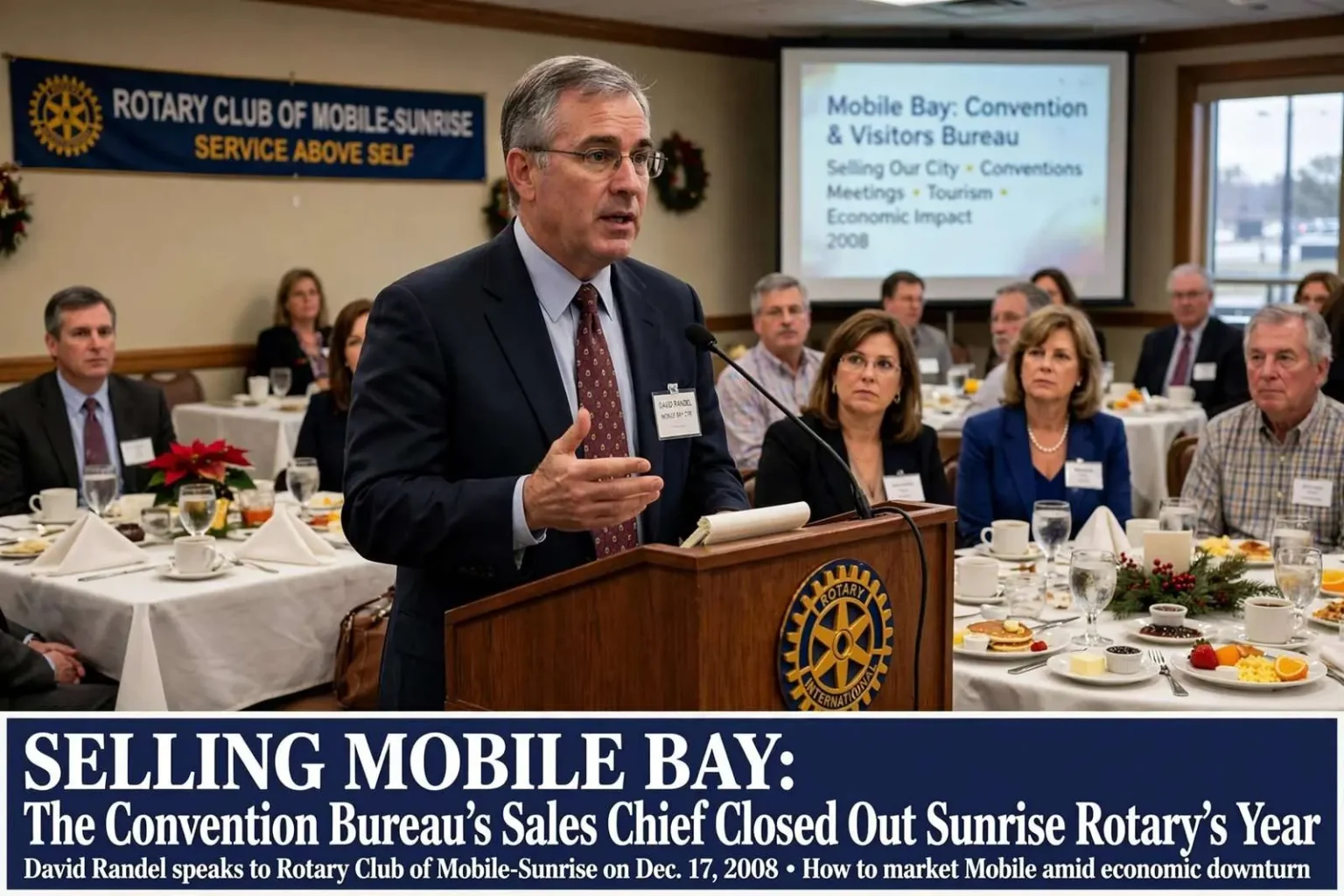
The Rotary Club of Mobile-Sunrise closed its 2008 program year on Dec. 17 with a subject that had grown steadily less abstract as the national economy deteriorated: how, exactly, does a mid-sized Gulf Coast city persuade people to come here and spend money?
The speaker was David Randel, vice president for sales at the Mobile Bay Convention and Visitors Bureau, who oversees the bureau’s sales team and its work bringing conventions, meetings and conferences to the Mobile Bay area.
A hotelier’s résumé
Randel came to the job with more than 30 years in the hospitality industry. He served most recently as vice president of villa marketing for Marriott Vacation Club International. His career at Marriott also included stints as area director of marketing, director of marketing and director of sales, and he worked as a principal sales trainer within the organization.
That background made him an unusually practical speaker for a business audience. Sales training at a global hospitality company is built on a simple discipline — know the product, know the buyer, and make the match — and Randel’s move from marketing resort villas to selling a city followed the same logic at a larger scale.
What the bureau does
The convention and visitors bureau is a private, not-for-profit organization contracted by the city to serve as the marketing arm of the Mobile Bay area. Its charge is to attract visitors and conventions so they might experience the region’s history, culture and attractions — strengthening Mobile’s standing as a national destination, adding economic stability and, in the bureau’s language, enhancing the quality of life across the region.
Stated plainly, the bureau’s job is to convert Mobile’s assets — Carnival, the waterfront, the architecture, the food, the proximity to the beaches — into hotel nights and restaurant tabs.
In December 2008 that was harder than it had been in years. Corporate travel budgets were among the first casualties of the financial crisis, and cities across the country found themselves competing for a shrinking pool of meetings. Convention sales is a business of bookings made years in advance, and the collapse of late-2008 meant that meetings being negotiated for 2009 and 2010 were suddenly vulnerable to cancellation, renegotiation or relocation to wherever the price was lowest.
Randel’s audience of business owners, professionals and civic volunteers had a direct stake in the answer, which is why the bureau routinely asks community groups to understand their own role in its success: the delegates a club member recruits, and the visitor who is treated well, are part of the sales force.
Santa, a choir and pancakes
The club also looked back at its Dec. 10 meeting, which members described as full of Sunrise tradition — the family pancake breakfast, the annual visit from the St. Paul’s Choir, and the timely appearance of Santa Claus himself. Elle Weishaar of St. Dominic’s Parochial School was named Student of the Week at that meeting.
The holiday meeting is the kind of fixture that defines a morning club. Sunrise Rotary draws members from across the metro area to early gatherings where family participation is woven into the program, and the December pancake breakfast — with the choir and Santa in the room — doubles as the club’s welcome to the season for children and grandchildren of longtime members.
Housekeeping before the break
Attendance chairman Billy McLean reported that attendance had climbed back above 70 percent, against a club goal of 75 percent. “Let’s continue to encourage good attendance and make-ups with new members, at our meetings, and in the newsletter,” he urged, noting that many members were exceeding the goal and that the club could celebrate its attendance alongside its programs, service projects and contributions.
Attendance is more than a statistic in Rotary culture. It is the mechanism that keeps service commitments staffed and the club’s network active, and chairmen like McLean track make-ups — meetings attended at other clubs — as a sign of members’ engagement beyond their home table.
The club continued to seek a Spanish-speaking Rotarian team leader and non-Rotarian team members for a Group Study Exchange trip to Peru set for April 15 to May 15, 2009. The program, a Rotary international tradition, sends young professionals abroad to study their vocational fields while experiencing another culture, and the search for a Spanish-speaking leader reflected the practical demands of a month in South America.
Suggestions for district governor for 2011-2012 were due to past district governor Richard Bollinger by Dec. 22. The nomination cycle, running years ahead, is how Rotary maintains its leadership pipeline — district governors are chosen from club ranks well in advance, and every member’s name offered by a deadline like this one enters a process that leads to the district’s top volunteer post.
Members were also reminded of a standing $858 Fund-A-Star grant the club and Rotarians Gigi Armbrecht and Jim Frost had sponsored for Melissa Lockett’s Backpacking with Reading project at W.D. Robbins Elementary School in Prichard.
The grant is representative of how Rotary clubs of Mobile-Sunrise work at the neighborhood level. Rather than large institutional gifts, the club’s Fund-A-Star mechanism puts modest, targeted sums behind individual projects — in this case a reading initiative at a Prichard elementary school, where a single program can reach a whole classroom’s worth of students across a school year.
Prichard, which borders Mobile to the north, has long figured in the club’s service map, and education projects like Backpacking with Reading send books home with children who might otherwise have few at hand. The $858 figure — small by institutional standards, decisive by classroom standards — captures the scale at which most Rotary service actually operates.
The holiday schedule
Mobile’s Rotary clubs went dark for the holidays on a staggered timetable. Sunrise would not meet again until Jan. 7. Mobile-West resumed Jan. 6, and the downtown club Jan. 8. Sunrise had no meetings on Dec. 24 or Dec. 31.
The staggered restart is a small detail of civic life, but it matters to the Rotarians who make up the region’s clubs: make-up attendance at a neighboring club’s meeting counts toward home-club requirements, and members returning early from the holidays often fill each other’s rooms in the gap week.
Reconvening into a new year
When the club reconvened in the new year, it did so in a very different economic climate — and with a program calendar that would soon include a real estate economist, the Senior Bowl and the port.
That slate captured the issues a Gulf Coast city faces in a downturn: the housing market’s collapse, the fate of a college football institution that fills hotels each January, and the port whose cargo volumes track the health of global trade. Each speaker addressed a facet of the same underlying question Randel had closed the year with — where the money that sustains Mobile comes from, and how the city attracts more of it.
The Rotary year that ended Dec. 17, 2008 thus closed on a note of practical civic economics. A sales executive had explained how a city markets itself in the worst economy in a generation; a club had checked its own attendance, tended to its grants and exchanges, and paused for pancakes and a choir before confronting that answer in January. For a service organization whose membership is drawn from the city’s businesses and professions, the connection between the two — a healthy visitor economy, a healthy civic network — was the quiet theme of the season.
The Dec. 17 meeting itself followed the club’s standard format: a buffet breakfast, calls for guest introductions, committee reminders and the program speaker — the machinery that keeps a service club running week after week. Finishing the year with an outside speaker on civic economics, rather than a purely ceremonial program, reflected the club’s practice of using even holiday-adjacent meetings for content members could use in their businesses.
Randel’s talk also arrived at a moment when the bureau’s own funding model was under the same pressures it was hired to fight. Lodging taxes that support destination marketing fall when hotel occupancy falls, so the 2008 crisis hit the bureau’s revenue and its mission simultaneously — one more reason its representatives spent the winter reminding community groups that tourism was everyone’s business.
For the Rotary members in the room, the message carried a practical edge. Restaurant owners, bankers, printers and retailers all sit inside the visitor economy’s supply chain, and the bureau’s pitch was that every club member who refers a convention, books a visiting colleague into a downtown hotel or welcomes a family in town for the Senior Bowl is performing the same sales work the bureau’s staff does full time — with the proceeds landing in Mobile payrolls rather than in some competitor’s.
As the club adjourned for the holidays, the combined message of the month was one of stewardship: of the club’s own attendance and grants, and of the city’s visitor economy heading into the hardest year it had faced since the years after Hurricane Katrina. Both stewardships would be tested in January, when the pancakes were gone and the economists arrived.