‘We Are in the Golden Age Now’: A Councilman on Race Relations in Mobile
Asked in March 2005 to name Mobile's golden age, City Councilman Fred Richardson answered with the present tense, and pointed to a small change in newspaper style as a milestone.
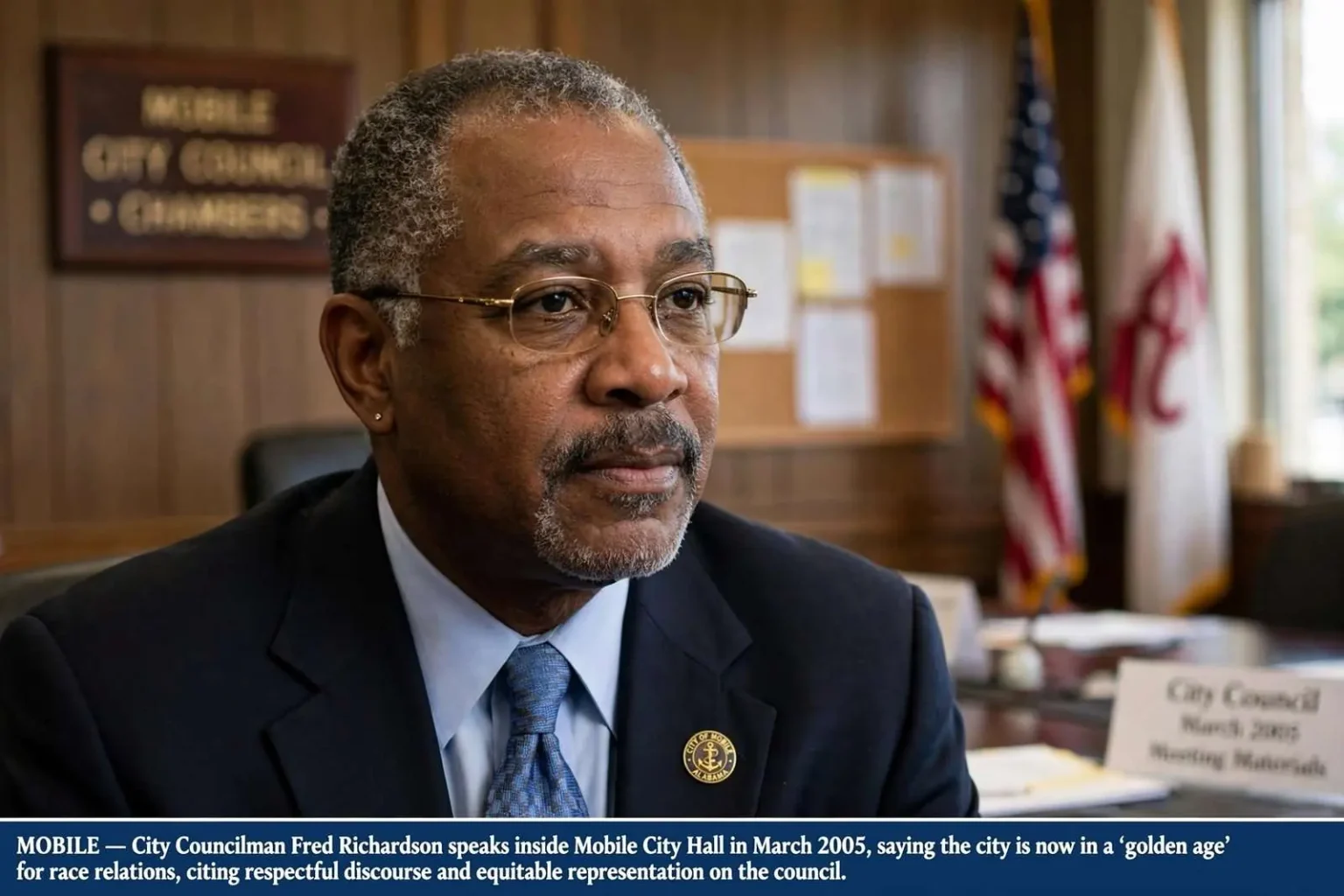
MOBILE — When a series of local interviews in March 2005 asked prominent Mobilians to identify the city’s golden age, most reached backward — to the cotton boom, to the shipyards, to a remembered era of prosperity. City Councilman Fred Richardson answered in the present tense.
“We’re in the golden age now,” he said, speaking of race relations in Mobile. “We are in an age where people are being represented and the level of service is delivered based not on district, based not on race, religion or national origin, and not on other non-meritorious facts.”
It was a striking claim, and Richardson was careful to note that it had not always been possible to make. “In the past, that was not always true,” he said.
A Council Divided by Politics, Not Race
Richardson, a longtime member of the Mobile City Council, argued that when relations among council members grew strained — and they did — the strain came from political differences rather than racial animus. “On the council, I am not familiar with any racial bickering,” he said. “There are no racial slurs.”
The distinction mattered to him. A body that argues about budgets, districts, and priorities is a body doing its job. A body that argues about race is something else. Richardson’s point was that Mobile’s council, whatever its disagreements, had crossed from the second category into the first.
The council he described was the product of a hard-won structural change. Since the mid-1980s, Mobile’s seven council members had been elected from individual districts rather than citywide, a system that guaranteed neighborhoods across the city — from Africatown and Toulminville in the north to the growing suburbs of west Mobile — a representative of their own. Every member therefore had a constituency to answer to, and every fight over paving, drainage and development had a district’s name attached to it.
In Richardson’s telling, that structure did part of the work of racial peace on its own. A council elected by districts could disagree fiercely about where money went without anyone suggesting the disagreement was about anything other than geography and priority. The alternative — a citywide body in which a majority’s preferences always governed — had been precisely what the old litigation said was constitutionally suspect, and Mobile had lived under both systems within living memory.
The Milestone in the Newspaper
Richardson then raised what he acknowledged might seem a small matter, but one that had stuck with him: the practice, long followed in the local press, of identifying Black elected officials by their race in news copy. The stories, he noted, had referred to “black Councilman Fred Richardson” and “black Councilman Clinton Johnson” — but the same story never said “white Mayor Mike Dow.”
The asymmetry was the whole of the problem. To be marked was to be treated as a departure from a default, and the default was unmarked.
“The newspaper has abandoned their long practice of identifying minority members of public bodies by the color of their skin,” he said. “That has stopped and it is a milestone in race relations here.”
What made it a milestone, in his account, was not the change in style alone but how the change came about. “I asked that they drop that and they did,” Richardson said. He read the response as a sign of respect — and respect, he argued, is the foundation of all good relations, racial or otherwise.
Newspaper style is an easy thing to dismiss until one considers what it teaches readers day after day. For decades, Mobile readers had encountered a city government in which one councilman’s race appeared in his description and the mayor’s did not — a typographic hierarchy of belonging that no individual story intended and that accumulated meaning over years. The paper’s decision to drop the identifiers changed nothing about any story’s facts and everything about the frame around them.
‘No One Is Hyphenated’
“I really think that that is a milestone in race relations locally,” he said. “No one is hyphenated. We are all treated as one. That is our challenge and it will always be our challenge.”
The closing phrase carried a good deal of weight. Richardson was not declaring the work finished. He was describing a golden age as something maintained rather than achieved — a standard that has to be met continuously, and that can be lost.
That formulation set his answer apart from the others collected in the series. To call a bygone era golden is to make a claim about the past that no one can contradict; to call the present golden and immediately add that keeping it “will always be our challenge” is to make a claim about the future that can be tested. Richardson, who had spent years on the council watching district fights over everything from Toulminville revitalization to west Mobile growth, was offering a verdict on how far the city had come and a warning about how little it would take to slip.
His own vantage point gave the assessment credibility on both sides. Richardson had been elected from one of the districts where the city’s Black political power was concentrated, had served long enough to remember when the markers he described were routine, and sat in 2005 on a council whose debates he could quote from memory. When such a member said the arguments were about politics and budgets, it carried a weight that an outsider’s reassurance could not.
The Spring of a Transition
Richardson’s remarks came in a spring when Mobile was in the middle of a political transition. Mayor Mike Dow had announced he would not seek a fifth term, and the field to succeed him was forming. Among the candidates was Mobile County Commissioner Sam Jones, who would go on that August to become the first Black mayor in the city’s history — a fact that gives the councilman’s assessment, offered months earlier, a certain retrospective resonance.
Dow’s retirement closed a sixteen-year era in which the city had pursued harbor expansion, downtown redevelopment and convention-center projects under a single administration, and the open race drew candidates from every faction of the city’s political map. A city that had fought court battles over whether its governing body could reflect its Black population was about to elect, without litigation or crisis, a Black man as its chief executive.
The city’s history on race is not simple, and Richardson did not pretend otherwise. Mobile was where the modern civil rights litigation over at-large elections was argued — a case that reached the U.S. Supreme Court and reshaped how municipalities across the country structured their governing bodies, eventually pushing Mobile itself to abandon citywide elections for its commission in favor of the district system that produced the council of 2005.
That litigation tradition and the conciliation of 2005 are the two halves of the same story. The city that had to be taken to court to change how it counted votes was also, twenty years on, a city where a Black councilman could say, credibly, that the arguments were about politics — and where the practice of marking Black officials by race could end with a request rather than a lawsuit.
Asked to name the golden age, Richardson had chosen the one he was living in. It was, in its way, the most optimistic answer anyone gave — and the only one that came with a maintenance schedule attached.
The newspaper practice Richardson described had deeper roots than any single newsroom policy. For most of the twentieth century, Southern papers routinely identified Black subjects by race in headlines and copy while leaving white subjects unmarked, a convention so pervasive that readers stopped noticing it. What changed in Mobile by 2005 was not only the style rule but the fact that a Black councilman could raise the matter publicly and be answered with a change rather than a defense — an exchange that, small as it was, would have been unthinkable in the city’s newspaper columns a generation earlier.
Richardson’s comments about the council’s civility also carried a practical political dimension. Mobile’s district system had created safe seats on both sides of the racial ledger, which meant council members answered to constituents who expected results rather than gestures. In such a body, coalition-building across racial lines was not an act of charity but the ordinary mechanics of assembling five votes for anything — a road project in one district traded for a drainage fix in another. Members who could not work across the council’s racial and geographic lines simply could not deliver for their districts.
The “no one is hyphenated” standard also spoke to how Mobile’s civic leadership class had evolved by mid-decade. The city’s chambers of commerce, ordinary civic clubs and downtown institutions had spent the 1990s deliberately integrating their boards, and by 2005 biracial cooperation was the explicit expectation in civic life rather than an innovation. Richardson was describing, from inside city government, the same shift the business community had advertised to the nation during its recruitment campaigns.
History would test the councilman’s “always our challenge” warning sooner than the interview’s readers could know. The 2005 mayoral contest that followed Dow’s retirement produced a crowded field, a runoff, and ultimately a Black mayor governing a city whose racial arithmetic remained close to even — the very conditions under which the standards Richardson described would be renewed or squandered, one council fight and one newspaper column at a time.