A Facebook Page and a Promise: Nathan Davis Challenges Jim Barton in District 104
Republican Nathan Davis launched a primary challenge to veteran state Rep. Jim Barton with a Facebook page and a platform built on one very local promise: no more annexation of Tillmans Corner.
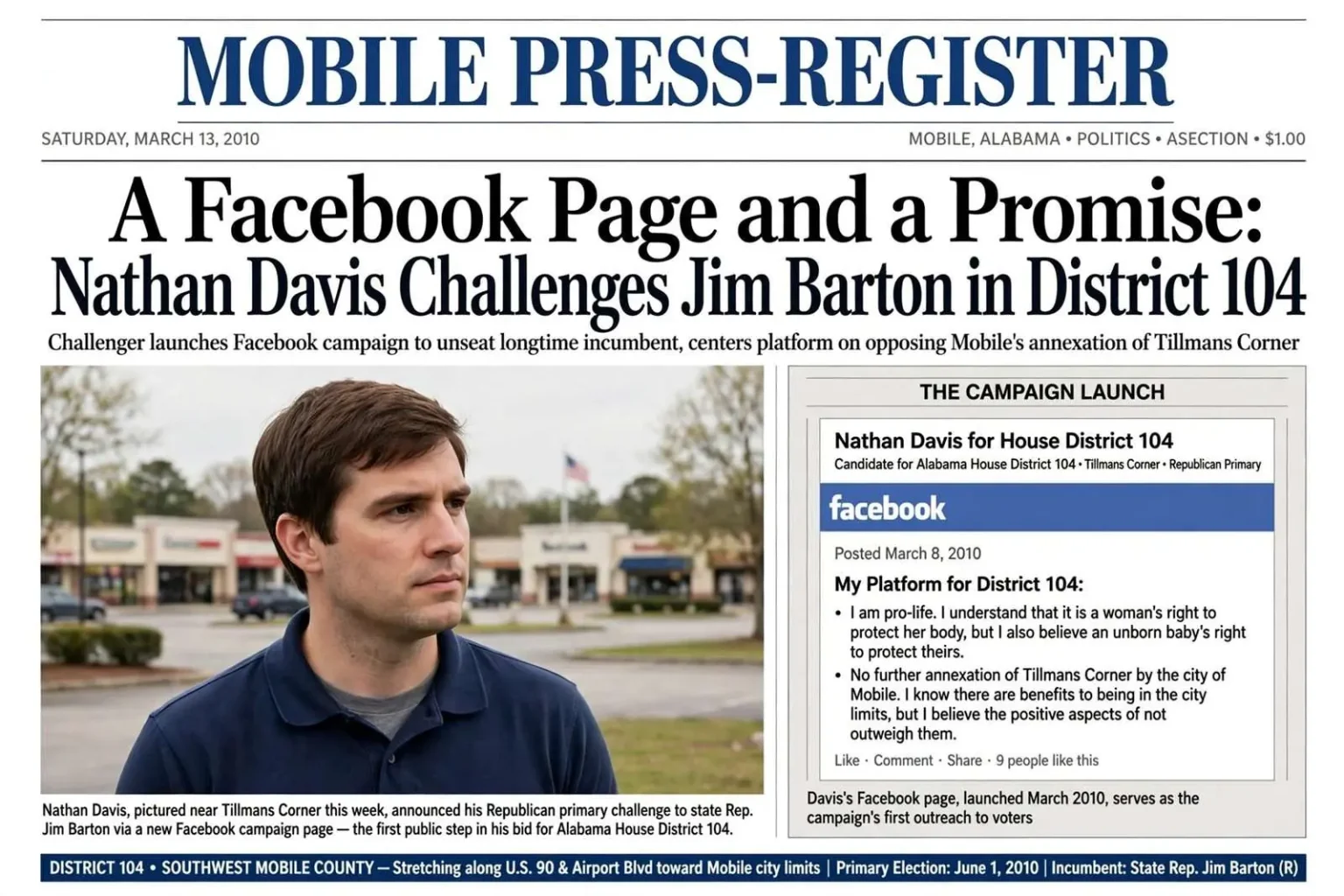
Nathan Davis has established a presence on Facebook for his campaign in Alabama House District 104, giving a Republican primary challenge to a veteran incumbent its first public infrastructure — and giving Tillmans Corner a candidate running explicitly on its behalf.
Davis recently launched his challenge to state Rep. Jim Barton, a Republican who had held the seat and risen in the House GOP caucus. The district covers portions of southwest Mobile County, a stretch of the county where suburban neighborhoods, commercial strips and long-established unincorporated communities run together along the U.S. 90 and Airport Boulevard corridors toward the Mobile city limits.
A Facebook page is, by later standards, a modest thing on which to launch a legislative campaign. In Alabama in early 2010, it was still a novelty — and Davis made it the first stop of his race, putting his platform in front of voters before yard signs, fundraisers or a formal announcement tour had arrived.
The platform
Two planks appeared on the campaign’s Facebook page. The first was abortion. “I am pro-life,” Davis wrote. “I understand that it is a woman’s right to protect her body, but I also believe in an unborn baby’s right to protect theirs.”
The second was the one with local teeth, and it was labeled with unusual bluntness: City of Mobile interference.
“No further annexation of Tillman’s Corner by the city of Mobile,” Davis wrote. “I know there are benefits to being in the city limits, but I believe the positive aspects of not, outweigh them.”
The pairing said something about how legislative campaigns are assembled in south Mobile County. The first plank aligned the candidate with the Republican base on the social question that defines party primaries across Alabama. The second addressed the specific, durable grievance of the neighborhood where the race would actually be decided — a position that separated Davis, at least rhetorically, from anyone in the race who might look kindly on Mobile’s expansion.
The statement on abortion, with its careful attempt to balance a woman’s claim and an unborn child’s, sounded like a candidate thinking out loud rather than a platform line cut from a party handbook. The annexation statement, by contrast, was plain and unhesitating, aimed squarely at a constituency that had been saying the same thing for decades.
Why annexation is the issue in Tillmans Corner
Tillmans Corner is one of the largest unincorporated communities in Alabama — a substantial commercial and residential area southwest of Mobile that has, over decades, repeatedly declined to become part of the city. Its commercial core grew up along the old highways leading out of Mobile, and its residential sprawl filled in behind the stores, creating a population base that by any reasonable standard would constitute one of Alabama’s larger cities if it were incorporated on its own.
It never has been, and the refusal is not accidental. The arguments are old and well-rehearsed on both sides. Mobile has long looked west and south for the sales tax revenue and the population that annexation would bring; the city’s tax base had been eroding for years as retail development moved outside its limits, and every big-box store that opened in the unincorporated county took revenue with it that the city treasury could not touch.
Residents of the unincorporated areas, for their part, have generally preferred lower taxes and the county’s lighter regulatory hand, and they have been suspicious that annexation would bring city taxes without a proportionate improvement in city services. The suspicion is fed by experience: residents who pay city taxes elsewhere in Mobile County often tell the same story about services that did not arrive as promised.
The mayoral campaign of 2005 had turned partly on the question, with candidates asked directly what Mobile could offer the areas it hoped to annex. The answer that came back — roads and drainage — struck west Mobile County residents as beside the point, since they did not consider those to be their problems. To neighborhoods that had built their own sense of civic identity without a city hall, the city’s pitch sounded like a solution in search of a problem.
That history explains why an anti-annexation plank has legs in a district like 104. The grievance is not a single dispute with a filing deadline; it is a standing arrangement of local life, renewed every time the city’s boundary conversation resurfaces. A candidate who names it early can claim a constituency that no amount of generic campaigning can reach.
Running for the Legislature on an anti-annexation platform is, in that light, less about state law than about signaling. A state representative does not decide annexation; the city, the affected residents and, in some cases, the Legislature itself all play a part. Annexation in Alabama can proceed by referendum, by legislative act, or in limited cases by the city’s own action, and legislators have historically been drawn into the fights when annexation proposals required their blessing or when residents sought legislative protection.
But a candidate who says plainly that he will not help Mobile expand into Tillmans Corner is telling voters where he stands in a dispute they have been having with the city for most of their lives. It is a promise that costs little to keep — a legislator’s day-to-day work rarely touches annexation directly — and it is worth a great deal to the voters who hear it. In that sense the plank is less a legislative program than a declaration of identity: I am from here, and I am not with the city.
The challenge Davis faced
Beating a sitting Republican in a Republican primary is difficult, and beating one who has built seniority is harder. Barton was an established figure whose position in the House would grow considerably more powerful after November 2010, when Republicans took control of the chamber for the first time since Reconstruction and the caucus’s veterans moved into committee chairmanships. Seniority in the Legislature is accumulated across election cycles, and a member who has held a seat through multiple terms arrives at each new one with relationships, staff knowledge and institutional memory that a first-time challenger cannot match in a single campaign.
For the district, seniority carries tangible value. A committee chairman representing southwest Mobile County is positioned to steer budget attention toward local projects, to move legislation through the process and to give the district a voice in the majority’s decisions. That argument — experience translated into influence — is the standard one incumbents make, and Barton was well placed to make it.
What Davis had was a Facebook page, a clear message on the one issue that unites his corner of the county, and a primary date — June 1 — on which turnout in a state legislative race would be low enough that a motivated constituency could matter. Low-turnout primaries reward candidates whose supporters feel something strongly. A district race in June, at the bottom of a ballot topped by a governor’s race, will draw a fraction of the November electorate, and the fraction that shows up skews toward voters with a stake in a particular grievance or cause.
An anti-annexation campaign is built precisely for that arithmetic. Davis did not need to win the argument across the whole district; he needed the voters for whom the city-limits question is a defining one to know that someone was finally running on it.
Social media as a campaign vehicle was, in early 2010, still a novelty in Alabama legislative races. Most challengers in south Mobile County were still ordering yard signs. A candidate who opened with a Facebook page was making a small statement about how he intended to reach people — cheaply, directly and without the gatekeeping of the local press. Facebook in that era was expanding fast into middle-aged and older demographics, the very voters who dominate a June primary, and a campaign page cost nothing to maintain between fundraising cycles.
Whether the page translated into votes was a question the calendar would answer. But the choice of instrument fit the candidate and the district: a grassroots challenge, built on a neighborhood grievance and aimed at a low-turnout primary, was never going to be waged with the money and machinery of an incumbent. It was going to be waged one message at a time, in the places where south Mobile County residents were already talking to each other.
For Tillmans Corner, the race offered something it rarely gets: a candidate whose first public act was to promise that the community would stay outside the city. Whatever else the 2010 primary decided, that promise had now been entered into the record — on a Facebook page, of all things, in a race where even the infrastructure of campaigning was new.
The race also illustrated how much the ground had shifted under Alabama’s incumbents by 2010. The recession had rearranged the state’s political mood, and challenges from inside the Republican Party — once rare and almost always futile — were becoming a routine feature of primary season. A veteran legislator’s seniority still counted, but it no longer counted as insulation. Every incumbent in 2010 was running in an electorate that had been taught, by a decade of national and state frustration, that primary challenges were a legitimate way to register displeasure.
District 104 itself has long been a seat with a distinct civic personality. The neighborhoods it covers — Tillmans Corner, the communities around it and the suburban reach of southwest Mobile County — have for decades voted Republican in state races while maintaining a prickly independence from the city of Mobile that sits a few minutes’ drive to their northeast. The district’s voters are, in the main, county residents by choice, and their representatives have traditionally been expected to reflect that choice.
Barton’s service had been built on that base, and his rise within the House GOP caucus reflected the district’s steady reliability. A challenger’s task in such a seat is not to argue ideology — the party’s positions on the social and fiscal questions of 2010 were the incumbent’s positions too — but to find the issue where the district’s local loyalty outranks its party loyalty. Davis’s bet was that annexation was that issue.
The June 1 primary would test the bet in the least dramatic setting imaginable: a summer election day, light turnout, a ballot led by statewide races and decided, in legislative districts, by a few thousand votes. Campaigns of this kind are won in living rooms, church parking lots and Facebook feeds, one voter at a time. A challenger with a clear message and no money has exactly one way to compete in that environment, and it is to be present — online, in the neighborhoods, at the places where the district’s voters gather — for every day the calendar allows.
Whether Davis’s page grew into a full campaign or remained what it was on the day it launched — a promise with an audience — the move marked the point at which the annexation question entered yet another of the district’s elections. The issue that had shaped mayoral races and county commission campaigns was now, for the first time in a while, at the center of a legislative primary in District 104. The voters who had been having that argument with the city for most of their lives could finally see their position on a candidate’s platform, spelled out in a sentence, on the newest campaign medium the state had yet seen.