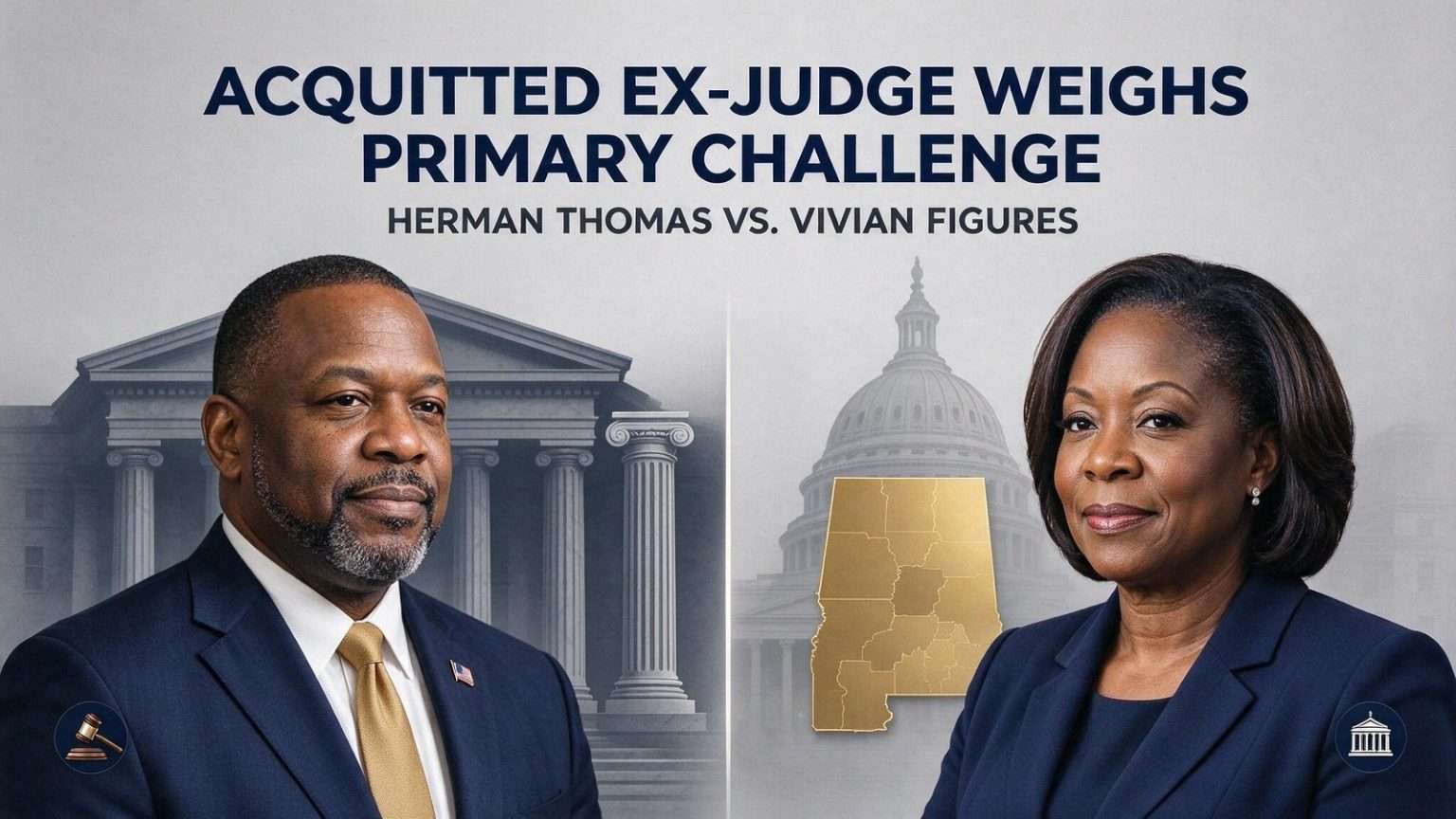
Former Mobile County Circuit Judge Herman Thomas, acquitted last fall of all charges in one of the most sensational trials in the county’s history, is among several prominent local figures considering a challenge to state Sen. Vivian Davis Figures in the Democratic primary for Senate District 33.
Thomas would say only “I appreciate you calling” when asked about his plans. He would neither confirm nor deny the reports, nor accept a characterization of the exchange as declining comment.
The coyness was, in its way, a message. A figure who had spent months at the center of the county’s most notorious criminal case was signaling that he remained a presence in Mobile politics without yet committing to the race that would test how much of that notoriety had converted into standing among the district’s voters.
The Trial Behind the Candidacy
Thomas resigned his judgeship just before the state Court of the Judiciary was to convene on charges of judicial misconduct. He was then tried on criminal charges alleging he had paddled young inmates in a second office at the courthouse for his sexual gratification, offering leniency in exchange. The charges at one point numbered 103 counts. After a three-week trial in the fall of 2009, he was found not guilty of all of them.
The case had consumed the county’s attention for the better part of two years, from the first complaints through the resignation and the indictment to a trial that filled the courthouse annex’s largest courtroom with spectators and reporters. The allegations — a sitting circuit judge, young jail inmates, an unused office, sexualized paddlings traded for favorable treatment — were unlike anything in the county’s judicial history, and the sheer arithmetic of the indictment, 103 counts spanning years and multiple accusers, made acquittal a striking outcome.
Thomas said the media had not treated him fairly or covered his trial with balance, arguing that testimony and evidence in his favor went unreported while lurid allegations were sensationalized. He said he might explain his grievances more fully at an appropriate time.
The Alabama State Bar had suspended his license to practice law pending resolution of the criminal case. A bar panel in Montgomery was set to hear his appeal to regain it on Tuesday, Feb. 16 — Mardi Gras Day. In deference to the Mobile holiday, the bar reportedly reset the matter for the following week, according to Tony McLain, general counsel for the Alabama State Bar.
The scheduling note became a small story in itself: the state’s lawyers’ organization, headquartered two hours north, had planned the hearing without checking Mobile’s calendar, and the observation that Feb. 16 was Mardi Gras — a day on which no Mobile lawyer, witness or judge could reasonably be expected in Montgomery — forced the postponement. For a lawyer seeking readmission to the bar, the episode was a reminder that he remained, professionally, a Mobile man regardless of what had happened in the courtroom.
Reinstatement mattered for more than the right to practice. In Alabama politics, “Judge Thomas” carried a title earned over a decade on the district and circuit benches, and a candidate’s professional standing — restored license, cleared reputation — shaped how any campaign biography could be written. Until the bar panel ruled, the acquittal stood as the only restoration he had received.
Why a Figures Challenge Would Be Extraordinary
Figures’s family was directly involved in the case against Thomas. Her son Akil, imprisoned on drug-related convictions, testified for the prosecution, saying he had received leniency from Thomas in exchange for submitting to paddlings. Sen. Figures also testified as a prosecution witness.
A campaign by Thomas against Figures would therefore be a rematch of the trial conducted by other means, in front of the voters of a district that had followed every day of it. No candidate in the state would enter a race having testified as the prosecution’s central accuser against the man running against him — or having watched his mother take the stand in the same case. The district’s voters would be asked to referee, at the ballot box, the same conflict a circuit jury had just resolved.
Senate District 33, which reaches across much of central Mobile and into Prichard, was drawn as a Black-majority district and had been held by the Figures family for a generation. The primary was the only contest that mattered in most cycles, so the decision of any challenger — Thomas, or anyone else — was in practice a decision to take on the family’s organization in the neighborhoods where it had been built.
Who Figures Is
Figures won a Mobile City Council seat in 1993. She left it in 1997 after defeating state Rep. James Buskey in a special election to fill the Senate District 33 vacancy created by the death of her husband, Michael Figures, a founder of the New South Coalition and one of the most formidable Black political figures the region produced. She was re-elected in 1998, 2002 and 2006.
The succession was itself a piece of Mobile political history. Michael Figures had built a law practice and a political organization that spanned the city’s civil rights generation, and his death in 1996 created an instant contest among the district’s established figures. His widow, then in her first term on the council, defeated a sitting state representative for the seat, and the New South Coalition — the political organization her husband had co-founded to mobilize Black voters and candidates across Alabama — became the foundation of her own machine.
In 2008 she won the Democratic nomination for the U.S. Senate seat held by Republican Jeff Sessions. With Barack Obama drawing 39 percent at the top of the Alabama ticket, Figures took 37 percent — a respectable showing in an unwinnable race, and one that raised her statewide profile considerably.
Running only four points behind the presidential nominee who was carrying the Democratic ticket to its best showing in a generation gave her a claim to statewide viability that no other Mobile Democrat could match, and it equipped her with a donor and volunteer list that reached beyond Senate District 33. Any challenger sizing up the 2010 primary had to assume she would be stronger in defeat than most incumbents are in victory.
The Rest of the Field
Also weighing the Democratic primary was Victor Crawford, longtime chief of computer data operations for Mobile County and son of the late Vernon Crawford, the pioneering civil rights attorney whose litigation helped produce the form of city government that first put Black officials in Mobile’s City Hall.
The elder Crawford’s place in Mobile history was secured in the courtroom: his challenges to Mobile’s at-large, commission-style government were part of the legal campaign that eventually forced the city to elect its council by districts, opening City Hall to representation from Black neighborhoods for the first time. He ran for the council himself in Mobile’s first mayor-council election in 1985, suffered a stroke during the campaign and died in January 1986. Michael Figures had once been an associate in his law firm — one of the ties that bound the city’s civil rights legal generation together.
Victor Crawford confirmed he intended to seek public office for the first time. His candidacy would have carried a family name from the district’s western precincts — Prichard and the northside communities that had looked to the Crawfords for decades — and set two legacies of Mobile’s Black political tradition against each other: the courtroom lineage of the Crawfords and the electoral organization of the Figures family.
William Carroll, re-elected four months earlier to a second term representing District 2 on the Mobile City Council, was also mentioned, though sources close to him suggested he was as likely to stay at City Hall. Carroll’s District 2 overlapped a piece of the senate district, giving him name recognition among exactly the voters a primary would turn out, and his fresh council mandate meant a race would mean abandoning a seat he had just been re-elected to hold.
On the Republican side, Walter Bracy, 59, pastor of First Baptist Church of Prichard and older brother of Prichard City Council President Napoleon Bracy, said he would formally announce in February. Bracy also works as a paraprofessional teacher in the Mobile County Public School System.
Bracy’s entry gave Republicans a name on the ballot in a district where the party rarely competed, and a pulpit in Prichard, the city at the district’s northern end, from which to run. The pastor’s mantle was a familiar credential in Mobile County politics, where ministers have long converted congregational standing into candidacies, and his brother’s post on the Prichard council gave the family a second foothold in the district’s public life.
Party primaries were set for June 1.
The calendar shaped every calculation. Qualifying would close in early April, which left the winter for the rumored candidates — Thomas, Crawford, Carroll — to decide whether to test the Figures organization or yield the field to it, and left Figures herself facing, for the first time in her Senate career, the possibility of a primary that was also a family reckoning: a rematch, held at the ballot box, of the trial the whole district had watched.