A Six-Figure Exit: The Retirement Math Facing Bishop State’s President
With a federal and state investigation swirling around Bishop State Community College, its longtime president stood to collect a lump sum of roughly $529,000 under Alabama's DROP program if she retired at term's end.
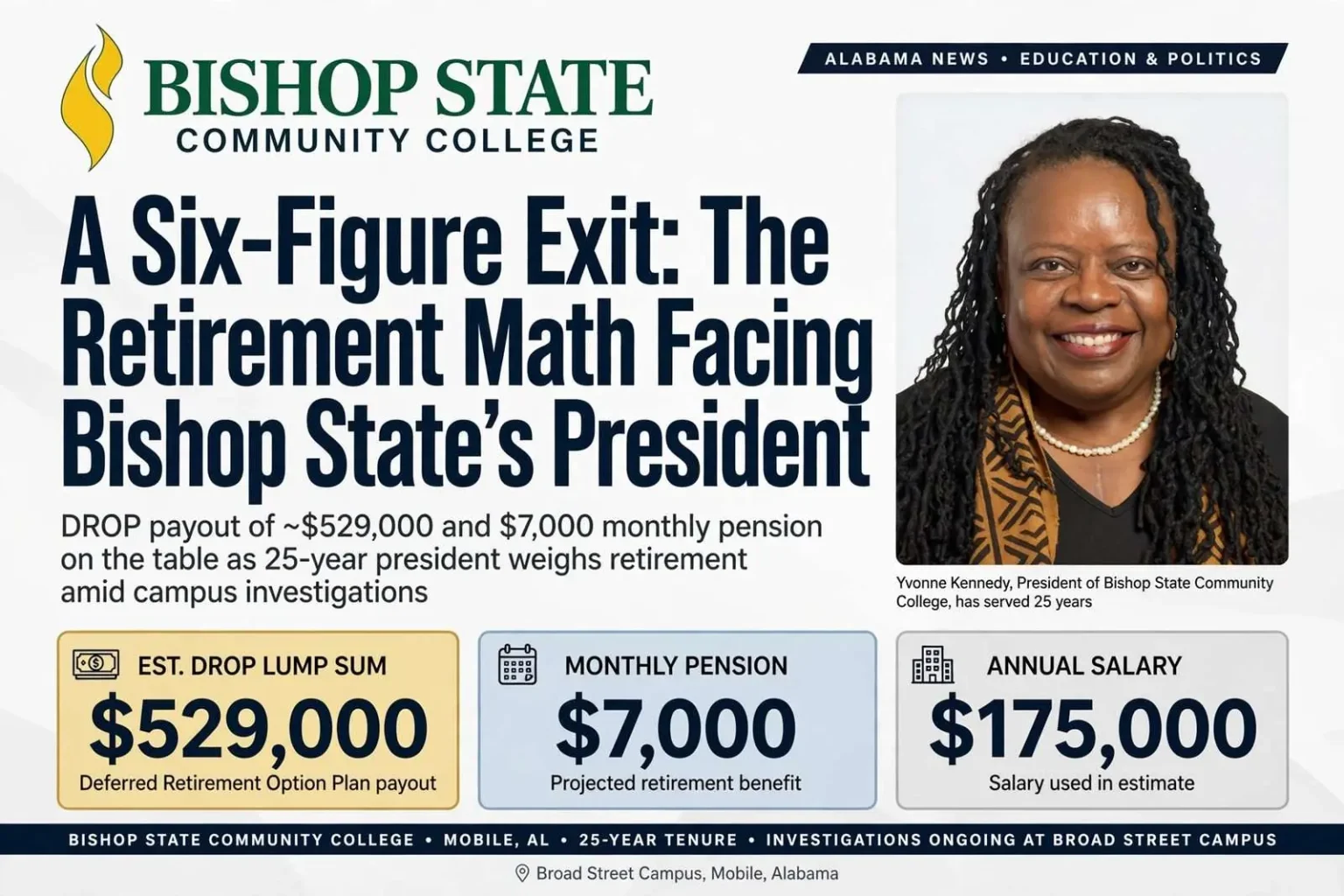
The financial arithmetic of a graceful exit was drawing attention at Bishop State Community College, where longtime President Yvonne Kennedy stood to receive a lump sum payment of about $529,000 if she retired at the end of the school year. The approximation was calculated using the Retirement Systems of Alabama’s own online calculator, together with Kennedy’s years of service and her salary of $175,000. Her monthly pension in retirement would run to roughly $7,000.
The payout would come through the Deferred Retirement Option Plan, known as DROP, a program instituted about five years earlier to keep experienced state employees from walking out the door. The problem it addressed was straightforward: veteran employees who had already earned full retirement benefits could quit, start drawing a pension and take a second job elsewhere, leaving the state without their expertise. DROP was designed to change that calculation by giving experienced workers a financial reason to stay on the payroll a little longer.
How the Deferred Retirement Option Plan works
Under DROP, an employee who agreed to keep working had his or her retirement pay accumulate in an account rather than being paid out monthly. When the employee finally retired for good, the accumulated balance was delivered as a lump sum and the monthly pension began. In effect, the program let a retirement-eligible worker bank a pension while still drawing a salary, converting additional years of service into a single large payment on the way out the door.
The Retirement Systems of Alabama administers the pension plans that cover state employees, public educators and employees of Alabama’s public two-year colleges, and the online calculator that produced the Bishop State estimate is a publicly available tool on the system’s website. Members enter their salary, years of service and plan assumptions, and the calculator returns projected monthly benefits and lump-sum figures. It was that tool, applied to Kennedy’s service record and her $175,000 salary, that produced the roughly $529,000 estimate and the projected monthly pension of about $7,000.
For someone with Kennedy’s tenure and salary, the result was a substantial check on the way out. Retirement analysts generally note that a lump sum of that size reflects decades of contributions and interest, and that the monthly figure it converts to is comparable to what a career educator or administrator at the top of the pay scale would expect. The DROP arrangement rewards staying longer, but only up to a point: once an employee in the plan finally leaves, the account closes and the ordinary pension rules take over.
A decision watched across the campus
Whether Kennedy would take the exit available to her was, in the weeks the estimate circulated, an open question at the Broad Street campus. A decision to retire at the end of the school year would trigger the lump-sum payout and end a 25-year run as the school’s chief executive. A decision to stay would keep her in office while the investigations described below continued to unfold around the institution she led.
The cloud over Broad Street
The timing was what made the number newsworthy. Several Bishop State employees were under indictment in connection with financial irregularities at the Broad Street campus, and federal and state investigations were continuing, according to authorities. The cases involving the college’s employees were among the most closely watched pieces of a larger reckoning in Alabama’s two-year college system, and any departure by the school’s president would inevitably be read in that light.
As the school’s chief executive for 25 years, Kennedy had drawn sustained public criticism, although she personally had been neither accused of nor charged with any wrongdoing. She had not returned calls seeking comment. Supporters pointed out that an indictment of employees is not an indictment of a president, and that the investigations had produced no charges against her. Critics, meanwhile, argued that a quarter-century at the top of an institution made her accountable for its condition, whatever the legal outcomes for individual employees.
A second public life in the Legislature
Kennedy also had a second public life. She had represented north Mobile in the Alabama Legislature for about 25 years, one of the most durable political careers in the county. Her service in Montgomery overlapped almost exactly with her presidency at Bishop State, an arrangement that was legal under Alabama law and was in fact common at the time, when two-year college employment and legislative service overlapped in ways that would eventually draw statewide scrutiny.
That overlap was one thread of the wider investigation into the two-year college system. Lawmakers and college employees often moved in the same circles, held positions in the same institutions and influenced the same budgets, and the potential for conflicts of interest became a recurring theme as the inquiry widened. Kennedy’s dual role — legislator and college president for roughly the same quarter-century — made her one of the most visible examples of the pattern, even absent any personal accusation.
A scandal with statewide reach
The Bishop State case was one piece of a widening investigation into Alabama’s two-year college system, an inquiry that reached across the state and into the Legislature itself. What began as scrutiny of financial practices at individual campuses grew into a broader examination of hiring, contracting and dual employment arrangements throughout the system, and Mobile was one of the focal points.
Its political implications were not lost on party strategists. House Minority Leader Mike Hubbard, the new state Republican chairman, was blunt about what he saw in it.
“The two-year college scandal that you have been following, it appears to go deep and wide, and I believe there will be some opportunities to pick up some special elections before 2010,” Hubbard said.
It was the kind of remark that reveals more than intended: a scandal in the community colleges, read openly as a seat-count opportunity. Whatever the investigations determined about individual employees, the political class in Montgomery was already weighing what the fallout would mean for legislative districts where the two-year colleges were major employers and civic institutions.
The stakes for Bishop State
Lost in the accounting was the institution itself. Bishop State Community College served a largely Black student body in Mobile, offering the kind of two-year credentials and transfer pathways that, for many families, represented the only realistic route into higher education. The college’s programs fed students into careers in health care, technical trades and public service, and its credits transferred into the state’s four-year universities for students who wanted to continue toward a bachelor’s degree.
A scandal that damaged the college’s accreditation, enrollment or reputation would fall hardest on students who had the fewest alternatives. Community colleges live and die by public confidence: enrollment follows reputation, and state funding follows enrollment. For the neighborhoods around the Broad Street campus, the prospect of a damaged Bishop State meant fewer affordable routes into nursing, allied health, construction trades and the transfer pipelines that had carried generations of Mobile students into universities.
What the numbers said, at a glance
The arithmetic that circulated on the campus and in the local press came down to a short list of figures drawn from the retirement system’s own calculator:
Estimated DROP lump sum: about $529,000. Annual salary: $175,000. Estimated monthly pension: about $7,000. Tenure as president: 25 years. Status: not accused or charged with wrongdoing.
Each figure carried its own weight in the public conversation. The lump sum, large as it was, represented deferred pension payments that had accumulated while Kennedy continued working under DROP. The monthly pension was the ordinary retirement allowance her years of service and salary level supported. The tenure figure explained why the numbers were so large: a 25-year presidency atop a longer career in education had pushed her benefits to the top of what the system’s formulas produce.
Open questions on Broad Street
Whether she would take the exit available to her, and what would follow at the Broad Street campus, remained open questions as the investigations ground forward. A retirement would have ended a singular chapter in Mobile’s public life — a woman who had led the same college for a quarter-century while representing north Mobile in Montgomery for nearly as long — and would have handed the lump sum and pension the calculator predicted. Staying would have meant continuing to answer for an institution under federal and state examination.
Either way, the episode illustrated how Alabama’s retirement system, its two-year colleges and its part-time Legislature intersected in the career of one official. The same calculators that let any member model a retirement had, applied to the top of Bishop State’s organizational chart, produced a number that made the politics of the two-year college scandal suddenly concrete: a six-figure exit, a $7,000 monthly pension, and a campus whose students had the most to lose from whatever came next.