Royal Street Goes Both Ways Again as Downtown Mobile Undoes Decades of One-Way Traffic
Mobile moved in late 2006 to restore two-way traffic on Royal Street and blocks of Dauphin and St. Francis, an $800,000 project tied to the Battle House Hotel and the RSA Tower.
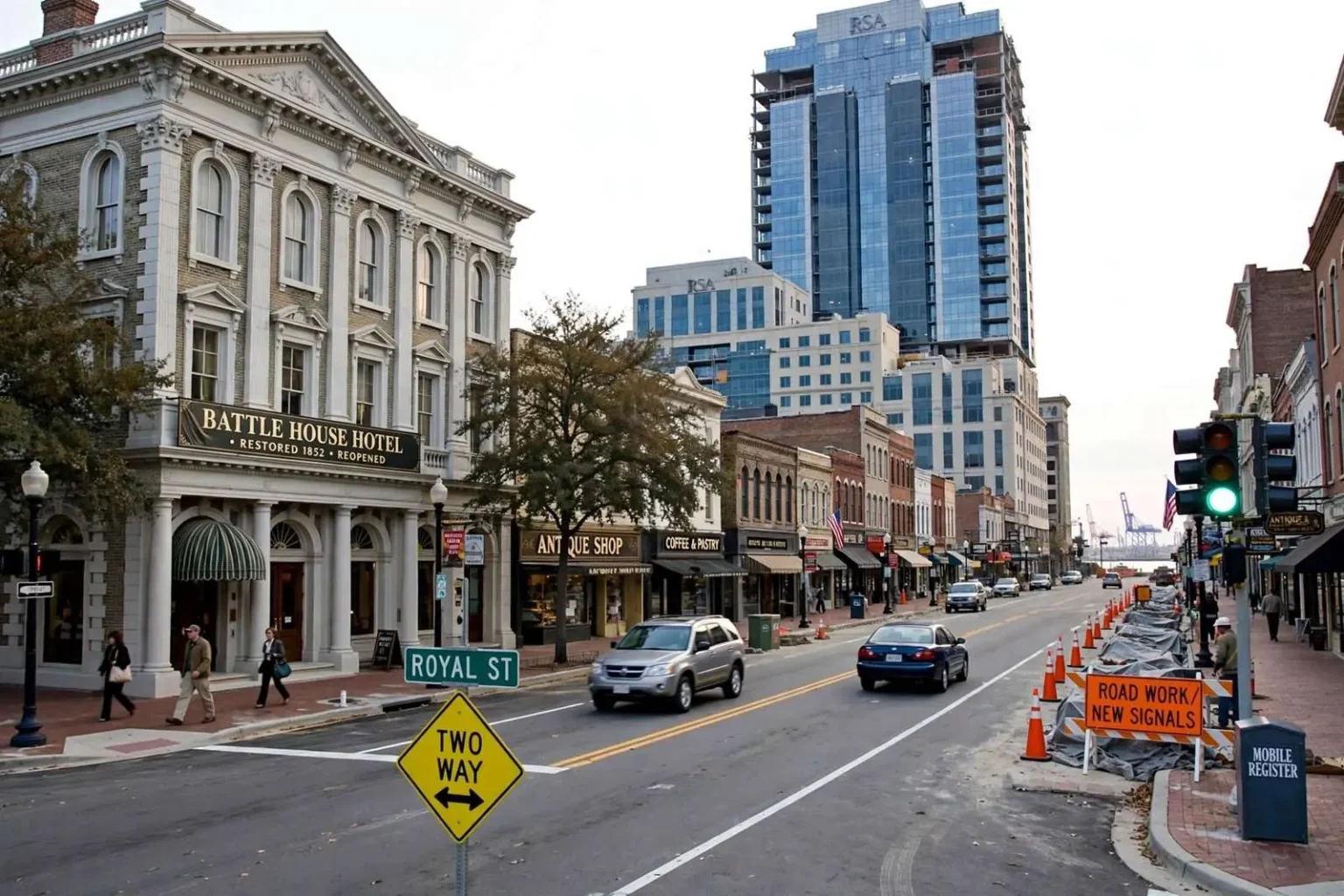
The City of Mobile moved in late 2006 to step back to the future downtown, restoring two-way traffic to Royal Street and to a block of Dauphin and St. Francis streets after decades in which Royal had carried cars in only one direction.
Royal Street had run one-way northbound from the Bankhead Tunnel for ages, part of a mid-century approach to urban traffic that prized moving vehicles through downtown as quickly as possible. That thinking was, by 2006, in full retreat in cities across the country.
The one-way conversions of the 1950s and 1960s were sold in their era as modernization: synchronized flows, faster commutes and a cleaner path from the tunnels and bridges into the heart of town. What they cost was harder to see in a traffic engineer’s diagram. One-way networks treated downtown as a place to pass through, not a place to arrive, and by the early 2000s Mobile’s city leadership had joined a national reconsideration of that philosophy — a movement that asked what a street is for before asking how fast cars can leave it.
What Was Changing
Under the plan, Royal Street would be reborn to motorists headed in either direction, running two-way all the way north to the post office at Congress Street. Dauphin Street and St. Francis Street would revert to two-way traffic between Royal and Water streets.
City Councilman Reggie Copeland said the changes were made in part to accommodate two major downtown developments then coming online: the restored Battle House Hotel, the landmark hostelry on Royal Street, and the RSA Tower, the high-rise office building rising beside it.
Both projects, driven by the Retirement Systems of Alabama, represented an enormous bet on the future of downtown Mobile, and both would deliver visitors and workers who needed to actually reach the front door.
The logic was straightforward. A guest arriving at the Battle House — the restored 1852 hotel that David Bronner’s Retirement Systems of Alabama had returned to service as the anchor of the lower Royal Street district — should be able to pull up to the entrance from either direction. The RSA Tower next door would bring hundreds of state workers into the same blocks every weekday. A one-way grid built for throughput made both buildings harder to reach; a two-way grid made them addresses instead of destinations you hoped to glimpse while driving past.
The Timeline and the Price
Copeland said the work might be finished before Christmas.
“We might have it done with signage and traffic lights maybe by the middle of December, maybe even earlier,” he said. “I can’t give an exact date because it’s being done in-house, not by a contractor.”
City Traffic Engineer Bill Metzger put the cost of the Royal, Dauphin and St. Francis project at an estimated $800,000, covering signalling, signage, resurfacing and the rebuilding of medians.
Doing the work in-house rather than bidding it to an outside contractor saved time and money but made the schedule harder to promise precisely; the city’s own crews fit the signal and striping work around their other responsibilities. The $800,000 estimate covered the full mechanical conversion of the three streets: swapping signal heads and timing, replacing one-way signs with two-way signage, repaving travel lanes to their new configuration and rebuilding the medians that had channelized northbound flow for decades.
Copeland said merchants along the affected stretches were delighted with the project.
Why Merchants Wanted It
The enthusiasm of downtown businesses was not sentimental. One-way street networks, whatever their virtues for commuters, are hard on retail. They cut a storefront’s visibility roughly in half, they make it difficult for a driver who spots a shop to circle back, and they encourage traffic to move at speeds that discourage anyone from stopping at all.
Converting streets back to two-way slows traffic, doubles the exposure of each address and restores the fine-grained circulation that makes a downtown navigable on impulse. By the mid-2000s, cities from Vancouver to Charleston were reversing the one-way conversions of the 1950s and 1960s for precisely these reasons.
The arithmetic behind a storefront’s visibility is unforgiving. On a one-way street, only the traffic traveling in one direction ever sees the shop at all; on a two-way street, every passing vehicle does. And the driver heading the wrong way — the one who noticed the restaurant or the antique store and wants to come back — on a one-way grid must run a loop of blocks that often kills the impulse entirely. Slower two-way traffic also makes street parking easier to enter and exit and makes pedestrians feel safer crossing, both of which translate directly into foot traffic for the businesses along the curb.
Mobile’s timing put it in step with a national pattern. The same reversal movement had already reclaimed one-way grids in cities of every size, and the lessons were consistent: conversion costs a fraction of what new construction would, and the retail and residential benefits arrive as soon as the signs change.
More Conversions Under Consideration
The Royal Street project was not intended to be the last. Other downtown streets identified as possible candidates for conversion to two-way traffic included St. Joseph, St. Francis, Washington and St. Louis.
Taken together, the list amounted to a systematic rethinking of how automobiles moved through Mobile’s historic core, a district laid out long before the automobile existed and rather poorly served by being retrofitted for it.
Mobile’s street grid dates to the city’s colonial-era plan, with its long blocks and narrow rights of way oriented toward the waterfront. Forcing mid-century highway logic onto that grid had produced the worst of both worlds: streets too wide to feel like a walkable downtown, yet too short and too interrupted to move traffic the way a modern arterial would. The candidate list for future conversions — St. Joseph, Washington, St. Louis and the remaining blocks of St. Francis — suggested officials saw the Royal-Dauphin-St. Francis work as the first phase of a grid-wide undoing, block by block as development justified each one.
The Larger Project
The street conversions belonged to a broader downtown revival then gathering force. The Battle House had been shuttered for decades before its restoration. Dauphin Street’s entertainment district was reviving. The cruise terminal was drawing passengers to the waterfront.
Each piece depended on the others, and all of them depended on people being willing and able to come downtown.
The early-2000s renaissance rested on a chain of investments that reinforced one another: the RSA Tower brought office workers, the restored Battle House brought overnight guests, the renovated Saenger Theatre and the Dauphin Street bars and restaurants brought evening crowds, and the Alabama Cruise Terminal brought ship passengers whose visits put downtown Mobile in front of thousands of travelers a season. None of those investments paid off if the people they attracted could not easily find and reach the front doors.
Eight hundred thousand dollars in signals, signs, pavement and medians is a modest sum against the cost of a hotel restoration or an office tower. But it addressed something that neither of those projects could fix on their own: whether a visitor arriving in Mobile could actually find the place, park near it and get back out again.
Royal Street had been designed, in an earlier era, to move traffic past downtown. The 2006 project was an admission that the city would rather traffic stopped there.
What the Conversion Meant on the Street
For the neighborhoods inside the grid, the change was felt before it was read about. A driver leaving the Bankhead Tunnel — the four-lane underpass that funnels traffic beneath the riverfront — had long been spilled onto a one-way system that shot vehicles north through the historic core with little reason to slow down. With Royal running two-way, that same arrival now delivered a motorist directly into the blocks where the city wanted him: the hotel, the restaurants, the shops in the restored storefronts between Government Street and the waterfront.
Signal timing was the invisible half of the work. Retiming a corridor for two-way flow means coordinating lights so platoons of cars meet green in both directions — a fundamentally different problem from the one-way progression that had moved traffic north in waves. Getting the timing wrong produces gridlock and a public backlash; getting it right is what allows a street to serve both the shopper looking for a parking space and the commuter who still needs to cross downtown in reasonable time. It is also why the in-house approach mattered: the city’s own traffic engineers, who would live with the signals after the ribbon-cutting, were the ones tuning them.
The medians that were rebuilt as part of the $800,000 project carried their own message about what the streets were now for. Medians on a converted two-way street serve pedestrians as well as cars — a refuge that lets someone cross a wide block in two stages — and they frame left-turn lanes that give drivers direct access to businesses on the opposite side. On a one-way street, medians mostly exist to manage speed; on a two-way street they are part of the storefront access that merchants had been missing.
The project also served the hotel’s economics directly. A restored landmark property competes with modern hotels on history and character, and the arrival experience is part of the product: guests arriving for a wedding, a convention or a weekend should see the entrance from both directions and reach the door without a lap of the block. The same held for the tower’s tenants, whose clients and visitors needed a legible way in and out. In that sense the conversion was not an amenity layered onto the two developments — it was infrastructure they required to succeed, delivered by the city at a cost that was a rounding error against their construction budgets.
By the time the signage went up and the signals were switched, the question was no longer whether downtown Mobile could support two-way traffic but why it had ever been made one-way at all. The 2006 work put Royal, Dauphin and St. Francis back in the business of delivering people to places — and left the city with a template, and a candidate list, for finishing the job street by street.