Daphne’s William Wynne Named to Alabama Pardons and Paroles Board
Gov. Bob Riley appointed William Wynne Jr. of Daphne, chief U.S. probation officer for the Southern District of Alabama, as a special member of the state Board of Pardons and Paroles.
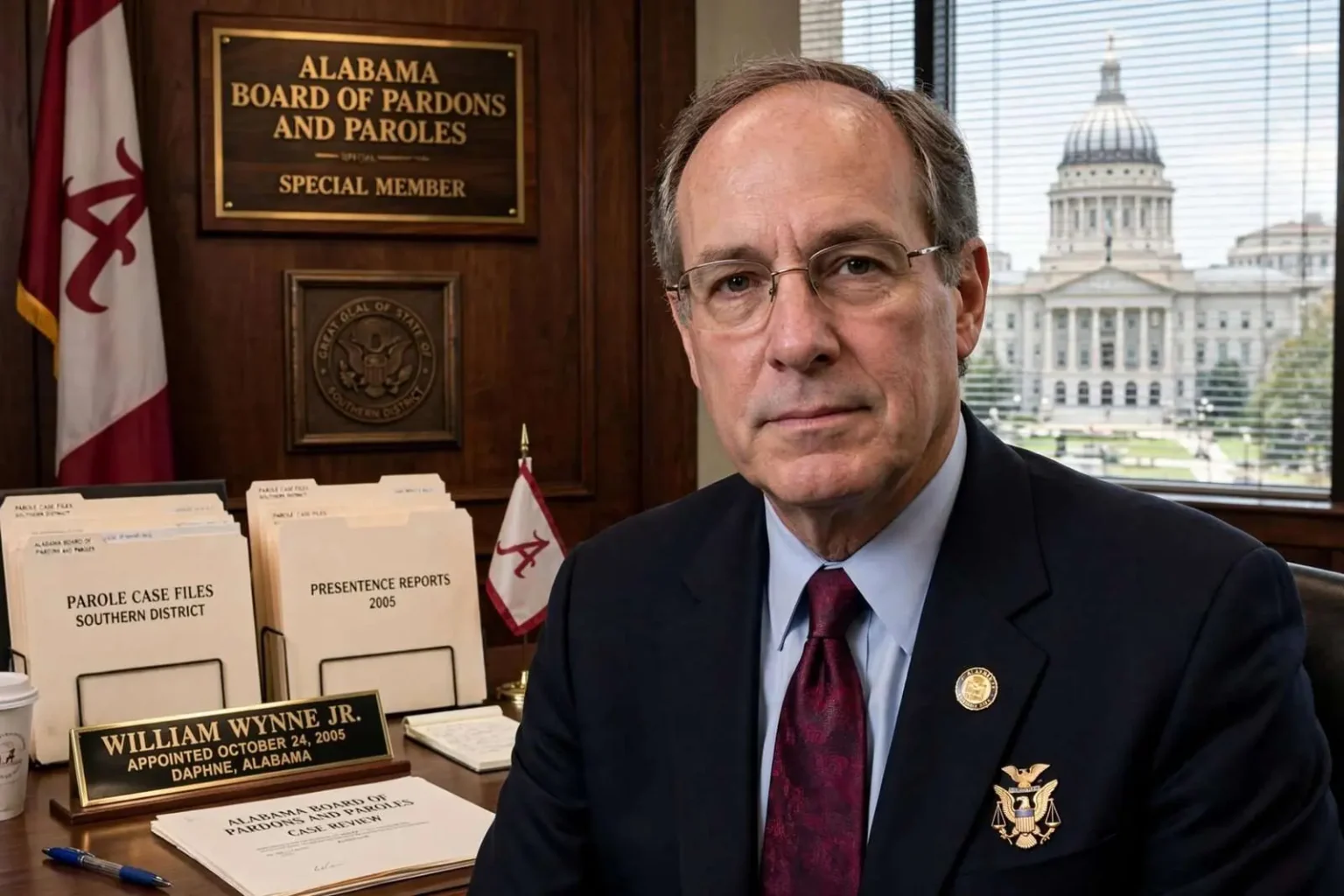
Gov. Bob Riley appointed a Mobile native and veteran federal probation official from Daphne to one of the more consequential and least understood boards in Alabama government, naming William Wynne Jr. as a special member of the Alabama Board of Pardons and Paroles. The appointment, announced from the Governor’s Office in Montgomery, placed a career federal probation man in a seat where the state decides, case by case, who leaves prison and who does not.
Three Decades in Federal Probation
Wynne had served as a U.S. probation officer for the Southern District of Alabama since 1976, and since 1988 had been the district’s chief U.S. probation officer. The Southern District encompasses thirteen counties in southwest Alabama, an area running from the Gulf beaches north through Mobile, Baldwin, Washington, Clarke and Monroe counties and beyond — a jurisdiction that stretches from the tourist beaches and the Port of Mobile to the Black Belt’s small towns.
Probation officers occupy an unglamorous but pivotal position in the criminal justice system: they prepare the presentence reports that shape federal sentences, and they supervise offenders released into the community. A presentence report gathers the biography, the crime, the prior record and the prospects of a defendant into a document a judge can act on; supervision then determines, in practice, whether release works. It is work that happens out of public view, but it touches nearly every federal criminal case in the district.
Nearly thirty years of that work — the last seventeen of them running the office — gave Wynne an unusually practical grounding for a board whose central task is deciding whether an inmate is ready to return to society. Few appointments to the state board arrive with that kind of résumé. The position rewards exactly the habits a career of federal probation builds: reading files closely, weighing risk honestly, and resisting both sentiment and fury.
The Governor’s Rationale
“William Wynne’s experience as a federal probation officer makes him well qualified for a seat on the Board of Pardons and Paroles,” Riley said. “I have full confidence in his abilities and know he will serve the people of Alabama with honesty and integrity.”
Wynne had served on a number of national committees, among them the National Law Enforcement Telecommunications System, the panel that coordinates and maintains national standards for the exchange of electronic information among state and federal law enforcement agencies. Work of that kind — building the data systems that let a patrol deputy in Washington County and a federal agent in Mobile see the same record — is invisible to the public but foundational to how law enforcement functions.
He earned a bachelor of science degree in 1975 and a master of science degree in 1976, both from the University of Alabama. He turned 53 that week. A Mobile native who had settled in Daphne, he represented the common profile of the coastal Alabama professional: raised in the city, established across the bay, working in institutions that span both counties.
The Appointment
Position: Special member, Alabama Board of Pardons and Paroles. Effective: Oct. 24, 2005. Term expires: Sept. 30, 2006. Vacancy created by: the resignation of Jennifer Mullins Garrett. Confirmation: required from the Alabama Senate.
The nomination came from Chief Justice Drayton Nabers, and Wynne acknowledged both the chief justice and the governor in accepting. “I am honored that Chief Justice Nabers nominated me and Gov. Riley appointed me to the Board of Pardons and Paroles,” Wynne said. “I look forward to serving my fellow citizens of Alabama and I appreciate the confidence that Chief Justice Nabers and Gov. Riley have in me.”
How the Board Works
The Alabama Board of Pardons and Paroles is a three-member body with authority over parole decisions, pardons and the restoration of civil rights for people convicted of crimes. Under the structure in place at the time, members were appointed by the governor from nominations submitted by the chief justice, the lieutenant governor and the speaker of the House — a design intended to distribute the appointment power across the branches of state government — and were subject to confirmation by the state Senate.
The board’s docket is enormous by any measure. Thousands of Alabama inmates become eligible for parole consideration during any given stretch of years, and each decision requires a hearing, a file, a victim’s statement perhaps, and a vote. Pardons and civil-rights restorations — which in Alabama determine whether a person can vote, hold office, or pursue certain licenses — run through the same small body, making it one of the few state agencies whose decisions change individual lives on a weekly basis.
Few state boards touch as many lives so directly. Its decisions determine whether thousands of Alabamians remain behind bars or return home, and they have long been a subject of political scrutiny from every direction: from families of victims who believe the board too lenient, from reform advocates who believe it too cautious, and from a state whose prisons have been chronically overcrowded for decades.
That scrutiny is part of the job. Parole members serve at the intersection of politics and punishment, and every high-profile denial or release draws comment from the governor’s office, the courthouse press and the advocacy groups on either side. A special member’s vote matters in that environment precisely because the margin between two positions on the board can decide an outcome.
Why the Background Mattered
Board members read the same documents probation officers write — risk assessments, institutional records, supervision histories — and a member who spent a career on the other side of those files reads them with an insider’s eye for what they show and what they omit. Wynne’s decades of supervising federal defendants in the community meant he had seen, in real time, which released offenders followed the rules and which did not. For a board that must predict human behavior on paper, that experience is the closest thing to a laboratory Alabama’s system offers.
The appointment also reflected the channels through which Alabama fills such seats. Nominations flow from the constitutional offices named in statute, the governor chooses among them, and the Senate confirms. A Mobile-area nominee chosen by a Baldwin County-resident profile, put forward by a chief justice and confirmed by a senator from every region of the state, illustrates how the state’s judicial and executive branches interlock in the quiet appointments that never make a ballot.
A Local Appointment With Statewide Reach
For coastal Alabama, the appointment placed a Baldwin County resident with deep Mobile roots on a board whose deliberations occur in Montgomery but whose consequences are felt in every county. Families in Mobile and Baldwin County who appear before the board — as victims, as relatives of inmates, as petitioners for pardons — would now have one member whose knowledge of the Gulf Coast’s courts, communities and enforcement culture came from decades of working inside it.
The Southern District Wynne had run covers a diverse swath of the state, from the port and shipyards of Mobile to the resort economies of the beaches and the agricultural counties north of the bay. Federal probation work in that district spans drug trafficking cases moving up the interstate corridors, white-collar cases from the banking and construction economy, and everything between. That breadth of exposure transfers directly to parole work, where no two files look alike.
Wynne’s service on national bodies such as the National Law Enforcement Telecommunications System also pointed to a habit of mind the board could use: attention to how information is collected, standardized and shared. Parole decisions are, at bottom, decisions about records — disciplinary files, program completions, prior supervision failures — and a member attuned to how those records are built brings a useful skepticism to them.
It was, in the ordinary run of state government, a routine announcement: a resume, two quotes, a term that would expire the following September and a confirmation vote ahead. Boards like the Board of Pardons and Paroles are filled by such announcements several times a decade, and most draw little attention outside Montgomery.
But the ordinariness is the point. In the lives of the people who would come before the board, it was anything but routine. The board’s three members hold discretion over thousands of cases in a given year, and a single vote is often the deciding margin. Every vote the body cast would send someone home to a family in Mobile or Prichard or Bay Minette, or keep someone in a cell in a crowded state prison system. Putting a man with Wynne’s career in one of those seats was, by the standards of Alabama government, a deliberate choice about who should hold that power — and the governor and the chief justice made it in the open, with the paperwork to prove it.