37,000 Votes Send Gulf Shores Fire-Rescue to the ‘Good Morning America’ Finals in New York
Backed by more than 37,000 votes, Gulf Shores Fire-Rescue earned a spot in the finals of ABC's 'Good Morning America' firefighters' challenge, sending three firefighters to New York City.
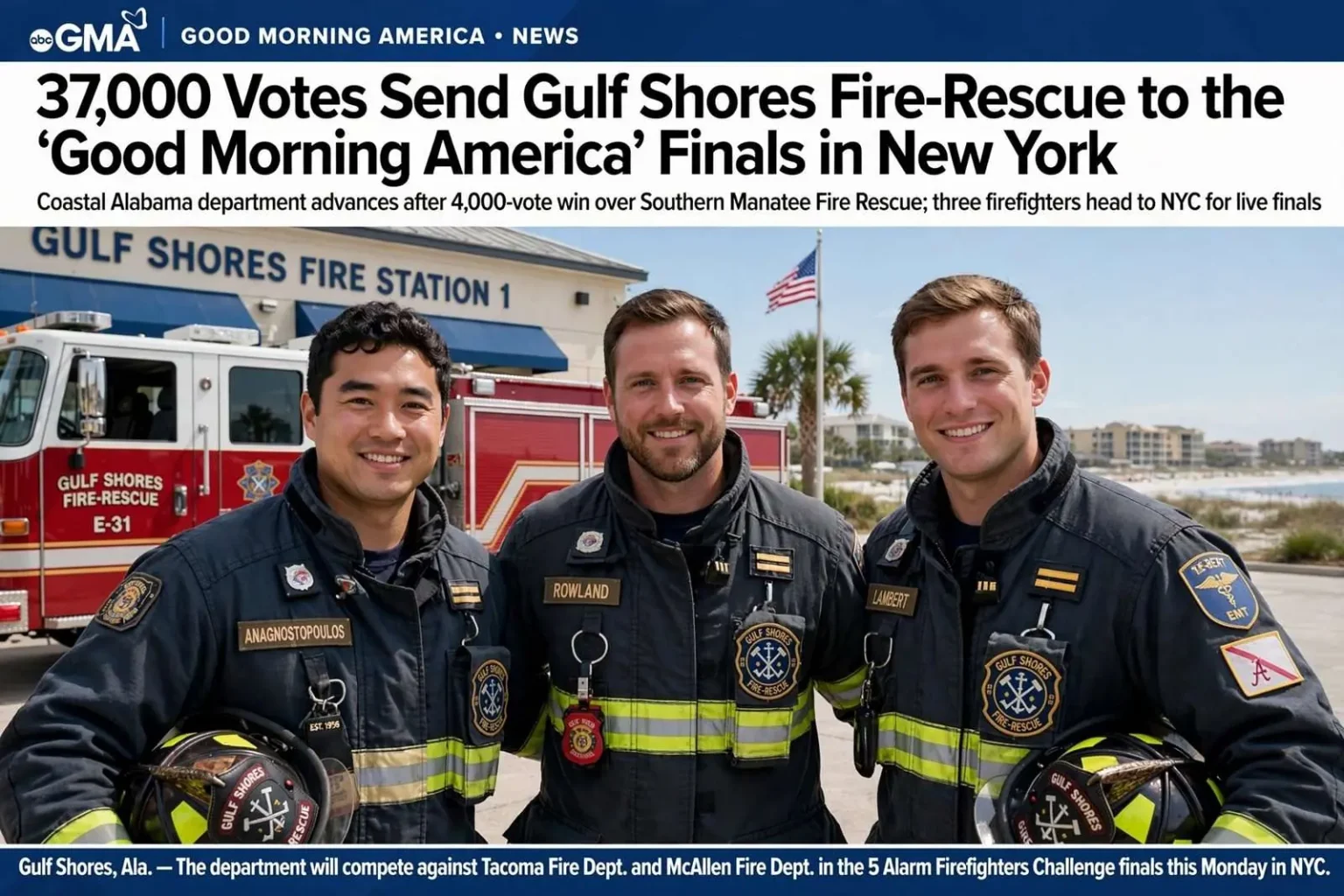
Powered by more than 37,000 votes and a wave of hometown support, the Gulf Shores Fire-Rescue Department earned a place in the finals of ABC’s “Good Morning America” firefighters’ competition, with three of its members bound for New York City.
As the last of six semifinalists in the show’s “5 Alarm Firefighters Challenge,” the department was pitted in an online vote against Southern Manatee Fire Rescue of Sarasota, Florida. Viewers chose their favorite firehouse, and Gulf Shores came out ahead by roughly 4,000 votes. The poll ran for seven hours before closing at 2 p.m. on the program’s website — a short, frantic window in which the department’s supporters mobilized across Baldwin County and beyond.
A homemade video, a statewide push
Each competing department produced a video set to the song “Safe and Sound” by Capital Cities. The Gulf Shores entry featured firefighters lip-syncing at the station and around town, complete with dance scenes shot against a smoky backdrop and even a beach rescue. The contrast between the department’s day job — protecting a resort city of crowded beaches and busy highways — and its willingness to dance in front of a camera was precisely what made the entry shareable.
Fire Chief Hartley Brokenshaw credited a broad, energetic effort for the win. “Everyone in the department pitched in and did their thing,” he said. “It was a true team effort. And the voting was a true effort of the whole state, county, everybody. I mean we had everybody, every city in the county voting for us. I think every city in the state was voting for us, too.”
Brokenshaw singled out fire-medic Justin Parks and his wife, Jamie Parks, for spearheading the project. Jamie Parks, who owns and directs South Baldwin Dance Center in Gulf Shores, choreographed the video while Justin Parks filmed it. “It had to be done pretty quick, within a week of when they found out about it,” the chief said. “I was really proud of them.”
The speed of the production shaped the result. A video assembled in a week, starring working firefighters and choreographed by a local dance teacher, carried the homemade charm that social media audiences reward, and the department’s supporters passed it along until the vote became a matter of civic pride. Volunteer fire departments and city governments across Alabama pushed their residents to vote, turning a national entertainment contest into an impromptu statewide campaign.
Heading to the Big Apple
The next phase would play out live in New York City, where three Gulf Shores firefighters were set to face crews from the Tacoma Fire Department in Washington state and the McAllen Fire Department in Texas. Representing Gulf Shores were Lt. Robert Rowland, fire-medic Nick Anagnostopoulos and firefighter-EMT Logan Lambert, with Justin Parks joining as an administrator.
“Good Morning America” planned to fly the men north that Sunday. The competition was expected to begin Monday and to feature physical and knowledge-based challenges, with the possibility of a cooking segment. Each department would earn points, and the highest scorer would take home $10,000 in prize money. If Gulf Shores won, Brokenshaw said, the department would put the winnings toward training.
The contests were designed as entertainment, but they draw on real skills: the physical challenges echo the strength and endurance the job demands, and the knowledge rounds test the sort of quick recall of procedures and equipment that firefighters maintain through constant drills. For the three competitors, representing a department of their size on national television was an unfamiliar stage; for the department, the exposure was worth more than the prize.
The department behind the video
Gulf Shores Fire-Rescue protects a city whose population swells each summer with beach visitors, a profile that makes it one of the busier departments on the Alabama coast. The department answers fire and medical calls along the beach boulevard, in the neighborhoods west of the city and along the waterways that thread through it, and its members train for the specific hazards of a resort coast — water rescues, high-rise calls in the beach hotels and heavy seasonal traffic that slows response times. The “beach rescue” scene in the contest video was not a fanciful touch; it is the kind of call the department answers routinely.
Departments of Gulf Shores’ size rarely appear on national television, which is part of why the semifinal run resonated. Fire service competitions on morning shows have become a recurring format, but the departments that reach the finals tend to be large city organizations with public-relations staffs. A coastal department that produced its own video in a week, with a dance teacher’s choreography and a firefighter’s camera, beat that template at its own game.
The contest also spotlighted the role of family in a small department. Justin Parks filming and Jamie Parks choreographing turned the project into a household collaboration, and the South Baldwin Dance Center’s involvement connected the fire service to the city’s broader community of small businesses. The dance center’s students and families became part of the voting bloc that carried Gulf Shores past its Florida rival.
What the $10,000 would mean
The prize money, should Gulf Shores win, is earmarked for training — a choice that reflects how fire departments actually spend windfalls. Training budgets are among the first line items squeezed in tight municipal years, and the certifications that keep firefighters current on rescue techniques, emergency medicine and hazardous materials response cost real money in course fees and overtime. A department that can send its members to additional training without straining the city’s budget treats the prize as an investment rather than a windfall.
‘As far as I’m concerned we’ve already won’ More than the prize, the chief said, the experience underscored the community’s backing. The video, he noted, had taken on a life of its own. “It’s one of those things. It just kept kind of growing every day,” Brokenshaw said. “It just kept getting bigger and bigger.”
He returned repeatedly to his gratitude for the support that carried the small coastal department past larger competitors. “As far as I’m concerned we’ve already won,” Brokenshaw said. “No matter what goes on up there, we’ve already won.”
A rare turn in the national spotlight
For Gulf Shores, the run offered a rare turn in the national spotlight, a chance to showcase both the department’s spirit and a beach town’s willingness to rally behind its firefighters. Cities Gulf Shores’ size accumulate recognition through tourism coverage and, occasionally, weather coverage; a morning-show competition built on firefighters’ personalities was an unfamiliar and welcome kind of attention.
The semifinal margin — roughly 4,000 votes in a seven-hour window — testified to how completely the mobilization worked. Online voting contests reward organized campaigns over raw population, and Baldwin County’s network of fire departments, city governments, churches and school communities functioned as exactly that. By the time the poll closed, the result had become a shared civic achievement that stretched well beyond the city limits.
Whatever the outcome in New York, the department left home knowing that tens of thousands of votes had already made its case. Three of its members would spend a Sunday flying north and a Monday competing on national television, and a department that protects a stretch of the Alabama coast would do so with its name known a little more widely than the week before.
The “5 Alarm Firefighters Challenge” unfolded across a summer of semifinals, with six departments competing for three finals slots through head-to-head online votes. The format made every round a test of mobilization rather than sheer size, and it rewarded departments whose communities treated the vote as a civic event. Gulf Shores entered as the underdog in population terms against its Florida opponent and emerged with a decisive margin, setting up a finals round against winners from the Pacific Northwest and South Texas.
The three finalist departments represent strikingly different corners of American firefighting. Tacoma is a full-sized city department in the Pacific Northwest; McAllen serves a fast-growing border metropolitan area in the Rio Grande Valley; Gulf Shores protects a small resort city whose population multiplies each summer. What the finals competition measures, though, is not department size but the fitness, knowledge and teamwork of the individuals on stage — terrain on which a three-person contingent from Alabama competes on equal footing.
For the competitors themselves, the week carries the double weight of representing their colleagues and enjoying the experience. Firefighters who spend their careers on calls that rarely make the news find themselves on a national broadcast, competing in events their families can watch, with their department’s name read to a national audience. The department’s leadership treats that exposure as a recruiting asset in an era when departments along the Gulf Coast compete for a limited pool of certified candidates.
Back home, the department’s regular work continued while its representatives flew north. Beach calls, medical runs and fire responses do not pause for a television appearance, and the shifts left behind covered the workload as usual. That ordinary continuity — the same crews, the same rigs, the same stretch of coast to protect — is the quiet backdrop to the department’s moment on national television, and the reason the community it serves voted for it in numbers no seven-hour poll would have predicted.