Baldwin Beach Express Interchange Opens, and Officials Bet It Will Boost Beach Tourism
With the final interchange complete, Gov. Robert Bentley helped open the Baldwin Beach Express to Interstate 10 in August 2014, giving beach traffic a new route and easing pressure on Alabama 59.
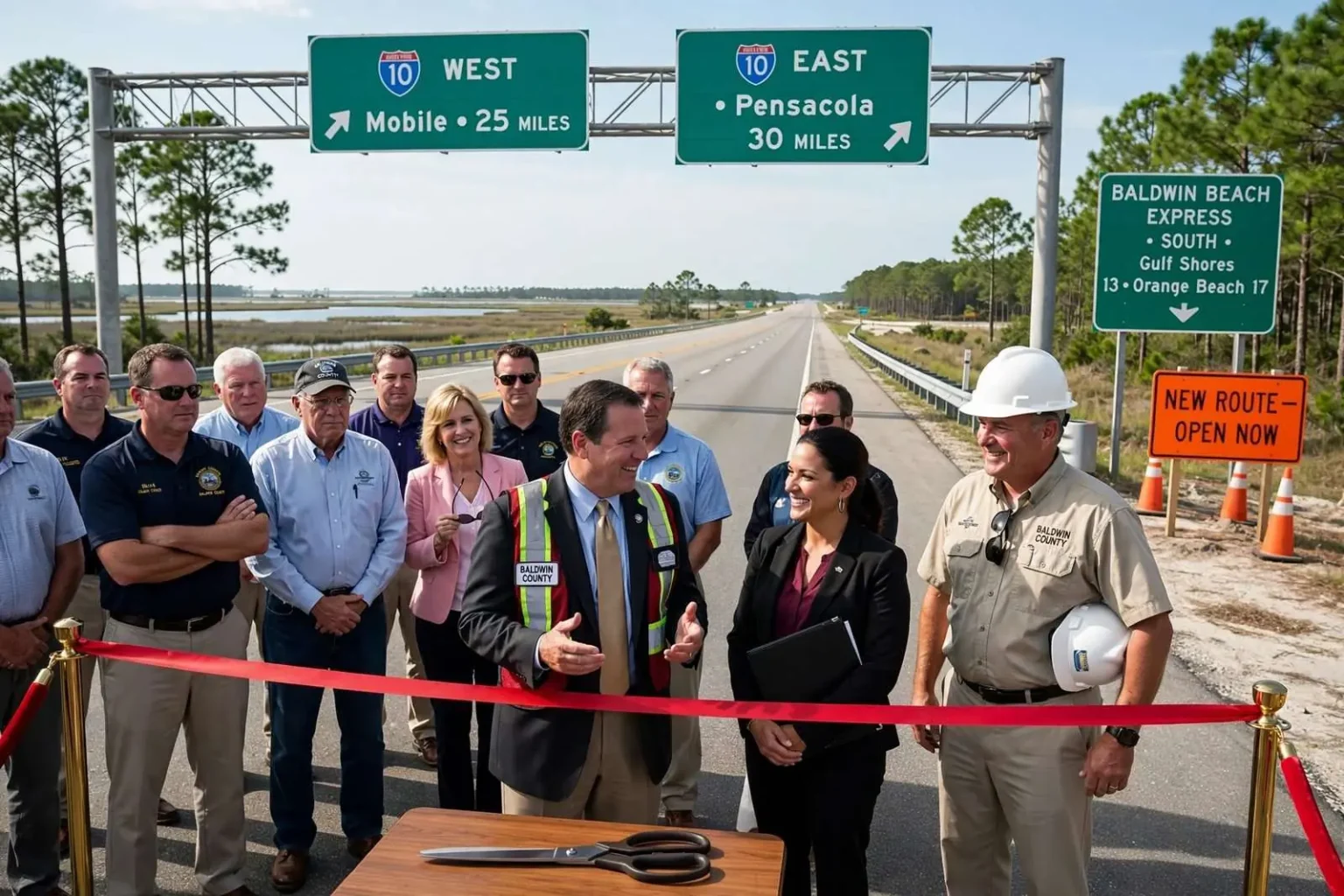
The completion of a new north-south corridor in Baldwin County was expected to give a lift to the county’s biggest economic engine — tourism — Gov. Robert Bentley said during a ribbon-cutting in August 2014. Speaking at a ceremony marking the opening of the highway’s connection to Interstate 10, Bentley said the Baldwin Beach Express would make it easier for visitors to reach the beaches of south Baldwin County, cutting minutes off a trip that generations of beachgoers had measured in frustration as much as mileage. “Economically, this is very important for this county,” the governor told the crowd of officials and residents gathered under the August sun.
A New Route to the Coast
The 12.8-mile Baldwin Beach Express runs from Interstate 10 to the Foley Beach Express, creating a continuous high-speed corridor from the interstate down to the heart of Baldwin County’s beach country. The four-lane highway was built to relieve traffic on Alabama 59, provide a quicker path to and from the beaches, and serve as a hurricane evacuation route — the last function one that residents of a county repeatedly raked by Gulf storms consider anything but theoretical. Motorists had already been using stretches of the highway as construction phases were completed, but the interchange at I-10 was the final piece of the $86.7 million project, the link that connected the whole route to the national highway system.
Its opening came roughly two weeks before Labor Day, the unofficial end of the busy beach season, with the governor joined by a host of local and state officials. The timing meant the new interchange would get its first real test not from the peak of summer traffic but from the Labor Day crowd — one final surge of beach-bound vehicles before the season turned. For transportation planners, the interchange represented years of work to stitch together a route that bypassed the stoplights and strip-mall congestion of the Alabama 59 corridor entirely, funneling interstate traffic onto a road designed from the start to handle hurricane-scale evacuations and peak summer loads alike.
The project’s design reflected Baldwin County’s particular geography. South Baldwin’s beach towns — Gulf Shores, Orange Beach and the unincorporated Fort Morgan peninsula — sit at the end of a narrow funnel of roads, with the Intracoastal Waterway and Mobile Bay constraining how traffic can move. For decades, nearly every visitor from the north had converged on Alabama 59, the two-lane-turned-four-lane artery better known to generations of tourists as the Gulf Shores Parkway. When that road jammed, as it reliably did on summer Saturdays, the entire regional economy felt it: restaurants waited on late tables, rental check-ins backed up, and residents found themselves trapped behind the very traffic that paid their bills.
Tourism Dollars at Stake
The stakes for Baldwin County were considerable. Of the $11 billion spent by visitors in Alabama in 2013, $3.2 billion was spent in Baldwin County, according to Alabama Tourism Department figures — nearly a third of the state’s entire tourism economy flowing through one county’s beaches, condos, restaurants and charter boats. Tourism already ranked among the county’s largest employers, supporting thousands of jobs in hospitality, retail and recreation, and every tax dollar it generated helped hold down the property tax burden on year-round residents.
“It just makes us more efficient in getting people in here to spend their money,” Baldwin County Commissioner Chris Elliott said. “These type of projects, these type of investments in our revenue-generating parts of this state means a bigger pie for the whole state.” Elliott’s framing made the case that the highway was not merely a local convenience but a state economic asset: every hour a visitor spent idling on Alabama 59 was an hour not spent on the beach, in a restaurant or at a marina, and every frustrated trip risked a family choosing a different destination altogether the following summer.
Bentley framed the highway as part of a longer strategy to improve infrastructure in south Baldwin County. He noted that in 2013 he had signed a bill clearing the way for a lodge and conference center at Gulf State Park, a facility expected to draw still more visitors to the coast — a project that would place thousands of additional vehicle trips onto the same constrained road network the Beach Express was built to relieve. “We can’t bring all the people down there unless we can move them around and get them out,” the governor said. “This is just a part of what we’ve got to do.”
The governor’s remarks connected the highway to a broader philosophy his administration had applied to Gulf State Park and the coast generally: that the state’s natural attractions deserved public investment capable of matching their drawing power. The park, one of Alabama’s most visited state properties, had been rebuilding from Hurricane Ivan damage for years, and the lodge bill represented the most ambitious piece of that recovery. Infrastructure, in Bentley’s telling, was the connective tissue between the state’s tourism marketing and its actual capacity to absorb the visitors that marketing attracted.
Relief for Locals and Visitors Alike
Gulf Shores Mayor Robert Craft said residents of south Baldwin County welcomed the highway because it gave them the option of avoiding Alabama 59, one of the county’s most heavily traveled roads. During summer and spring weekends, that route fills with beachgoers, and locals had long planned their own errands around the tide of tourist traffic. “It’s going to mean that our visitors are going to get there without being so frustrated, and our locals are not going to be frustrated with visitors,” Craft said. “It gives us an opportunity to have two ways in and out.”
That second route carried weight beyond convenience. For a barrier-adjacent community whose single main artery could close in a storm, redundancy is safety. The Beach Express gave south Baldwin residents a northward path that did not depend on Alabama 59’s bridges and intersections, and gave emergency managers another tool for moving people during evacuations. The evacuation function had been written into the highway’s justification from its earliest planning stages, and local officials had spent years explaining to state leaders that the corridor’s value could not be measured only in summer Saturdays.
For longtime beachgoers, the improvement was easy to appreciate. Mary Lee Swindle, 73, of Foley, recalled how difficult the drive had been when she lived in Tuscaloosa and traveled to the coast to vacation. “I loved the beach, but I hated to try to get to it,” she said. “From I-65 down there would take you two hours, if you were lucky.” Her experience was the common one — the last hour of an Alabama beach trip historically consumed by the slow crawl down the parkway — and it was exactly the experience the new corridor was designed to end.
An Eye on the Next Phase
Even as the interchange opened, officials looked ahead. Baldwin County’s goal was to extend the highway from I-10 all the way to Interstate 65, a northern leg that would let traffic from Montgomery, Birmingham and beyond bypass the I-10 bottleneck entirely — though the county did not yet have the money to build it. The missing segment would transform the Beach Express from a coastal relief valve into a true regional corridor, but its price tag far exceeded anything local government could fund alone.
Baldwin County Commission Chairman Skip Gruber said he was optimistic the funding would eventually be found. “I will tell you that the other part from here to I-65 will happen, too,” he said. “I can’t tell you the exact date, but it will happen.” Gruber’s confidence reflected the county’s track record of assembling funding from federal, state and local sources for projects that private growth had outpaced, and the certainty that the county’s growth would eventually force the extension’s hand one way or another.
For a county that measured its prosperity in beach traffic and tourism dollars, the message from the ribbon-cutting was clear: the Baldwin Beach Express was meant not only to ease a summer headache, but to keep visitors and their spending flowing into south Baldwin County for years to come.
The opening also capped a decade of argument over how Baldwin County should grow. The county’s population had surged for years, turning pastures along the Highway 181 and Highway 104 corridors into subdivisions and pushing commuters and tourists onto roads built for another era. Every new roof in Foley, Fairhope or Daphne added vehicles to a network that had not kept pace, and projects like the Beach Express were the county’s answer — expensive, slow-moving, and constantly at risk of being overtaken by the growth they were meant to serve.
Transportation planners counted the new corridor among the most significant additions to the region’s network since the completion of the original Foley Beach Express, the toll road that had itself been built by a private venture to give beachgoers a faster alternative to Alabama 59. The two roads, linked at the county’s southern end, now formed a continuous express route from I-10 to the coast, with the state’s newest highway feeding directly into the older toll facility that had proven the demand for such a route decades earlier.
The economic logic of the investment was straightforward, and Elliott had summarized it: visitors who arrive efficiently spend more, return more often, and tell their neighbors. Baldwin County’s $3.2 billion share of the state’s tourism economy depended on a experience that began the moment a family left the interstate, and the county’s leaders had long argued that the last hour of that journey — the part spent in traffic on the parkway — was the part most likely to sour the whole trip. The Beach Express attacked precisely that weak point.
There were limits to what one highway could do. The extension to I-65 remained unfunded, Alabama 59 still carried the bulk of summer traffic through towns that depended on its pass-by business, and the county’s growth continued to add vehicles faster than any single project could absorb. Officials acknowledged that the Beach Express was a piece of a larger puzzle — alongside the lodge at Gulf State Park, ongoing widening projects and eventual improvements to the I-10 corridor itself — rather than a final answer to the region’s traffic.
But for the visitors who would roll down the new interchange that Labor Day, and for the residents of Gulf Shores and Foley who would watch the beach traffic flow past on a road built to handle it, the opening marked the most visible change to south Baldwin County’s infrastructure in a generation. The governor cut the ribbon, the officials shook hands, and the highway settled into its long-term job: moving people to the coast quickly, moving them out safely when storms threatened, and keeping the region’s multi-billion-dollar tourism economy running at full speed.