Third Restaurant Fails at the Alabama Gulf Coast Zoo as Safari & Vine Closes Mid-Season
Safari & Vine, the restaurant on the grounds of the Alabama Gulf Coast Zoo in Gulf Shores, has closed after roughly four months. Its owners also shut Portabella's in Foley, saying they ran out of time and money.
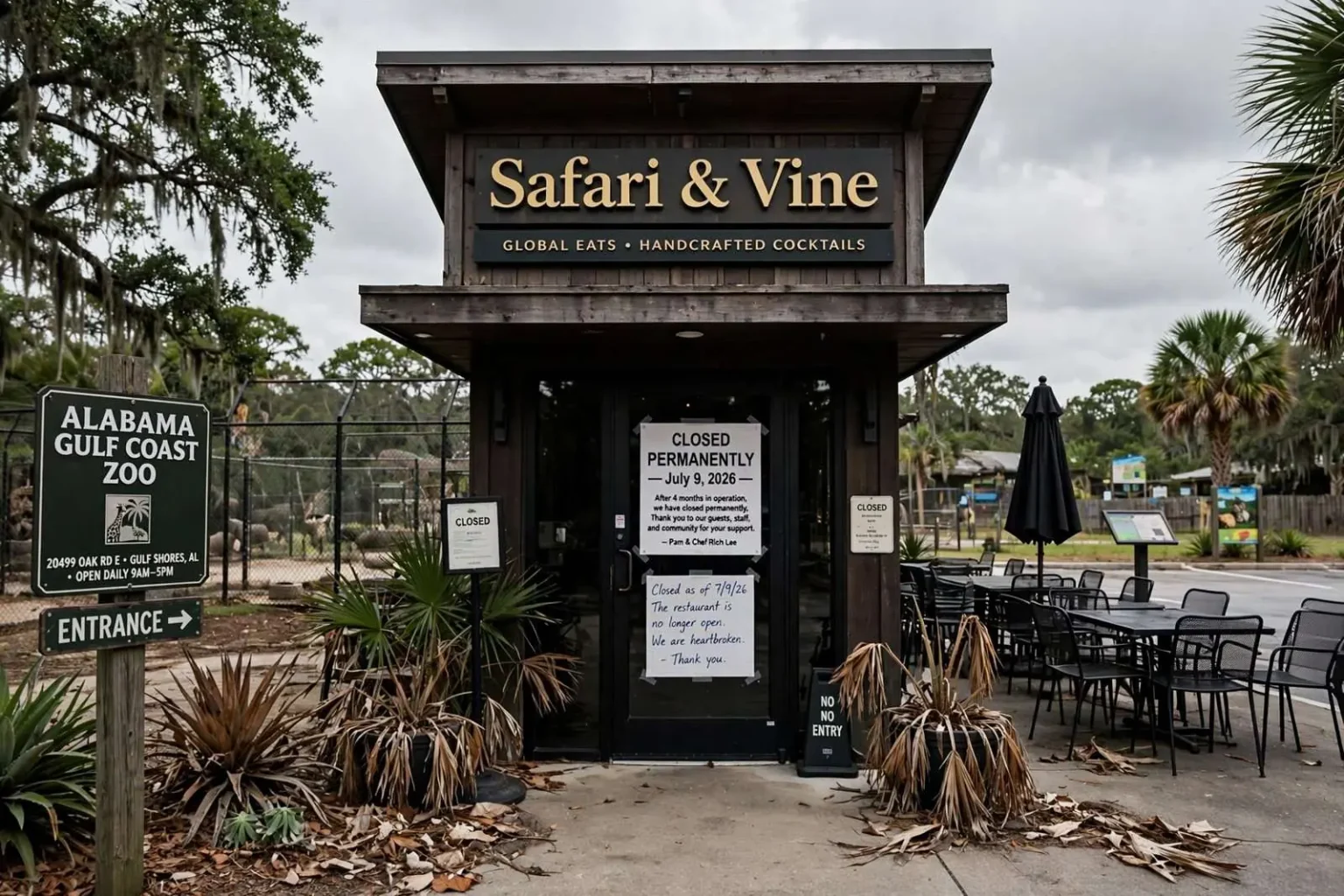
The restaurant space at the Alabama Gulf Coast Zoo in Gulf Shores has gone dark again. Safari & Vine, which opened on the zoo grounds in March 2026, closed permanently on July 9, 2026, after roughly four months in business. Its owners, Pam and Chef Rich Lee, announced the closure publicly and said plainly that they had exhausted their financial runway.
A Closure With Difficult Timing
The date is what makes this closure so stark. Along the Alabama coast, July is the peak of the year. Rental units are booked, the beaches are full, and restaurants that survive the lean months of January and February do so on the strength of what they bank between Memorial Day and Labor Day. Closing in the middle of that window is not a seasonal adjustment. It is the sign of a business that could not hold on long enough to reach the money.
The owners also closed Portabella’s in Foley, a separate restaurant they operated, at the same time. In a message to customers, they wrote that they had hoped conditions would turn around but “ran out of time and money,” and thanked guests and staff for their support. They described being heartbroken over the decision and said they were proud of what they had built despite its short life.
The Third Concept to Fail at the Same Address
The location at 20499 Oak Rd. E. has now defeated three separate restaurant concepts in succession.
The Safari Club – the original operation at the site, built around sustainability and international flavors.
Savanna – the successor concept, which ran until May 2025.
Safari & Vine – opened March 2026, closed July 2026, offering a globally inspired menu that ranged from peri-peri wings to hand-crafted cocktails.
When three different operators with three different menus fail at the same address, the pattern usually says more about the location than about any one restaurateur. And the zoo restaurant presents a genuinely unusual set of business challenges.
Why the Zoo Location Is Hard
On paper, a restaurant attached to a major attraction sounds like a guaranteed customer base. In practice it is a difficult proposition, and the reasons stack up:
Demand follows the attraction’s clock. Zoo visitors arrive in the morning, tire by mid-afternoon, and leave. Dinner service, where restaurants make their margins, does not align with that rhythm. A concept that depends on evening traffic has to persuade people to drive to a zoo after the zoo has closed.
The address is not on a dining corridor. Diners in Gulf Shores gravitate toward the beach road, the marina districts and the established restaurant rows. A destination on Oak Road does not capture drive-by traffic. Every customer has to be a deliberate decision.
Seasonality is brutal. A coastal restaurant needs local, year-round regulars to survive the winter. Building that base takes several seasons, and few new operators are capitalized to lose money for two winters while it forms.
Safari & Vine’s operators tried to solve at least one of these problems by design: the restaurant was structured so the public could enter and dine without buying a zoo admission ticket. That removed a real barrier. It was not enough.
What the Closure Means Locally
Two restaurants closing at once means two staffs out of work in the middle of the summer season, though the timing at least means other coastal kitchens are hiring. It also means the zoo, one of the area’s most visited family attractions, is again without an onsite dining operation during its busiest months, leaving visitors to leave the grounds when they want a meal.
The Alabama Gulf Coast Zoo relocated to its current Gulf Shores campus several years ago, a major expansion that gave the facility far more room than its former site. The restaurant was part of the vision for that expanded campus, a place where the zoo could function as more than a two-hour attraction. Three failed attempts complicate that vision considerably.
The Broader Restaurant Climate on the Coast
The closures in Gulf Shores and Foley land in an industry that has been squeezed from several directions. Restaurant operators along the Alabama coast have contended with elevated food costs, higher insurance premiums and a labor market where kitchen and service staff remain difficult to retain. Beach-area restaurants also carry the added burden of extreme seasonality – a summer crush that must generate enough margin to carry the business through slow winter months. For a concept tied to a seasonal attraction, that math is even harder.
What Happens Next
The future of the restaurant space has not been announced. Whether the zoo seeks a fourth operator, restructures the concept toward a lower-overhead model such as a cafe or counter-service operation, or repurposes the building entirely remains an open question. For now, the doors are locked, and a space that has twice been rebranded and relaunched sits empty in the middle of the tourist season. Locals and visitors who had begun to work Safari & Vine into their rotation are left waiting to see what, if anything, takes its place.
The Zoo’s Place in Gulf Shores Tourism
The Alabama Gulf Coast Zoo is one of the anchor family attractions in Gulf Shores, drawing visitors from across Baldwin County, the wider Gulf Coast and inland Alabama who are looking for something to do beyond the beach. Like many attractions that relocated or expanded in recent years, it built out amenities – including an onsite restaurant – intended to keep guests on the property longer and turn a two-hour visit into a half-day outing. The repeated failure of that dining component shows how hard it is to convert attraction traffic into a sustainable restaurant customer base, particularly for dinner, which is when full-service restaurants earn their margins.
What a Fourth Attempt Might Look Like
Industry observers of coastal attractions note that counter-service and cafe formats tend to match attraction rhythm better than white-tablecloth dinner service, because they capture the midday visitor without requiring a separate evening draw. A grab-and-go or quick-service model also carries lower overhead, fewer staff and a smaller capital risk – all advantages for a space that has now burned through three operators. Whatever comes next, the Lees’ departure leaves a staff with summer-season experience that other Gulf Shores and Foley kitchens are actively hiring, which softens the local employment blow even as it closes two beloved neighborhood tables.
The Alabama Gulf Coast Zoo relocated to its current campus on Oak Road East in Gulf Shores in recent years, replacing a smaller site that had constrained the zoo’s growth. The relocation, supported by public and private fundraising, allowed the zoo to expand its animal collection, its facilities and its visitor amenities, with the restaurant space part of a broader vision for an expanded half-day experience.
Gulf Shores, on the barrier island between Mobile Bay and the Gulf of Mexico, has a population of roughly 12,000 permanent residents that swells dramatically during the summer tourist season. The city’s restaurant industry is heavily seasonal, with most operators relying on the Memorial Day-to-Labor Day window to bank the revenue that carries them through slower winter months.
Restaurant closures along the Alabama Gulf Coast have been a recurring feature of the local economy in recent years, with elevated food costs, higher insurance premiums and tight labor markets all putting pressure on operators. Coastal restaurants carry the added burden of extreme seasonality, where a weak summer can mean the difference between a viable business and a closing.
The Alabama Gulf Coast Zoo is one of several family attractions in Gulf Shores, alongside Waterville USA, the Gulf State Park pier, and the beaches themselves. The zoo’s animal collection includes species from around the world, and its education programs serve school groups from across Baldwin County and beyond.
The Portabella’s restaurant in Foley, operated by the same ownership as Safari & Vine, had a separate location and menu that gave the operators a presence in two Baldwin County communities. The simultaneous closure of both restaurants reflects the financial pressure on the owners rather than a single-location issue. Both restaurants had drawn regular customers and were fixtures in their respective downtown areas.
Coastal restaurant operators often point to insurance costs as a major line item, particularly for properties within reach of storm surge. Premiums for wind, flood and business interruption coverage have risen sharply along the Gulf Coast in recent years, and many operators struggle to absorb the increases. The cost pressures are particularly acute for newer restaurants that have not had time to build the cash reserves that sustained operators can draw on.
Animal-care facilities attached to restaurants and other attractions require specialized permits and inspections, and operators have to navigate both the food service regulatory environment and the animal welfare standards set by state and federal agencies. The Alabama Gulf Coast Zoo’s restaurant operation had to coordinate with both sets of requirements, adding operational complexity that independent restaurants do not face. That additional layer of compliance is another factor that makes the zoo location a difficult proposition for any single operator.