In a Foley Backyard, a Master Gardener Turns Soil Into Therapy
Foley master gardener Diane Clark manages diabetes, a serious foot infection and strict lifting limits, yet still tends a backyard of succulents and herbs she treats as rehabilitation.
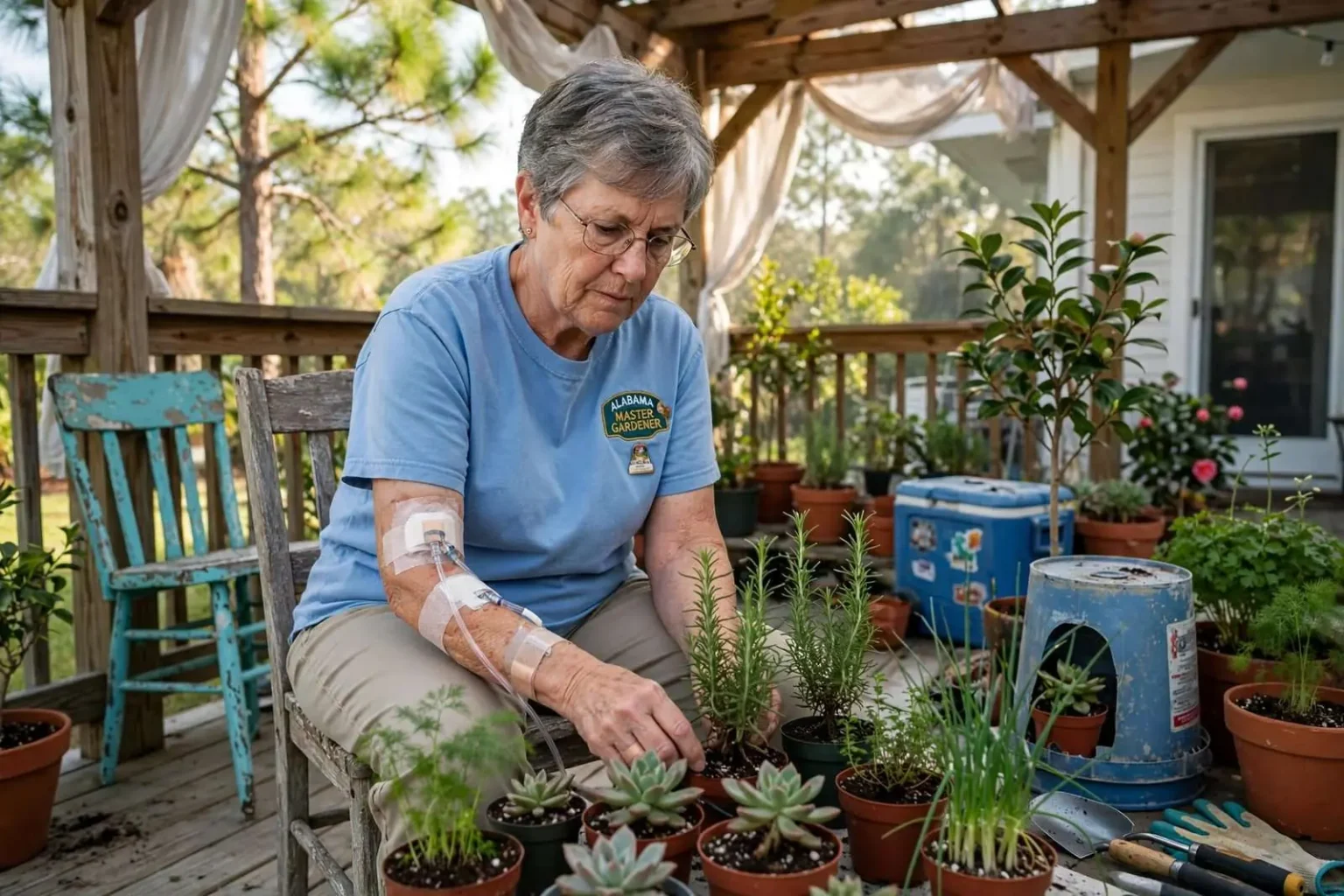
Before the sun clears the pines over south Baldwin County, Diane Clark is already outside. She is sitting on a chair, an overturned five-gallon bucket, sometimes a cooler working her way through the potted succulents and herbs that crowd the deck behind her Foley home. It is not a leisurely hobby. For Clark, the garden is a daily argument with a medical history that once suggested she would spend her later years immobile.
Gardening Around the Limits
Clark manages Type 2 diabetes and an infection in her foot that requires a PICC line for intravenous antibiotics three times a day. She has come through back surgeries and car accidents. She is currently restricted from lifting anything heavier than a gallon of milk. So she built the garden around the restrictions rather than against them.
A 24-foot deck and pergola system gives her stable surfaces and handholds designed to keep her steady while she works. Everything grows in portable containers she can reach from a seated position. Nothing requires her to haul, dig or bend in ways her body will not tolerate.
“I do what I can with what I’ve got left,” Clark said. “I am a very driven person, and I am not ready to be a couch potato.”
From a Michigan Apple Farm to the Gulf Coast
Her connection to growing things started far from the Gulf. Clark spent her childhood working a Michigan apple farm alongside her father and sisters. After retiring from a career at Verizon in 2003, she completed master gardener training and joined the Gulf Shores Gardening Club, where she has now volunteered for 15 years.
Alabama’s Master Gardener program, administered through the Alabama Cooperative Extension System, requires roughly 50 hours of classroom instruction in soils, plant pathology, entomology and horticulture, followed by a volunteer service commitment. Graduates become a de facto public resource – the people who answer the “why is my tomato doing this” questions at plant clinics, libraries and county fairs.
Succulents, Herbs and Curbside Salvage
Clark specializes in succulents, which she describes with affection as the plants that love to be ignored – a fitting match for a gardener who cannot always be on her feet. The rest of her beds run to the practical: garlic chives, rosemary, lemon thyme, dill and parsley. A camellia anchors the yard, as it does in a great many Baldwin County gardens.
Her eye for value extends well past the plant nursery. Clark is a devoted salvager of the Baldwin County curbside, and she recently rescued a turquoise chair she spotted at the side of a road in Bay Minette, an item she estimates would have cost about $30 new. Her husband, Scott, is regularly amazed by what comes home with her and occasionally suggests she leave the discarded pots and half-dead plants where she found them. She is not persuaded.
“Recycling is a one-way ticket to heaven,” Clark said.
The Case for a Garden as Rehabilitation
What Clark has arrived at through instinct has a growing body of research behind it. Horticultural therapy is used in rehabilitation settings to improve fine motor control, grip strength, balance and mood, and gardening is frequently recommended for people managing Type 2 diabetes because moderate, sustained activity helps regulate blood glucose.
For patients with mobility limits, container and raised-bed gardening is the standard adaptation, allowing the work to happen at a seated height with minimal load bearing. Gulf Coast gardeners face their own constraints: sandy soils, punishing August humidity, salt in the air near the beaches and a hurricane season that can undo a year of work in an afternoon. Container gardening happens to answer several of those problems at once, since pots can be moved into shelter ahead of a storm and their soil composition controlled entirely by the gardener.
Where There’s a Will
Clark says her focus stays on what she can still accomplish rather than on what she has lost, and she is deliberate about wanting other people facing physical obstacles to see the yard as evidence. Growth, she argues, does not require a body in perfect working order – only a willingness to adapt the method.
“Where there’s a will,” she said, “there’s a way.”
Residents interested in horticulture training can contact the Baldwin County office of the Alabama Cooperative Extension System, which coordinates Master Gardener classes, plant clinics and volunteer opportunities across the county.