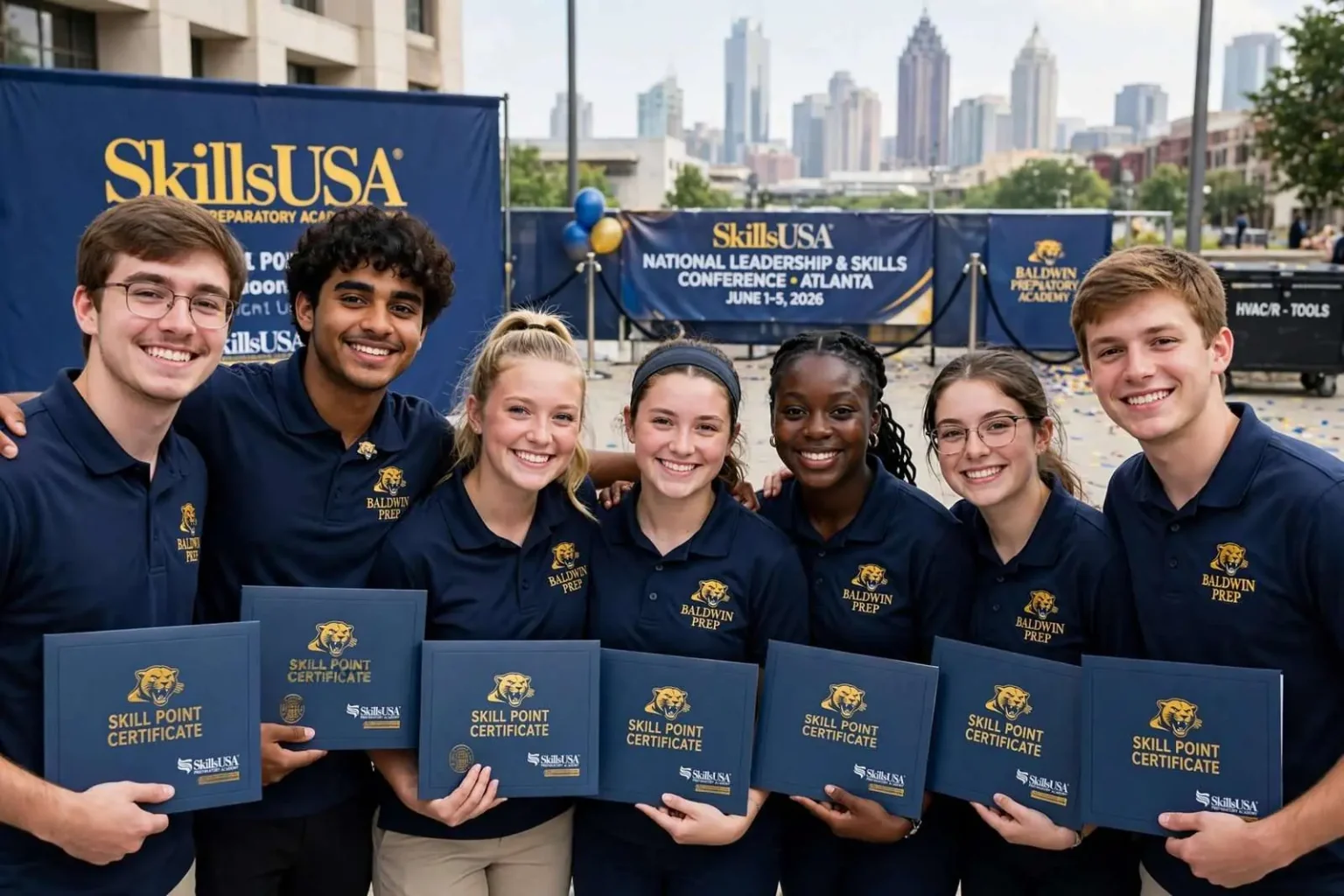
A group of students from Baldwin Preparatory Academy in Loxley returned from Atlanta this summer with national recognition in hand, having earned Skill Point Certificates at the 2026 SkillsUSA National Leadership Skills Conference held June 1-5. The certificates are awarded to competitors who meet a predetermined threshold score in their SkillsUSA Championships event. They are not participation awards. Each one certifies that a student demonstrated a measurable level of career readiness and technical proficiency against industry-written standards, and recipients are encouraged to include them in employment portfolios, where they serve as third-party verification of skill for prospective employers.
Baldwin County's Honorees American Spirit : Tanner Minchew, Gunner Ernst and Laken Moebes of Baldwin Preparatory Academy. Chapter Display : Braxton Powell, Leila Powell and Taylor Coleman of Baldwin Preparatory Academy. Entrepreneurship : Naomi Marshall, Shelby Semmes, Penelope Gigliotti and Avery Matthews of Baldwin Preparatory Academy. Heating, Ventilation, Air Conditioning and Refrigeration : James Castillo of Stapleton, a student at the Loxley campus. Every one of those students first had to win at the state level.
SkillsUSA's structure requires competitors to advance through local and state championships before qualifying for the national contest, which means the Baldwin County group had already outperformed peers from across Alabama before ever leaving the state. The Scale of the Competition The numbers behind the 2026 conference help explain why a national placement carries weight. A record 7,000 students competed in the SkillsUSA Championships, described by organizers as the largest gathering of the future skilled workforce in the country.
Contestants came from middle school, high school and college/postsecondary divisions and competed across 115 hands-on career and leadership contests, ranging from robotics, automotive technology, drafting and aviation maintenance to criminal justice and public speaking. The competition floor spanned roughly 1.79 million square feet — the equivalent of 41 acres, or about 31 football fields. Judging was not left to educators alone. More than 2,000 industry judges and technical committee members volunteered, backed by leaders from some 850 businesses, corporations, trade associations and unions who help design the contests and evaluate students against real workplace benchmarks.
"This showcase of career and technical education demonstrates SkillsUSA at its finest," SkillsUSA Executive Director Chelle Travis said. "Our students, instructors and industry partners work together to ensure that every student excels." Why Career and Technical Education Matters Here The results land in a county where skilled trades are in unusually high demand. Baldwin County remains one of Alabama's fastest-growing counties, and that growth has translated into sustained need for HVAC technicians, electricians, welders, construction managers and diesel mechanics — the same fields SkillsUSA competitions are built around.
Background and Context
A student such as James Castillo, certified in HVAC and refrigeration before graduation, is entering a labor market where employers along the Eastern Shore and the beaches routinely report difficulty filling those positions. The leadership and business categories matter just as much. The Entrepreneurship and American Spirit events emphasize the ability to build a business plan, communicate a value proposition and work as a team — skills that map directly onto the small-business economy that dominates towns such as Loxley, Robertsdale, Stapleton and Foley.
A Growing Pipeline SkillsUSA operates as a partnership among students, instructors and industry, and its Alabama chapters feed directly into the state's workforce development pipeline. Students who earn Skill Point Certificates frequently use them when applying for apprenticeships, industry credentials and postsecondary technical programs, including those offered at two-year colleges serving the region. Interest in those pathways has grown sharply along the Gulf Coast as regional industry — shipbuilding, aviation, logistics, hospitality construction and coastal infrastructure work — has expanded.
A high school student who leaves campus already holding a recognized credential can often step into a paying trade position or an apprenticeship immediately, without accumulating student debt. What Comes Next The next SkillsUSA National Leadership Skills Conference is scheduled for June 21-25, 2027, again in Atlanta. Alabama's qualifying competitions will run through the coming school year, giving Baldwin County students another route to the national stage. Additional information about the organization and its competitions is available at skillsusa.org. For families weighing whether career and technical coursework is a serious academic path, the Loxley results offer a straightforward answer.
These students competed nationally, were graded by working professionals against industry standards, and came home with credentials employers actually recognize. Baldwin Preparatory Academy's Role in the Region Baldwin Preparatory Academy, located in Loxley, is one of the county's dedicated career-technical high schools, designed to give students hands-on pathways into the trades and technical fields that drive the Gulf Coast economy. Its campus includes shops and labs for welding, automotive, health science, construction, culinary and other programs, and its instructors bring industry experience into the classroom.
The school's repeated success at SkillsUSA is not a coincidence — it reflects a deliberate alignment between what students practice daily and what the competition tests. For families across Baldwin County weighing high-school options, the SkillsUSA results are a concrete signal that the academy delivers the kind of technical readiness that leads to immediate employment or advanced apprenticeship. The Economic Stakes for the Eastern Shore Every student who earns a Skill Point Certificate in HVAC, welding, automotive or entrepreneurship represents a potential hire for a local employer who is currently advertising the same position.
Background and Context
Baldwin County's growth has outpaced its skilled-labor supply for years, and the pipeline from programs like Baldwin Prep through SkillsUSA into the workforce is one of the few mechanisms that reliably narrows that gap. When a Loxley student wins a national certificate in HVAC, the ripple effect reaches the restaurant that needs a refrigeration tech, the hotel that needs a maintenance supervisor and the construction firm that needs a foreman who can read plans. That connection between classroom competition and regional economic health is why the SkillsUSA results matter beyond the school.
The Industry Behind the Competition The 850 businesses, trade associations and unions that design and judge SkillsUSA events include major employers with Gulf Coast operations: shipbuilders like Austal and Ingalls, aerospace firms like Airbus, energy utilities, construction contractors and hospitality operators who all have a direct stake in the skills being tested. When those employers help write the rubric for an HVAC or welding contest, they are effectively pre-screening the next generation of apprentices for their own hiring pipelines.
Baldwin County students who excel at SkillsUSA are not just winning a trophy — they are performing in front of the people who will hire them. From Competition to Career on the Coast The path from a SkillsUSA medal to a career on the Eastern Shore is shorter than many parents realize. Coastal Alabama's two-year colleges — Coastal Alabama Community College and Bishop State Community College — offer articulation agreements that convert SkillsUSA credentials into college credit, and local apprenticeship sponsors give preference to candidates who have already demonstrated competency under competition conditions.
For a student like James Castillo, the HVAC certificate earned in Atlanta can translate into a registered apprenticeship with a Baldwin County contractor before the summer is over, putting him on a journeyman track while peers are still deciding on a major. That speed-to-career is the practical promise of the career-technical model, and the SkillsUSA results are the public evidence that it works.
Wider Significance for Coastal Alabama
This story is part of a broader set of changes playing out across Mobile, Baldwin and the wider Gulf Coast region. Local residents, businesses and government agencies have been watching developments like this one closely, because decisions made in Mobile and Baldwin counties often ripple outward into neighboring communities across south Alabama, Mississippi and the Florida Panhandle. Public meetings, council work sessions and state legislative hearings have all carried echoes of the underlying concerns, with stakeholders ranging from neighborhood associations to industry groups weighing in on what the outcomes will mean for daily life along the Gulf Coast. Reporters and editors in the region have worked to document how these issues affect ordinary people, from commuters on Interstate 10 to families visiting the public libraries and parks that anchor so many of the Port City’s neighborhoods. The deeper context often emerges over months rather than days, as projects move from announcement to planning to construction, and as the people most directly affected find their voices in the public record. Continued coverage remains important, both for accountability and for the historical record, and the unfolding situation is one that warrants attention from anyone with a stake in the future of south Alabama.
Looking ahead, observers across the region expect the conversation to continue evolving. Local officials have signaled their intent to monitor outcomes closely, and community organizations have indicated they will remain engaged as new information becomes available. The intersection of state policy, local implementation and on-the-ground impact is precisely where stories like this one tend to develop their lasting significance. For Mobile and Baldwin residents, the practical effects will play out over time, in everything from tax bills and utility rates to traffic patterns and the availability of public services. Following the developments requires patience and attention to detail, but it is also a reminder of how civic life in coastal Alabama continues to be shaped by decisions that begin far from the neighborhoods they ultimately touch. Residents who want to stay informed can do so by following local government meetings, attending public hearings when significant issues arise, and reading the regional reporting that tracks how these stories progress from one phase to the next.
Local news organizations continue to follow this story closely, and updates are expected as more details emerge. The developments have generated discussion across the region, with attention from both longtime residents and newcomers who are following the issue for the first time. Community leaders have emphasized the importance of staying engaged with local government and participating in public meetings when significant decisions are being made. As the situation continues to unfold, residents are encouraged to remain informed through reliable local reporting and official city and county communications channels. The story remains active, and additional information is anticipated in the coming days and weeks as the relevant agencies and stakeholders complete their work.