Regional Planner Chris Miller Took Sunrise Rotary’s Podium as Coastal Growth Pressed In
The assistant executive director of the South Alabama Regional Planning Commission — and a former Bay Minette city administrator — headlined the Rotary Club of Mobile-Sunrise as the club opened a busy December.
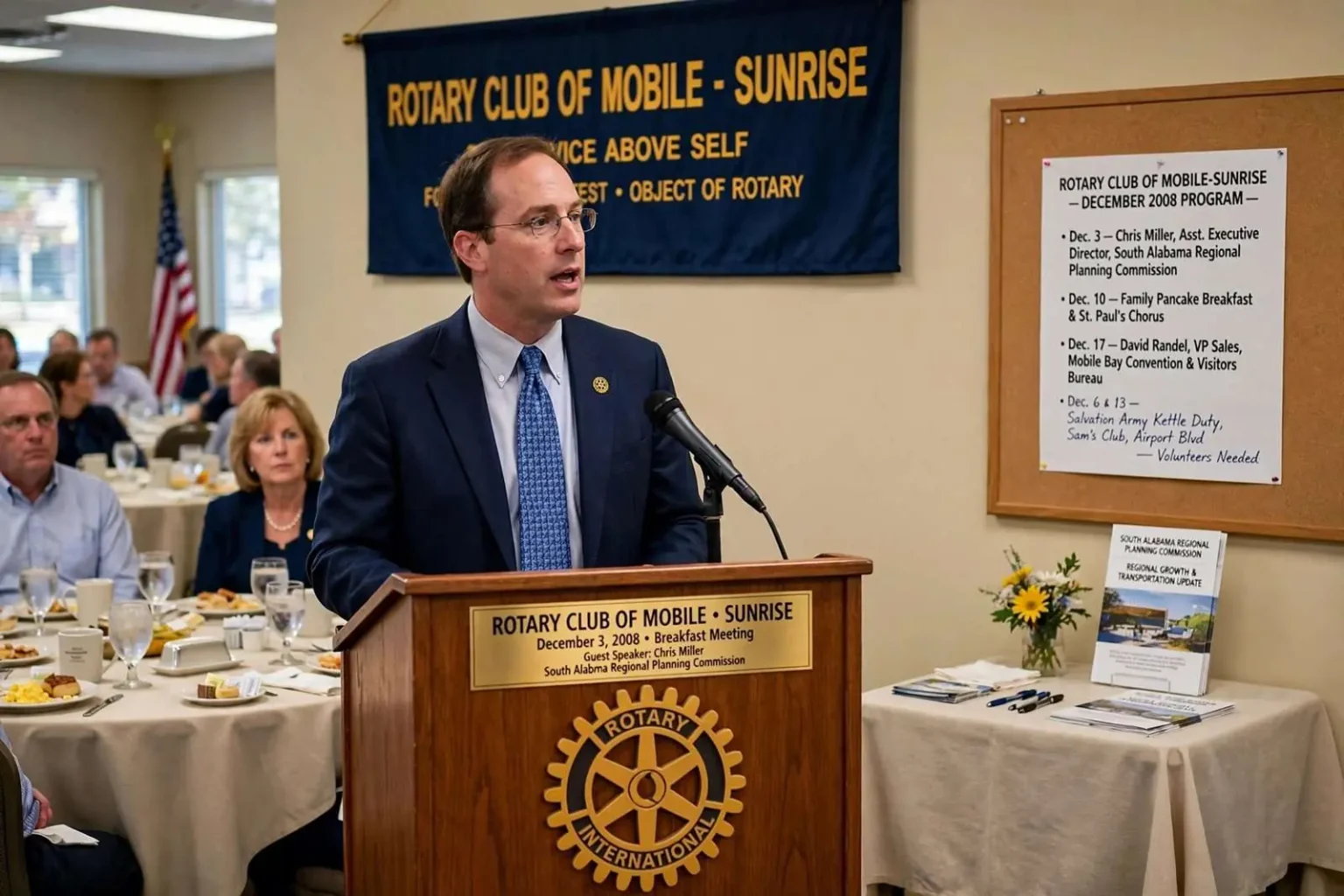
The Rotary Club of Mobile-Sunrise opened its December meeting schedule on Dec. 3, 2008, with a speaker whose day job sat at the intersection of nearly every argument the coast was then having with itself about growth: Chris Miller, assistant executive director of the South Alabama Regional Planning Commission.
Rotary’s Sunrise club is one of several Rotary chapters at work in Mobile, distinguished chiefly by the hour it keeps — a Thursday-morning breakfast gathering in a city where many of the older clubs meet at midday. Its December calendar mixed the ordinary business of a civic breakfast club with the extraordinary pressures bearing down on the region that winter, and Miller’s appearance at the podium tied the two together.
Miller had held his post at the regional planning commission since January 2006. Before that he served six and a half years as city administrator in Bay Minette, the Baldwin County seat, and, before coming south, four and a half years as a city administrator in Colorado. He holds a master’s degree in public administration from the University of Colorado and a bachelor’s degree in history from the University of Northern Colorado.
He and his wife, the former Christy Dazzio of Baton Rouge, had been married 17 years and were raising four children — three boys, ages 14, 12 and 8, and a 20-month-old daughter the club’s newsletter described, with evident affection, as red-haired and fiery. The family lives in Bay Minette and attends St. Agatha Catholic Church. Miller served as a co-chair of the Envision Coastal Alabama Equity Team and had recently been inducted as a member of the Downtown Mobile Rotary Club. He is, by his own account, an avid baseball fan.
Bay Minette, where Miller made his career before joining the commission, sits at the northern edge of Baldwin County and serves as the county seat — home of the courthouse and the county’s administrative functions even as the county’s population has surged southward toward the bay. Managing a city in one of Alabama’s fastest-growing counties gave Miller a firsthand education in the costs of growth: infrastructure that lags behind rooftops, schools that fill faster than they can be built, and roads that need widening the moment they open.
Why a planner mattered in 2008
The regional planning commission is the agency that stitches together transportation planning, grant administration and long-range land-use work across Alabama’s coastal counties — the unglamorous machinery that determines which roads get widened, which corridors get studied, and how federal money reaches local governments that are too small to chase it alone. Councils of governments like SARPC exist in every region of the country, created to give small municipalities a collective voice in Washington and Montgomery and to keep neighboring towns from competing blindly against one another for the same resources.
In south Alabama, that role carries particular weight. Mobile County and Baldwin County together hold dozens of incorporated and unincorporated communities, from the state’s third-largest city down to towns of a few hundred residents, and none of them individually commands the staff or the resources to manage federal transportation grants, aging-infrastructure programs and regional long-range plans on its own. The commission serves as the conduit through which many state and federal programs reach the smaller municipalities of the two-county coast.
In December 2008, that machinery was under unusual strain. The ThyssenKrupp steel complex north of Mobile was rising toward production. Shipbuilding was expanding on the downtown waterfront. Baldwin County was among the fastest-growing counties in Alabama, and the traffic on U.S. 98 and the Eastern Shore was making the case for planning more persuasively than any consultant could. At the same time, the national economy was contracting sharply, and local governments were beginning to look at revenue projections with real alarm. A speaker who could explain how the region’s plans were made — and who paid for them — had an attentive audience.
The pressure points of 2008
Each of the pressures Miller’s agency tracked was visible on the ground. The steel complex rising in the pine woods north of the city had drawn construction employment to northern Mobile County from across the region, and planners were already at work on the road, utility and housing questions that follow an industrial project of that scale. On the downtown waterfront, shipbuilding expansion promised more workers and more traffic in a district already crowded with port operations.
Across Mobile Bay, Baldwin County’s growth was remapping everyday life. Subdivisions followed the interstate corridors, commuters crossed the bay in growing numbers each morning, and the two-lane and four-lane links along U.S. 98 and the Eastern Shore carried more traffic than their designers had imagined a generation earlier. Growth of that kind generates tax revenue, but it also generates demands — for schools, sheriff’s deputies, water lines and widened roads — that arrive years before the revenue does.
And then there was the economy itself. By December 2008 the national financial crisis had moved from Wall Street to Main Street, and municipal budgets across the Gulf Coast were being rewritten as sales tax collections softened. For local governments, the planning commission’s grant-writing function was suddenly more valuable than ever: when local revenue stalls, outside money is often the only money available for projects already on the books.
Beyond his duties at the commission, Miller’s work with the Envision Coastal Alabama Equity Team placed him in the middle of the region’s larger conversation with itself. The regional visioning effort brought citizens together across county lines to talk about growth, transportation, the environment and quality of life, and the equity team’s particular charge was fairness — making sure the benefits and burdens of the coast’s rapid change were shared across its communities rather than falling unevenly on some.
The club’s December
Gigi Armbrecht served as program chairman for the month, the member responsible for filling the podium through the holiday season. The club’s calendar called for a family pancake breakfast featuring the St. Paul’s Chorus on Dec. 10, and a program on Dec. 17 by David Randel, vice president for sales at the Mobile Bay Convention and Visitors Bureau, who was to explain the bureau’s mission and the community’s role in its success. The club would not meet on Dec. 24 or Dec. 31, the Christmas and New Year’s holidays falling on the club’s regular meeting days.
The pancake breakfast was the sort of date that service clubs across the coast build their December around — an event that invites spouses and children to the table and lets the club’s ordinary weekly rhythm pause for something more social. The St. Paul’s Chorus brought student singers from the Mobile private school to the program.
Randel’s program a week later pointed the club toward a different corner of the local economy. The Mobile Bay Convention and Visitors Bureau is the organization charged with marketing Mobile and the surrounding area to meeting planners, tour operators and leisure travelers, the visitors whose spending supports hotels, restaurants and attractions across the city. In a year when the national economy was contracting, the bureau’s sales work — and the community’s role in welcoming visitors — was a subject of more than ordinary interest to a room full of local business people.
The bureau’s mission is inherently communal: no single hotel or restaurant can market a destination on its own, and the visitors bureau exists to do collectively what none of its industry partners can do alone. Randel’s task, as he explained the bureau’s work to the club, was to make the case that every resident who deals with visitors — from the hotel desk clerk to the volunteer at a festival gate — is part of the product being sold.
Kettle duty on Airport Boulevard
Members also signed up for Salvation Army Christmas kettle duty on Saturdays, Dec. 6 and 13, at the Sam’s Club on Airport Boulevard — a familiar December obligation for service clubs across Mobile. The red kettles outside stores and shopping centers are the Salvation Army’s most visible annual fundraiser, and the bell-ringing shifts that clubs fill each December supply much of the volunteer labor behind it. Airport Boulevard, one of the city’s busiest commercial corridors, was a dependable location for collections, and the club’s two Saturdays fell squarely in the peak of the holiday shopping season.
Kettle duty is unglamorous work — an hour or two beside a tripod and a red cauldron, greeting shoppers in the cold — but it is also the kind of visible service that defines Rotary’s public face in December. The Salvation Army’s coastal Alabama command, like its units across the country, depends on the kettle season to fund programs that carry through the rest of the year, from food assistance to disaster response, and clubs that staff the kettles take a measurable share of the credit for what the campaign collects locally.
The December program mix was characteristic of Rotary’s approach to civic life: one week devoted to families and music, one to the city’s visitor economy, and one to the machinery of regional government. Between meetings, the members’ calendars carried the kettle shifts. It was, by the standards of any December on the Gulf Coast, an ordinary month of club life — which is precisely the point of the organization’s weekly discipline, and the reason a speaker like Chris Miller could count on a room that already understood how the region’s civic machinery works.
A student and a global promise
The club named Sara Bryars, an eighth grader at St. Luke’s Episcopal School, its Student of the Week, and she was photographed with St. Luke’s headmaster Palmer Kennedy and club president Jay Ison. The Student of the Week recognition is a standing feature of many Rotary clubs’ programs, giving schools a regular channel to celebrate students whose work might otherwise go unnoticed beyond the schoolhouse, and giving the club a recurring window into the life of the schools it serves.
St. Luke’s, a west Mobile Episcopal school with grades from early childhood through high school, has long been part of the Sunrise club’s orbit, and recognitions like Bryars’ put the club’s weekly audience in front of students, teachers and administrators from across the city. For the students named, the photograph and the mention in the club’s newsletter are small honors that outlast the week — the sort of recognition that follows a young person into a college application or a first job interview.
Members were also being pressed to help meet Rotary International’s $100 million challenge, the matching commitment tied to a Bill & Melinda Gates Foundation grant aimed at finishing the eradication of polio — a campaign that gave a Thursday-morning breakfast club in Mobile a small share in one of the largest public health undertakings in the world.
The scale of the effort was easy to lose sight of at the level of a single club. Polio, once a childhood scourge that paralyzed hundreds of thousands of children a year worldwide, had been driven by the time of the 2008 campaign to a handful of countries, but eradication requires continuous vaccination campaigns, surveillance networks and funding, and Rotary International had been the volunteer backbone of the global fight for more than two decades. The Gates Foundation challenge matched every dollar Rotary raised toward the goal, effectively doubling the reach of whatever individual clubs contributed.
For Mobile’s Sunrise Rotarians, that meant the December chore list — a pancake breakfast, two Saturdays of kettle duty, a student photograph — sat alongside a piece of work with global reach, carried by clubs in nearly every country.
Miller’s talk closed the loop between the local and the regional. The speaker who ended the club’s 2008 program schedule was, fittingly, one of the officials whose daily work would help answer the growth questions the coast was asking — road by road, grant by grant, plan by plan — in the years that followed. The club would break for the holidays with a pancake breakfast behind it, two kettle shifts on the calendar, and a January ahead in which every argument about growth on the Alabama coast would still be waiting for an answer.