With Iowa and New Hampshire Behind Them, South Alabama Politicos Called the 2008 Race Wide Open
Days after Iowa and New Hampshire scrambled the field, dozens of Mobile and Baldwin county political figures offered wildly different forecasts for a presidential contest neither party could yet control.
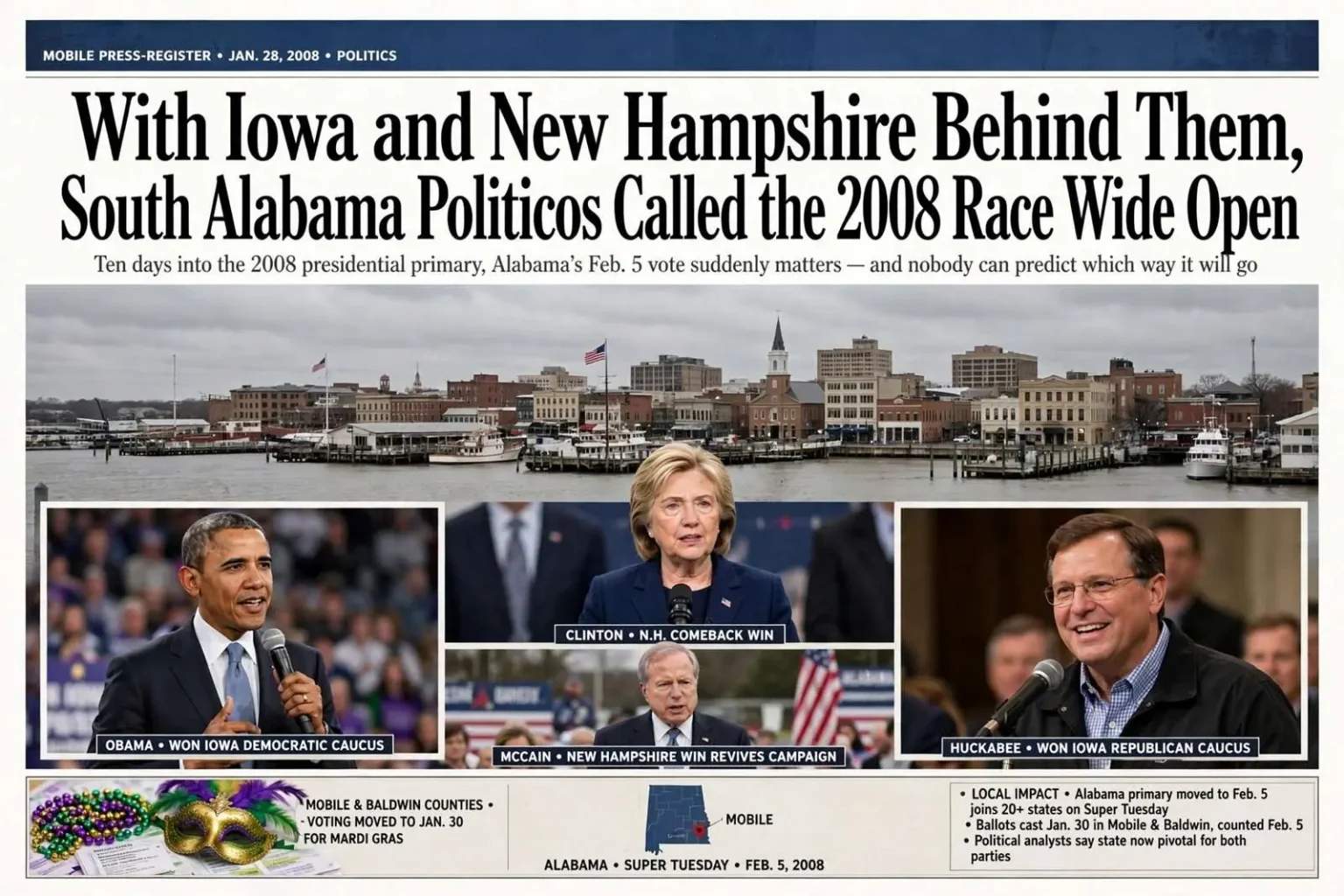
Ten days into the 2008 presidential primary calendar, the only thing the political class along Mobile Bay could agree on was that nobody knew anything. Iowa had gone to Barack Obama and Mike Huckabee. New Hampshire had answered by handing Hillary Clinton a narrow comeback win and giving John McCain new life. A survey of dozens of local and state political figures in January 2008 produced forecasts that pointed in nearly every direction at once.
The confusion was genuine, not the performed variety. On the Democratic side, the first two contests had split cleanly between the two leading candidates; on the Republican side, the winners of the first two states had both been written off months earlier by national pundits. Nobody along Mobile Bay — consultants, fundraisers, party officials, retired journalists — had a model for a primary season in which every assumption failed in the same week.
A field nobody could read
Some saw the contest ending quickly. A retired newspaperman predicted both nominations would be settled by Feb. 6 and that Clinton and McCain would emerge as the standard-bearers. A veteran pollster took the opposite view, warning that both parties might be arguing all the way to their summer conventions, something that had not happened in decades.
The two forecasts implied opposite strategies for Alabama. If the nominations were settled on Feb. 5, the state’s votes would matter enormously; if the fight ran to the conventions, the Feb. 5 contests would be one round in a long fight, and the candidates would keep campaigning in Alabama afterward. Either way, the state mattered more than it had in any presidential year in memory — the disagreement was only about how much.
Others read the New Hampshire exit numbers closely and came away convinced the Democratic race had already tilted. One Mobile consultant pointed out that Obama had carried voters earning between $50,000 and $150,000 a year, along with postgraduate voters, and that New Hampshire’s overwhelmingly white electorate had still left Clinton with only a three-point margin. In states with large Black electorates, he argued, the arithmetic would change dramatically.
That analysis applied to Alabama directly. Black voters constituted roughly a quarter of Alabama’s population and a much larger share of the state’s Democratic primary electorate, and the consultant’s reading of the exit polls suggested the Obama campaign’s coalition — built on middle-income voters, younger voters and Black voters — was ideally suited to the state’s Democratic electorate. Local Democrats who had spent decades watching the party’s primary voters divide along more traditional lines could see the possibility of a different kind of map taking shape.
On the Republican side, opinion split between Huckabee, McCain, Mitt Romney and Rudy Giuliani. A Mobile Realtor predicted Huckabee would run strong across the Southern primaries and described him as a throwback to the old conservative Southern Democrats. A longtime Baldwin County Republican, still loyal to Fred Thompson, conceded that Huckabee had “sucked the air out of Thompson’s sails.” A campaign fundraiser insisted Giuliani’s big-state strategy was sound and that the national press was missing the point.
The Huckabee comparison carried weight in Alabama, where the former Arkansas governor’s blend of evangelical credentials, populist economics and down-home style had obvious appeal in a state whose Democratic politics had been built on exactly that coalition for generations. Thompson’s stall — the Baldwin loyalist’s phrase about Huckabee sucking the air out of his sails described a candidacy that had been expected to consolidate the South and instead found the South already taken — was the local face of a national problem for the former Tennessee senator. Giuliani’s camp, meanwhile, was betting the nomination on delegate-rich states voting later in January and February, a strategy that looked either shrewd or delusional depending on which Mobile fundraiser one asked.
Alabama, for once, mattered
What gave the exercise its urgency was the calendar. Alabama had moved its presidential primary to Feb. 5, joining more than 20 other states on what came to be called Super Tuesday. That decision put Alabama voters in the middle of a nomination fight for the first time in memory, and both campaigns noticed.
For decades Alabama had voted in the late spring or early summer, long after the nominees were effectively chosen, and its primary was a formality — a chance to register a preference when the outcome no longer depended on it. The move to Feb. 5 reversed that. On a single day, a third or more of each party’s convention delegates would be allotted across the country, and Alabama’s would be part of the pile. Candidates who had never organized in the state suddenly had reason to; the state’s parties had reason to court them; and the state’s voters had a real vote for the first time in a generation.
Mobile and Baldwin counties drew an unusual wrinkle. Feb. 5 fell on Mardi Gras Day, and the conflict forced local election officials to move balloting in the two coastal counties to Jan. 30. The votes would be cast a week early but sealed and counted with everyone else’s on Feb. 5. It was a distinctly Gulf Coast solution to a distinctly Gulf Coast problem, and it briefly made Mobile and Baldwin the first Alabama voters to weigh in on a presidential nomination.
Mardi Gras is not a movable attraction in Mobile. The city’s Carnival season — the oldest in America, older than New Orleans’s by more than a decade and a half — culminates on Fat Tuesday with parades, masked societies and a downtown that belongs to the celebration, and no election administrator in either coastal county proposed holding a primary against it. The compromise moved the polling to the previous week while keeping the count on schedule, and the mechanics worked in both counties’ probate offices and courthouses: ballots cast Jan. 30, sealed, transported and counted with the rest of the state’s on the fifth.
Campaigns came calling
The Romney organization was already working Alabama hard. A Mobile-based fundraiser for the campaign, reporting in from a call center in Boston, said nine Alabamians were dialing for dollars that day and that the operation had raised $4 million in a single day. She dismissed the notion that second-place finishes in Iowa and New Hampshire were setbacks, noting that Romney led the field in delegates and total votes after a first-place finish in Wyoming, and said the campaign was likely to stage an event in Baldwin County in late January.
The delegate-count argument was the Romney campaign’s answer to everything that winter — the former Massachusetts governor’s organization had won more convention delegates than either Iowa or New Hampshire winner by dominating the caucuses and conventions in the small states between the marquee contests, and Wyoming’s haul was the exhibit. Whether the argument persuaded anyone was a different question, but the fundraiser’s report of Alabama callers working a Boston call center showed the campaign viewed the state’s Feb. 5 delegates as worth organizing for, and the rumored Baldwin County event signaled that the coast — reliably Republican, reliably donor-rich — was on the itinerary.
Local Democrats reported a similar surge of energy. Party officials described unusually high interest among women and younger voters, and several predicted turnout would exceed anything the state had seen in a primary. Others were more skeptical, warning that the long-promised youth vote had never actually materialized in Alabama before.
The skeptics had history on their side — every presidential cycle in memory had produced predictions of a youth surge in Alabama, and none had produced one — but the officials reporting the surge were describing something they could see: new registrants, first-time volunteers showing up at county party offices, and inquiries about the Jan. 30 balloting from voters who had never previously asked about a primary. The state’s Democratic primary would also settle contests for other offices down the ballot, giving additional voters a reason to come out even if their first choice in the presidential field had already left the race.
John Edwards, the former North Carolina senator who had finished second in Iowa, occupied a particular place in the local conversation — several of the surveyed politicos called him the most electable Democrat in the field, citing his populist economic message and his Southern roots. His campaign’s schedule through the South made him a familiar presence in neighboring states, though no one surveyed expected him to win Alabama; the question was whether his message would pull enough votes from both Obama and Clinton to keep himself alive.
What the moment revealed
Read today, the January 2008 forecasts are a reminder of how genuinely uncertain that winter felt. Obama would go on to win the Alabama primary and, eventually, the presidency. McCain would take the Republican nomination that many local Republicans had all but written off. Huckabee’s Southern strength proved real but insufficient. John Edwards, whom several respondents called the most electable Democrat in the field, was out of the race within three weeks.
Every one of the January predictions was wrong in some particular. The retired newspaperman’s Feb. 6 settlement of both races got the date right — the Republicans effectively decided when the Super Tuesday results came in — but the Democratic fight ran for months, past the conventions-approaching deadline the pollster had warned about, all the way to June. The consultant who read the exit polls correctly called the Democratic tilt. The Baldwin County loyalist watching Thompson fade watched him leave the race within the month. Giuliani’s big-state strategy collapsed without winning a single contest that mattered, and Huckabee’s Southern sweep indeed stopped short of a nomination.
The more durable point was the one nearly everyone made: for a state accustomed to voting after the outcome was decided, 2008 was different. Alabama was in the conversation, and along the coast, voters got there first.
For Mobile and Baldwin counties, the January of 2008 was also the moment the coast’s distinctive civic calendar collided with national politics and won. Mardi Gras came first; the primary arranged itself around it. When the ballots cast on Jan. 30 were finally counted on Feb. 5, the two coastal counties had already done what the rest of Alabama was doing — and for the first time in anyone’s memory, it had actually mattered.