State Shuts Down Arc of Baldwin County Group Homes, Town Hall Set for Fairhope
Families frustrated with how the state communicated ARC of Baldwin County's decertification voiced their concerns at a Fairhope town hall, where state officials outlined alternative care options while defending their handling of the closure.
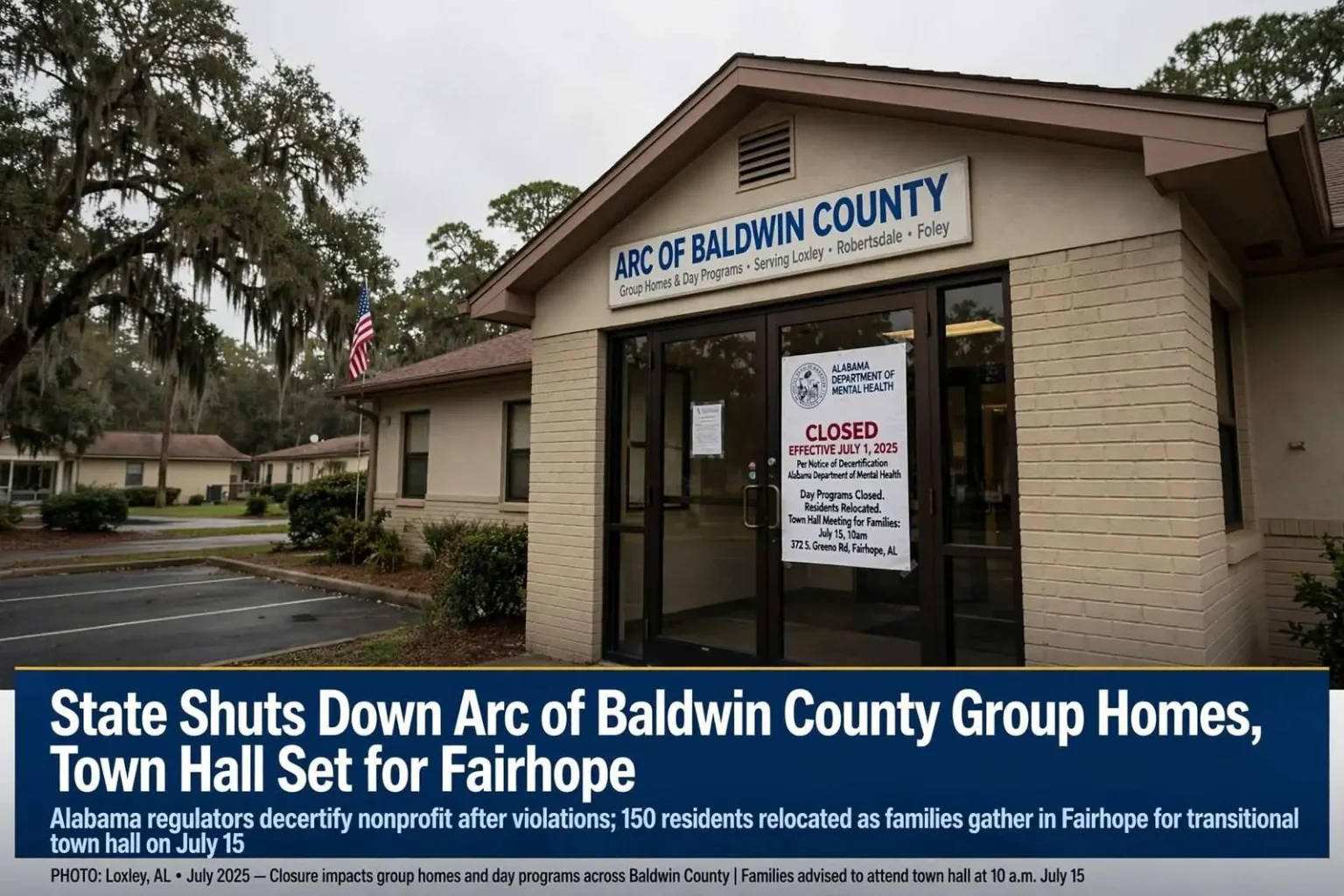
A Baldwin County nonprofit that has provided housing and day programs for people with intellectual and developmental disabilities has been fully shut down, and the families who depended on it are being summoned to a town hall meeting in Fairhope to figure out what comes next.
Arc of Baldwin County, which operated group homes and day programs across the county, ceased operations Wednesday pending an administrative hearing. The Alabama Department of Mental Health decertified the organization on July 1, according to documents sent to families.
What State Regulators Found
A review and notice of decertification issued by the state described several severe problems with the organization’s care for residents and its compliance with state guidelines.
In a letter to Arc Baldwin Executive Director Kathy Fleet, Alabama Department of Mental Health Commissioner Kim Boswell wrote that some of those issues resulted in injuries and deaths of residents.
“Enhanced monitoring reports indicated ongoing concerns with compliance, including missing documentation, staffing concerns, and continued deficiencies in medical care,” Boswell wrote.
Enhanced monitoring is a regulatory posture the state adopts when a provider has already drawn scrutiny. It means the agency was watching closely and continued to find problems anyway, which is generally the precursor to the most serious enforcement action available: pulling certification entirely.
The path to decertification stretched over most of a year: the department placed Arc Baldwin on “provisional” status after a site visit in September 2025, then conducted a “for cause review” from January through early March after what officials described as repeated adverse incidents and concerns for the health and safety of Medicaid waiver participants. That review also cited failures to follow required incident-reporting measures, a lack of administrative and executive-level response, and document deficiencies.
“Based on the recommendation of the Associate Commissioner for the Developmental Disabilities Division and provisions of the Alabama Administrative Code, it is my decision to decertify The Arc of Baldwin County, effective immediately,” Boswell wrote.
Who Is Affected
Arc of Baldwin County operated housing facilities in communities across the county, including Robertsdale, Foley and Loxley. Residents whose care is paid for through a Medicaid waiver are being relocated to new homes as part of the decertification.
The Medicaid waiver is the financial engine that makes community-based care possible for many adults with disabilities. It allows the state to pay for support services in a home or small residential setting rather than in an institution. When a provider loses certification, it can no longer bill that waiver, which is why decertification and closure amount to the same thing in practice.
- Residential group homes in Robertsdale, Foley and Loxley are affected.
- Day programs providing daytime structure and activities have closed immediately.
- Medicaid waiver participants are being placed with new providers.
- Support coordination agencies will help families identify alternatives.
The State and National Organizations Diverge
The situation produced an unusual public split. On Wednesday, the parent organization, The Arc of Alabama, distanced itself from the Baldwin County chapter while pledging assistance.
“We want to clarify that The Arc of Alabama and all the different affiliated local chapters throughout the state are separate and independent nonprofit organizations,” the statewide group posted publicly. It went on to say that while “our hearts are with everyone impacted,” the decertification “involves only The Arc of Baldwin County.”
The Arc of Alabama said it would continue to support the Baldwin chapter through the appeal process and assist with non-waiver services, and that The Arc of Gulf Coast Alabama would assist the day programs in Loxley, Foley and Robertsdale.
The state’s letter to families, however, stated flatly that those day programs will not take place. “This letter is to inform Arc of Baldwin County Day program participants of the program’s immediate closure,” it reads. “The Alabama Department of Mental Health understands the closure of these programs creates uncertainty and concern for many families. Our priority is ensuring that every individual affected has the support they need to transition smoothly to appropriate sustainable services.”
The Fairhope Town Hall
The state has scheduled a meeting to help families navigate the transition.
- Date: Wednesday, July 15
- Time: 10 a.m.
- Location: 372 S. Greeno Road, Fairhope
- Who should attend: Day program participants and their families
“To assist families during this transition and to support continuity of care, ADMH will host a meeting for all impacted day program participants and their families,” the letter reads. “Representatives from the support coordination agency will be present to help identify available service options and assist families in securing services that best meet each individual’s needs.”
What Families Should Understand
Decertification is not the end of the legal process. The organization retains the right to an administrative hearing and an appeal. But the closure is in effect now, which means families cannot wait for that process to conclude before making arrangements.
Anyone with a loved one affected should bring documentation to the town hall, including current service plans, medication lists and contact information for the individual’s support coordinator. Support coordinators, not the provider, hold the responsibility for helping families find a new placement, and they are the appropriate first call for anyone who cannot attend the meeting.
For a population that depends on stability and routine, an abrupt provider closure is genuinely disruptive. The state’s stated priority is a smooth transition. The families gathering in Fairhope will be the ones to judge whether that happens.
Update: State Cites Death, Training Failures in Decertification Letter
The Alabama Department of Mental Health’s decertification letter, dated July 1 and signed by Commissioner Kimberly Boswell, detailed a list of violations behind the decision, including staff training deficits and language barriers, nursing oversight and medical care noncompliance, inadequate supervision, failure to implement person-centered plans, and training and medical care compliance failures that the department said resulted in critical incidents and a death.
ARC of Baldwin County, based in Loxley, operates three centers in Robertsdale, Loxley and Foley, all of which face closure under the decertification. The organization plans to appeal, and has the right to request an administrative hearing provided it notifies Boswell in writing within 15 working days.
ARC of Alabama, the statewide umbrella network, clarified in a Facebook post that its affiliated chapters are separate, independent organizations, but said ARC of Gulf Coast Alabama will “continue to support the ARC of Baldwin County throughout the appeal process and assist them with non-waiver services.”
Update: Frustration Boils Over at Fairhope Town Hall
People gathered at the Altapointe Health offices in Fairhope on July 15 for the town hall meeting, arriving with a mix of uncertainty and frustration over how the decertification has been handled. ARC Baldwin County had provided day programming, services and housing for around 150 people with intellectual and developmental disabilities across its three centers before the state ordered it to relocate all Medicaid waiver residents to other certified providers.
Camille Cumuze, associate commissioner for developmental disabilities at the Alabama Department of Mental Health, told families the meeting was meant to connect them with other care providers already serving Baldwin County or moving in to help fill the gap left by the closure. Around a dozen organizations offering in-home care or day programs for people with intellectual and developmental disabilities were mentioned during the meeting. State health officials have listed Fairhope Residential and the Cindy Haber Center among the other Baldwin County providers available to displaced families.
“We understand that the breadth of the closure of these programs causes a lot of uncertainty for you and your families and causes a lot of concern for you and your families,” Cumuze said. “Our greatest concern is for the individuals that we serve here in the state of Alabama.”
Several attendees pushed back on how the state communicated the closure. Daphne resident Ruth Reed, whose son took part in ARC’s day programming, said she did not learn the program was ending until after it had already stopped.
“I wasn’t aware that the program was ending until after it was over and they called me to tell me about the meeting,” Reed said, adding that the abrupt closure threw her son’s daily routine into disarray. “The lack of communication to parents of these children in these programs is unacceptable, and I hope going forward it is corrected,” she said.
Fairhope resident Rebecca Watson, who has a special needs family member receiving services through ARC in another state, said the state’s handling of the situation undercut its stated concern for families. “What I think the Alabama Department of Mental Health has done is very irresponsible,” Watson said. “They can say that they care about these residents and these families, but the way that they’ve handled this, it doesn’t seem that way to me.”
Cumuze said she could not answer questions about the specific issues that led to ARC Baldwin County’s decertification because it remains an ongoing legal matter, but said she believes the department made the right call in shutting the organization down. She acknowledged, however, that notification to families “should have been sooner.”
“I understand that it’s frustrating, but we have to make sure that we follow our legal rules,” she said, noting that the department must also honor ARC Baldwin County’s rights during its appeal.
Melissa Valdes, public information officer for the Alabama Department of Mental Health, told attendees the appeal hearing will be open to the public, though a date, time and location had not yet been set at the time of the meeting. A hearing officer has been selected. ARC Baldwin County Executive Director Kathy Fleet said she could not comment further while the legal proceedings are ongoing.
Baldwin County is not the only Alabama chapter to lose certification this year. In May, a Montgomery chapter was decertified by ADMH following an investigation and disaffiliated, and its residents were relocated to other providers, including other Arc chapters.